Book airline tickets with Delta on Facebook

Many businesses worry that there is a weak connection between their engagement in social media and actual sales. But there are examples of companies that use social media to drive sales:

  • Pizza Hut generated $1 million in sales via an iPhone application
  • Sony and Dell have generated millions via Twitter channels
  • Dunkin’ Donuts are tracking sales from its Twitter account
  • Uniqlo in the UK are giving discounts based on the number of times an item has been tweeted
  • Below is also a case study from Jimmy Choo on how to drive sales:

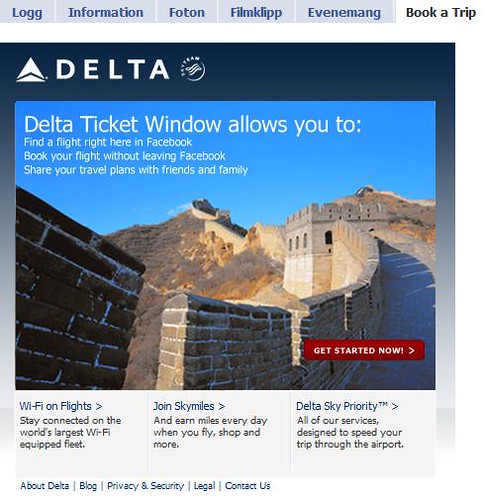
The latest example I have found (via a tweet by Sally Falkow) is Delta Air Lines that lets customers book airline tickets on the Delta Facebook page. According to an article on CNN, the ‘Ticket Window’ service has been up and running for about one month.

“Our customers are spending more time online and are looking for new ways to connect with us. We’re now delivering technology where our customers are – from our own website to our Facebook page to Internet news sites and beyond,” said Bob Kupbens, Delta’s vice president – eCommerce in a press release. “We already know Facebook is the most used website by inflight WiFi users on more than 2,000 Delta flights every day, giving us the natural launching point for a new online Ticket Window.”

Delta plans to expand its Ticket Window to other sites, including online banner ads to allow full booking capabilities within the airline’s advertisements.

delta-facebook-tickets

Promoting Facebook groups is a breach of the Swedish Radio and Television Act

A verdict today from The Swedish Broadcasting Commission (Granskningsnämnden för radio och TV) declared that public service radio and tv shows that encouraged listeners to join or discuss a topic in a Facebook group, were in breach of the Swedish Radio and Television Act.

facebook The Commission slammed the radio shows “Ring så spelar vi” in channel P4 and “Förmiddag” in the local channel P4 Kristianstad for encouraging listeners to join their respective Facebook groups. And the tv news show Sydnytt on SVT1 encouraged viewers to state their opinion on a certain topic on a Facebook page. That was also interpreted as being in breach of the Radio and Television Act because it was improper favoritism of a commercial enterprise.

One can question whether the law is really in tune with the current trends in the media landscape.

Update: According to the Commission, it is accepted to inform the public of the existence of a Facebook page or group, but encouraging listeners or viewers to join them is considered one step too far.

Thumbs up for social shopping

More and more retailers are starting to insert elements of social shopping to their web sites. Social shopping is the concept of involving a customer’s friends or other customers in the shopping experience by for example letting their recommendations influence what items are shown first on a site.

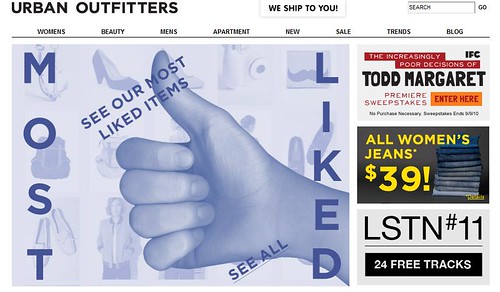
Here is an example. When you enter the US version of Urban Outfitters’ site, a giant thumb is currently being displayed.  Once you click on the image you can sort items (women’s, men’s or apartement) after which ones have been liked the most by people on Facebook. The top women’s item is a cardigan that has been “liked” 90 times. So if you want to know what clothes that currently are in fashion, this is a neat service. If you want a unique look, you probably should start searching among the least liked items.

urban-outfitters-facebook

Via Market.se (in Swedish).

Why we follow brands on Facebook and Twitter

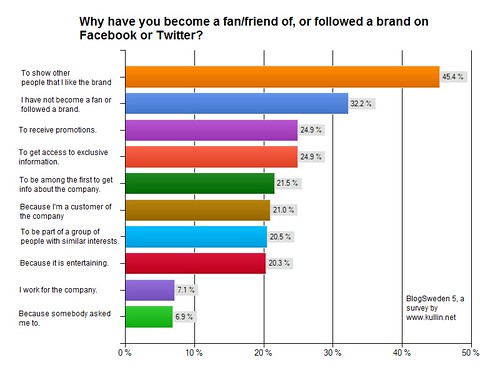
In April this year, I conducted the fifth annual survey of Swedish bloggers and blog readers. The survey called BlogSweden 5, included a total of 2,251 respondents, out of which  94% had at least one blog. One of the new questions this year was about why people choose to follow brands on Twitter and become a fan, or like, brands on Facebook.

Last year Razorfish surveyed 1,000 “connected consumers” about, among other things, why they “friended” brands or followed them on Twitter. The responses indicated that the primary reason was to get exclusive deals or offerings. The respondents in my survey also included internet users under the age of 18 and over 55, which the Razorfish study did not.

The most common response to why people become friends with or follow a brand on Twitter or Facebook is “To show other people that I like the brand”. I had expected that more tangible benefits such as getting exclusive information or promotions, would be the most common responses. Then again, we use brands to create or strenghten our identity and showing our support for a brand on Facebook might just play the same role as wearing it on a T-shirt. It tells others about who we are. Remember what Jack Trout wrote:

“People want to express themselves through brands – brands express a person’s personality and the people they like to be with.

why we follow brans on Facebook and Twitter

But we also follow brands on Twitter or Facebook to get deals or information before other people. Although the feeling of exclusivity might get lost if you are one of a million fans of the same brand, it still is a very good sign for marketers. The responses suggest that people who follow your brand on social media are already loyal customers or are interested in becoming customers.

Consumers are telling brands that they wamt to buy from you and they want to get more information about your company and products. So marketers should take note and start using social media as channels for building engagement among key audiences.

A third (32.2%) of the respondents in the survey had not become a fan of or followed a brand on Twitter or Facebook.

BP Oil Spill and Social Media

BP are now caught in the middle of the worst possible scenario – one of the company’s oil drilling rigs in the Gulf of Mexico exploded on April 22 and sunk, resulting in a major environmental disaster as more than 5,000 barrels of oil leak into the ocean per day. The long term reputation of the company is at stake because of the accident, that in many instances has been labelled “the BP oil spill”. On the EPA site, for example, it is called “the British Petroleum Oil Spill” and even the link to the site is http://www.epa.gov/bpspill/. As the Star Phoenix notes, “in PR circles, if a disaster gets named after your company, this is a bad thing”.

This is obviously a horrible situation, on so many levels, and I don’t envy the people at BP that have to handle communication during this tough time. And nowadays, crisis management has extended into social media and it is a parameter a company need to integrate into its communication strategy.
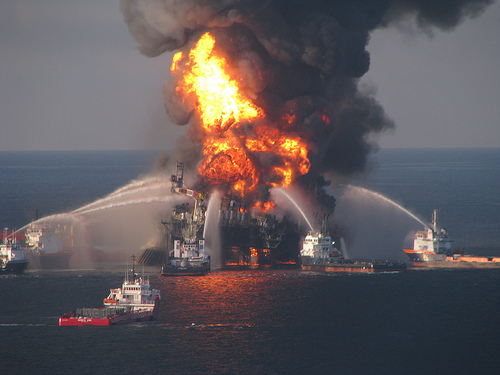
Oil Spill

As one would expect, BP is taking a severe beating in social media right now, when consumers vent their frustration with the effects of the disaster. On Twitter, thousands of tweets are currently being published mentioning BP in connection with the oil spill. Many of them are also directly addressing BP’s US corporate Twitter account with angry comments, suggestions and questions.
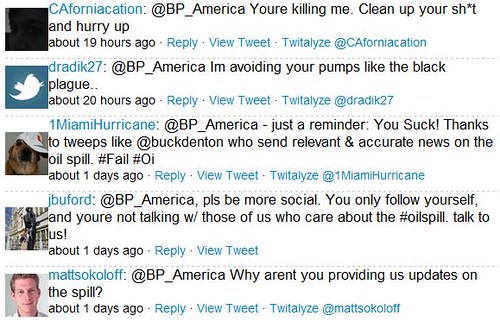
bp-oil-spill-twitter

However, BP are not responding to any of those comments. In fact, the company does not communicate much at all via @BP_America. The account does not respond, retweet or follow anyone else on Twitter (see Klout score below), making it a pure one way communication channel. On top of that, the few tweets that are being published are press releases syndicated to Twitter via Twitterfeed. Nothing wrong with that, but if you publish press releases on your site in capital letters, it doesn’t land well on Twitter, where it equals SHOUTING!
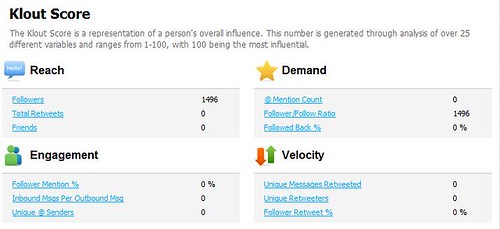
bp-oil-spill

I don’t want to point fingers at BP for not using Twitter to its fullest potential in this difficult position. Instead, why not point to other stakeholders in this catastrophe that are doing things well?
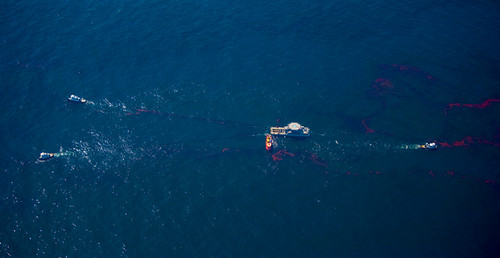
BP oil spill

For example, the US Coast Guard has a Flickr account where it publishes photos and images under Creative Commons license. Images are displayed on http://www.deepwaterhorizonresponse.com/ as a slide show. In the menu of the site, there is even a section for “Social Media” which points to the U.S. Coast Guard’s presence on Facebook, Twitter and Flickr. Update: I forgot to mention that this site is being maintained by British Petroleum, Transocean, the U.S. Coast Guard, the National Atmospheric and Oceanic Administration, the U.S. Department of Homeland Security and the U.S. Department of Department.

The US Environmental Protection Agency, EPA, also uses social media. Administrator Lisa Jackson responds on Facebook and Twitter. I’m sure there are many more examples. The problem for a company in a crisis, especially when you are already in the “bad guy” position, is that when you leave an entire arena to your opponents, the damage to your brand in the long run may be worse than it would have to be. Facebook has more than 400 million members and that’s a big channel to leave unattended. If you do a search for “BP oil”, the first hit you get is the group Boycott BP Oil. As a contrast, the BP America Facebook page has not been updated since Feb 18, 2010. In other words, there is room for improvement.

Photo credit: http://www.flickr.com/photos/uscgd8/
Ultravox Facebook campaign for “Vienna” single failed to reach UK top 40

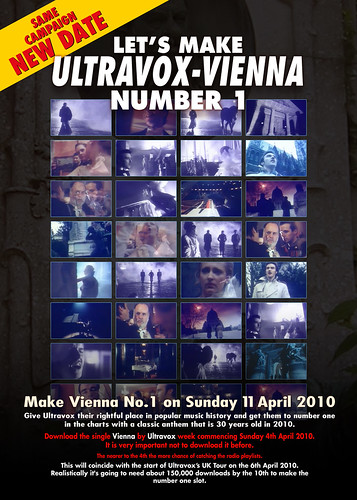
The 80’s synth band Ultravox is on the road again with their “Return to Eden part II” reunion tour, which will arrive in Stockholm, Sweden on April 28 (yes, I am going). Coinciding with the comeback tour, there has been a campaign to bring the 1981 single “Vienna” to the top of the UK charts. Back in 1981, the single only managed to reach second place, being beaten by Joe Dolce’s “Shaddap you face”. Through Facebook and Twitter, fans have been encouraged to download the song during the week ending April 11, in order to push it back into the charts.

According to the mid-week stats for last week, “Vienna” was just outside the top 100 singles, at #106 and in the end the single did not make it into the top 100. The live album Return to Eden however made it to number 75 in the UK album chart as a new entry.

Although the campaign didn’t reach the goal, it’s fun to see how old bands can use social media to engage with fans and create a buzz around a comeback.

vienna_campaign3