Social media for property developers

Now and then I’m asked if there is a line of business that shouldn’t use social media, or if there is a type of business that doesn’t belong on Facebook. While I’m sure that you can find reasons for not engaging in these channels, I always fail to come up with an example of an industry that shouldn’t participate in social media. I would argue that most businesses can reach at least some of their stakeholders, be it customers, employees, rectruiting candidates or partners, via social networks, blogs or other social tools. Why do I bring this up? Well, because I find it so interesting when I stumble upon a social media case story from an industry that isn’t your usual suspect of IT or consumer products.

Social media for property developers in Turkey
The property development company Signature International is building Horizon Sky, a community of apartments, penthouses and villas in the bay of Gulluk, near Bodrum, Turkey. In a project of this size, customers and potential customers of course have a great need for information and a lot of questions will arise along the way. In this case, a Facebook group that initially was started by one of the buyers has become as a key source for information and discussions.

“Set up by an entrepreneurial buyer back in 2008, the FaceBook Group has now become a surprisingly important part of our business.  With almost 340 members, each at a different stage in the Horizon Sky buying process, there’s always an ‘expert’ online to handle queries and as a developer we’re delighted to observe the debate,” says Daniel Dias at Signature International.

The group includes almost 500 photos, several videos and close to 50 different discussion topics.

“The most fascinating lesson that we have learned is what really concerns our clients.  Whilst we assumed that delays in the construction timeline or minor contractual changes would cause the greatest debate, we were wrong.  Most postings relate to communication.  Providing everyone is in the loop, regularly informed and aware of latest on-site progress, the Group tends to be happy.  So we have to make this a priority for Signature International,” Dias continues.

While this is by no means rocket science, it’s a good example of how almost any business can use simple tools like Facebook groups to engage with customers, and to connect customers to each other.

German companies block access to social networks

Two weeks ago, I blogged about how German car maker Porsche was blocking employees’ access to social networks such as Facebook and Xing for fears of industrial espionage. Yesterday, German weekly Wirtschaftswoche reported that more and more German companies are blocking social media sites such as Facebook and Twitter.

“For the majority of our employees many external social media sites are not accessible at work for security reasons,” a spokesperson for Commerzbank said.

Other companies such as Volkswagen, E.On and HeidelbergCement have banned Facebook and Twitter at work for some or most employees. While security reasons may be the most cited argument to block access to social networks, other reasons include productivity loss and increased strain on internal networks as employees download or stream large video files at work.

Footnote: The official Volkswagen page on Facebook has 484,000 fans.

Porsche blocks employee access to social networks

Porsche AG is blocking employees’ access to social networks such as Facebook and Xing, according to an article in Automotive News. The reason is to shield the sports-car maker from industrial espionage.

Porsche 911 Turbo

“Porsche is concerned that foreign intelligence services may be spying on workers posting “confidential” information on Facebook and other Web-based services, exposing the automaker to unwanted observation”, said Dirk Erat, a Porsche spokesman.

“These services imply a certain threat potential,” Erat said. Barring access at workstations to sites including EBay Inc. reflects “principal company policy,” he said.

I think this is wrong on so many levels. Employees that want to access Facebook at work, will circumvent such decisions by using their private smartphones and then the employer has even less control over what information is being shared. And engaged employees are great brand ambassadors that often share positive messages via social media to their networks. If you block them from doing that, they will not only be less inclined to feel good about their jobs, but they will also not be able to support the marketing of the brand. stopblocking.org

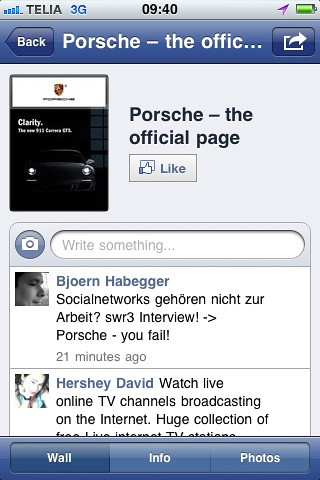
Then there is the issue of Porsche’s own presence on Facebook. The company has more than 800,000 fans on its fanpage. It’s kind of contradictory to use a social platform to communicate with engaged consumers and then block your own staff from the same site. And as you would expect, negative comments are already starting to appear on the fanpage.

Porsche Facebook

Read stopblocking.org for more information about organizations that block access to social media.

PS. One day I will own a Porsche. One day…

Footnote:
Image credit: kevbo1983 on Flickr.

Top reasons for unfriending on Facebook

Do you post all your Gowalla and Foursquare check-ins to your Facebook profile, as well as your tweets, Delicious bookmarks and TripIt travels? Chances are, you are starting to become as dull as dishwater to your Facebook friends. Sharing is caring, but oversharing might not be the ultimate way to add value to your network. A new study by Christopher Sibona, a PhD student at the University of Colorado at Denver, investigated why people unfriend someone on Facebook. The study, which surveyed some 1,500 Facebook users, found that 57 percent of those surveyed unfriended for online reasons, while 26.9 percent did so for offline behavior.

The number one reason for unfriending someone on Facebook was “frequent, unimportant posts”.

“The 100th post about your favorite band is no longer interesting,” he said.

The second reason was posting about polarizing topics like religion and politics. Third reason for being unfriended was posting inappropriate posts, such as crude or racist comments.

Footnote: Hat tip to @jeanlucr

The value of a “like” on Facebook

Facebook has released some statistics about people that click on the Like button on for example media sites. Apparently people who click the Facebook Like button are more engaged, active and connected than the average Facebook user. The average “liker” has 2.4x the amount of friends than that of a typical Facebook user. They are also more interested in exploring content they discover on Facebook — they click on 5.3x more links to external sites than the typical Facebook user.

Working Together to Build Social News

Swedish customers can book Lufthansa tickets on Facebook

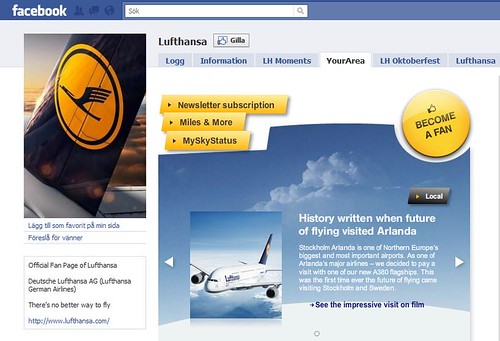
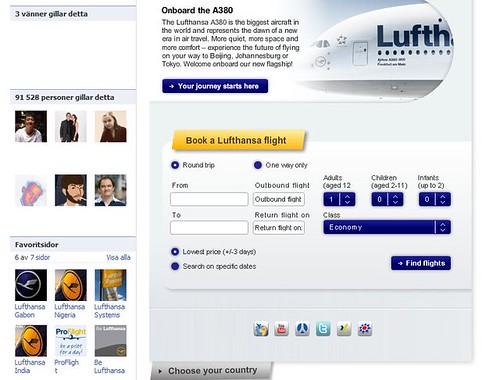
I blogged a week ago about how Delta Air Lines lets customers book airline tickets on the Delta Facebook page. EasyJet also has this application on its page on Facebook. Now Lufthansa has also introduced the same functionality to its page and it is available for customers in Sweden, USA, Germany, India, Spain, Great Britain, Greece, Turkey and the United Arab Emirates. Further markets will be added by the end of the year.

Lufthansa  also cooperates with the location-based site Foursquare in Germany and users who check in at three different locations via Foursquare can get a 20 euro voucher for their next Lufthansa flight booking.

lufthansa-facebook-1

Users who select a certain country, get local news (see below from Sweden).

lufthansa-facebook-2

lufthansa-facebook-3