Zlatan Ibrahimovic is not on Facebook, but his fans are

Portuguese footballer Cristiano Ronaldo uses both Facebook and Twitter to connect with fans. His official fan page on Facebook just reached 20 million “likes”, which is an amazing number. His Twitter account has close to 1.8 million followers.

The Swedish footballer who is closest to Ronaldo’s star status is AC Milan striker Zlatan Ibrahimovic, but as I have blogged before, he is not active on Twitter. Apparently he and/or his agent don’t bother too much about protecting the “Ibra” brand online. By the looks of it, he is not in control of the domain name zlatanibrahimovic.com and he has left Twitter open to a range of imposters. So what about Facebook? Well, for starters, he has not grabbed the vanity URL www.facebook.com/zlatanibrahimovic. It belongs to one Aymen Ak. An official page is nowhere to be found.

As is often the case, fans take matters into their own hands and create “fan” pages. The largest one currently has 725,000 fans and a community page has more than 100,000.
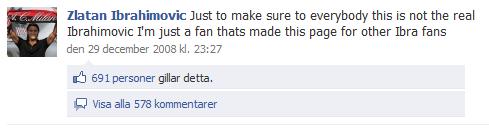
Zlatan Ibrahimovic facebook fan page

I don’t know if Ibrahimovic is just not interested in talking to his fans, is satisfied with his current “level of stardom” or if he has the wrong advisors. Either way, I am convinced that he could strengthen his brand even further if he would start to engage just a little with his millions of fans through social media. Better to start now, than after the career has ended.
Porsche tags one million Facebook fans on a 911 GT3 R race car

When Porsche reached one million fans on its Facebook page, the German sports car brand decided to celebrate the occasion by thanking its fans, each and every one of them. This video shows how a Porsche 911 GT3 R hybrid race car gets tagged with the names of one million Facebook fans and you can even search the names to see if you were one of them.

I wonder how many of these fans that are Porsche employees? Porsche recently said it blocked employee access to social networks like Facebook to prevent industrial espionage.

Via We Are Social.

Social media behind decrease in Christmas text messages

The last few years it has become quite common to send greetings to friends and family on Christmas Eve via text messages, SMS. But this year telecom operators in Sweden, Norway and Denmark report a significant decrease in the number of messages. In Sweden, the four operators Tre (3), Tele 2, Telia and Telenor distributed a total of 72.5 million text messages on Christmas Eve, down from 76.5 million in 2009. In Norway, Telenor report a decrease with 5 million text messages compared to 2008, this year Norwegian customers sent 17.1 million SMS. The same pattern can be found in Denmark, where Telia report a decrease by 1 million SMS.

The operators claim that the reason behind the lower volumes is an increased use of Facebook and other social media. The conclusion is supported by the fact that data traffic has increased during this Christmas compared to previous years, most likely because customers are taking photos and uploading them to Facebook and other social networks, where they share it with friends.

“Stay off of Facebook” competition shut down by Facebook

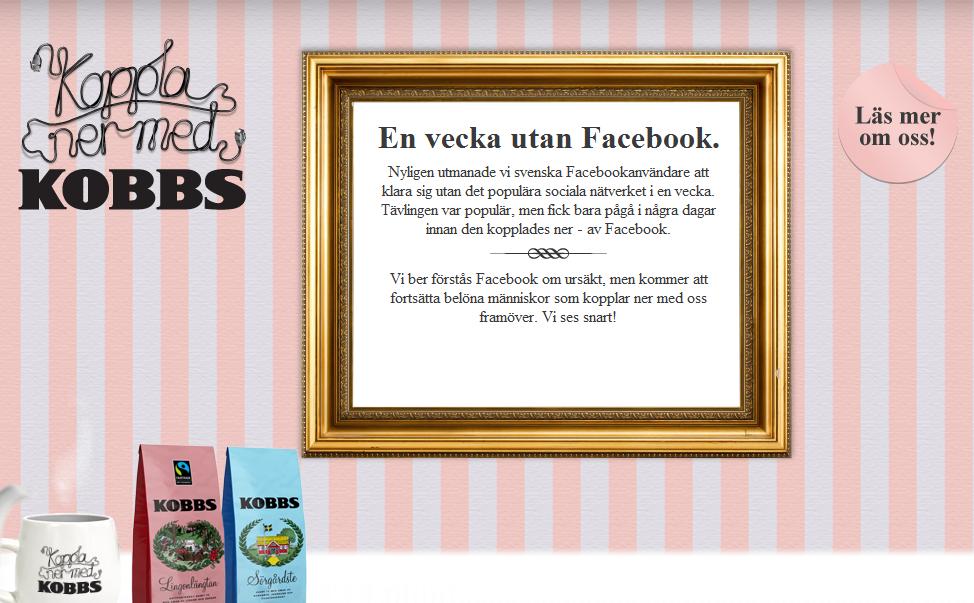
Oh, the irony. Swedish tea brand Kobbs launched a competition in which consumers were challenged to stay off of Facebook for a week. To take part in the competition, users had to connect via their Facebook profile. The competition was supposed to last for a month, but was closed down today, after being live only for a few days.

Contest shut down by Facebook

There is no publicly available information explaining why Facebook shut down the contest. My guess is that there could be several reasons that the contest was in breach of Facebook Promotions Guidelines, but the use of the brand Facebook in the contest headline is a prime suspect.

For some tips on how to run a successful contest on Facebook, check out these tips.

Backup your social media content with MyCube Vault

MyCube Vault is a new tool for backing up your content on different social media sites,or as the company puts it in the press release, “the first of a suite of services that will give users complete control of their online lives”. It is the brain child of internet entrepreneur Johan Staël von Holstein, who presented the Vault this morning at a meeting in Stockholm. The tool allows users to take ownership and control of content they have shared on social networks such as Facebook. The reasoning behind the need for this procedure is that MyCube predicts an increasing need for users to be in charge of their content, in terms of privacy, security and control. Who really owns your data on social networks will be a critical issue in the future, MyCube assumes.

In January next year, MyCube will also launch a beta of MyCube Exchange, a social network that will let users create and share content, not only on MyCube, but also on other sites. In other words, the plan seems to be to allow users to download all of their content with MyCube Vault, upload it to MyCube Exchange and then share it to all the places they choose. This will give users more control and in the long run an option to actually leave sites like Facebook and take all that content to some other place.

The Vault is an open source project and free of charge for users who use the tool to download their content to their own computer.

So far, the only service you can back up is Facebook, which of course you can already do directly inside Facebook. Hopefully more services will be added shortly. This is how you back up your Facebook content, using MyCube Vault.

How to backup content on Facebook using MyCube Vault
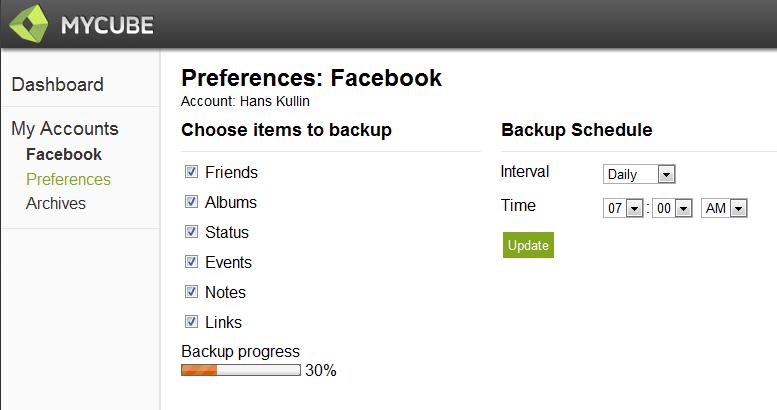
Give the application access to your Facebook account. Then backup your friends, albums, statuses, events, links and/or notes. You can also let MyCube Vault do a backup on a daily or weekly basis.

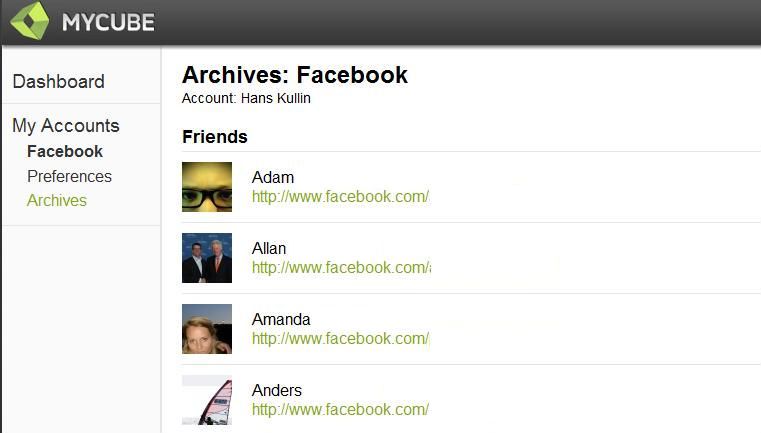
The Vault then downloads your content, for example the names of all your friends and a link to their profiles (I have erased their last names and full links in the image below).

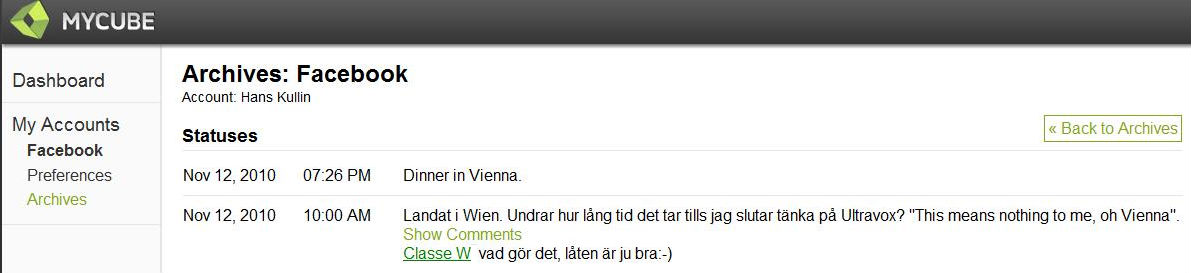
Status updates are downloaded, including comments.

A question that MyCube will probably face is the definition of who actually owns content. For example, I downloaded “my” content on Facebook but not only did the Vault download all my photos, it also downloaded all photos I am tagged in, which of course includes photos that aren’t mine.

Invites to Facebook mail probably fake

Twitter is currently buzzing about invites to Facebook Messages. Many people want to be among the first to try out the new mail that was announced by Facebook yesterday so when they see that you can get one of 100,000 invites by just retweeting a message, of course many take the chance.

The problem is that this is most probably completely fake. Why? Well, first of all, we’ve seen it before. When people were desperate to get an invite to Google Wave, they got tricked into retweeting the message“RT @waveinvite Just requested my Google Wave Invite! Get yours at http://waveinvite.co.cc” which was fake. The link went to a site that contained material that was NSFW.

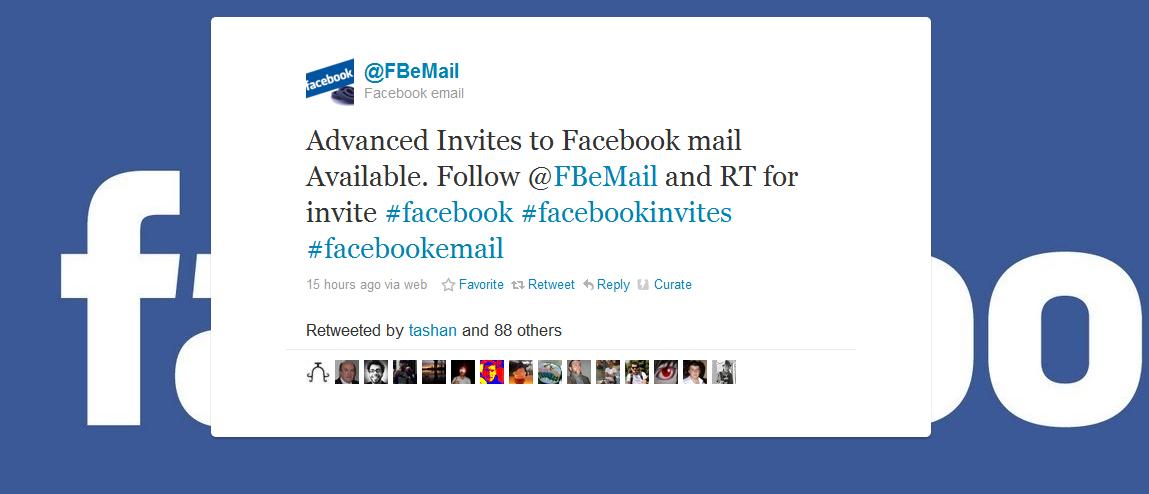
Second, how are they going to send an invite to someone who just retweeted a message, when they are not following you back? I don’t get that. And third, there are two different accounts pulling the same almost identical stunt, @fb_com and @FBeMail. Do you really think Facebook would communicate this way, using accounts that were just created? I don’t. So once again, think before you retweet something. It may not be true.

“100,000+ Advanced Invites to Facebook mail Available. Follow @fb_com and ReTweet for invite #facebook #facebookinvites #facebookemail

Invite Facebook mail

“Advanced Invites to Facebook mail Available. Follow @FBeMail and RT for invite #facebook #facebookinvites #facebookemail

Facebook mail invites

You can apply for an invite on the Messages page inside Facebook. And if you want to see what it looks like when you get the invititation, Jeremiah Owyang has a screen shot on Flickr.