L.A. clubs co-operate on the Social Strip

I had the pleasure of being invited to the Social+Cash conference last week, which focused on how to gain business value through social media. Key note speaker was Chris Heuer, founder of the Social Media Club. One of the things I took away from the day, except meeting up with a lot of good old and new friends, was a case story from Los Angeles. This case was initially presented at SXSW in Austin, Texas, earlier this month.

The Social Strip
It’s the story about the three Sunset Strip clubs the Viper Room, the Roxy, and the Comedy Store, that joined forces to drive business via social media channels. The clubs decided in 2009 to leverage the power of their collective network. The L.A. Times Music Blog writes:

“It all started when Roxy owner Nic Adler saw the Viper Room enter the world of Twitter. He virtually and publicly welcomed his competitor to the space by announcing their virtual presence to the thousands of “followers” interacting with the Roxy via Twitter. That simple gesture of goodwill opened the floodgates of camaraderie that has helped the Roxy increase its business by 30% over last year, Adler said, and has helped the Viper Room see its regulars return.”

By using social media channels the clubs managed to revitalize the legendary bar street. For example, visitors that checked in to the Roxy on Foursquare were upgraded to VIP status. Another initiative was the Tweet Crawl, a web 2.0 version of the old pub crawl, described in the video below.

Sunset Strip Tweet Crawl on KTLA from nic adler on Vimeo.

This way of collaborating with competitors is labelled “coopetition” and you can read more about the case in this presentation on thesocialstrip.us. See also The Social Strip on Facebook.

socialstrip

How people use social networks – a global study

The market research agency InSites Consulting has posted a terrific report about the global use of social networks. InSites surveyed 2,884 internet users in 14 countries and the report is a gold mine of interesting statistics. I have chosen to post two of the slides that I think are especially noteworthy.

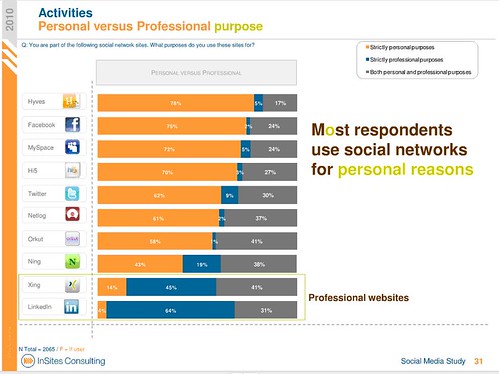
The first is a slide that shows professional vs personal use of different social networks. It is a clear difference in use of sites like Xing and LinkedIn on the one hand, and Facebook and MySpace on the other.

socialnetworks-pro-personal

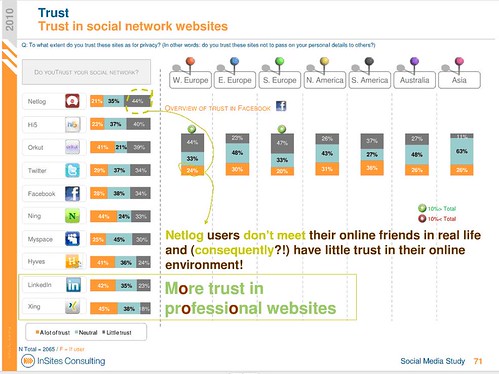
It seems that internet users have more trust in professional social networks than in ones used for personal purposes, with the exception of the Dutch site Hyves.nl, in which users also have a lot of trust. That might possibly be due to the fact that it is a local social network, but that is a guess on my part.

socialnetworks-trust

Here is the entire presentation and I encourage you to check it out.

Eight-year olds in the UK are joining social networks

face-book

Facebook’s privacy policy states that children under the age of 13 may not register on the social network. But that doesn’t stop kids from wanting to join the site. As an effect, parents are discussing in online forums how to react when their 10 or 11-year olds want to become members on Facebook. Here is one discussion (in Swedish) from last year in which a parent says that several kids in his or her 9-year old’s class are on Facebook. On the family forum Familjeliv there was a poll earlier in 2010 of how many kids under 13 that were members. About a third of the 52 that answered said that their kids were on Facebook, despite being under the mimimum age.

It is quite possible that this trend will only increase with the growth in popularity in social networks. Research from the UK communications regulator Ofcom reveals that children as young as 8 years old are ignoring social networking site rules and creating their own site profiles.

“The research found that a quarter of children aged 8-12 who use the internet at home say they have a profile on Facebook, Bebo or MySpace. All these sites have a minimum user age of 13.”

The research also showed that one in six parents didn’t know that their children were spending time on social networks.

In the UK, 1.6 million teens age 13-15 have a Facebook profile. It seems reasonable to think that also several thousand children under 13 are on Facebook, although they aren’t allowed to register.

Photo credit: ntr23

IKEA victim of Facebook hoax

ikeagiftcard

A while back, more than 200,000 Swedes were fooled to join a Facebook group that promised to donate 2 SEK per fan to the victims of the Haiti earth quake. Only problem was that once the group reached the goal, it changed name and added some really outrageous content. I was somewhat amazed that all these people didn’t see through that scam because when something seems too good to be true, it often is.

The latest scam is a Facebook campaign by IKEA that promises to give you a 1,000 USD gift card if you became a fan of the Swedish company. Of course, this is not really a campaign that is really run by IKEA. If you have any knowledge of the IKEA culture I’m convinced that you would agree that IKEA would never give money away in a stunt like this.

IKEA spokesperson Mona Astra Liss says the “false offer” is not some half-baked publicity stunt by IKEA. “It’s absolutely not a publicity stunt and absolutely not endorsed by IKEA,” she says. She adds that Facebook performs closed investigations of scams, so IKEA doesn’t know who’s behind the hoax.

Tags: , , . Ping.

Using social media to promote handball

In February 2007 I registered the domain socialamedier.com which is the Swedish translation of “social media”. Back then, the term was fairly new, but today there are literally thousands of self proclaimed social media experts out there, giving advice about how to be successful on blogs, Twitter or Facebook. It has come to the point where “social media guru” is almost seen as an invective.

So if you can’t stand to hear one more social media evangelist tell you about how they will end starvation and bring world peace through social media, instead you might want to read this blog post from a newbie who just recently discovered the benefits of social networking. Dominique Dumont is the USA Team Handball’s East Regional Director and she blogged yesterday about her experience with primarily Facebook and how she “discovered the holly grail of social media”.

“We promote the use of [Facebook], why, because the biggest problem in developing our sport is getting people together, communicating and getting organized. Facebook allows this in one swoop and it allows for unlimited growth. Not four physical walls of course, but a forum to meet each other, share ideas and plans of action on the subject in common. Once athletes participate in this multi-directional forum, they quickly gain momentum. “

It’s really a good story about a skeptic that turned into a convinced user. I encourage you to read the entire post. Dumont concludes:

“One day forced to use social media, and another, proud to see how useful it can be for all of us.”


Media Culpa celebrates six years of blogging

six On Feb 4, 2004, Mark Zuckerberg launched his Harvard student social network Facebook. At about the same time, I was goofing around with this new thing web log, and on Feb 17, I published my first blog post. Six years later Zuckerberg is a billionare and, well, I’m not. Either way, I’m happy that I have managed to keep this blog running for six years today and during that time I have published in excess of 1,400 posts.

During the years, the number of visitors peaked during the tragic Asian tsunami, in late December 2004, much thanks to a number of links from some mainstream media sites. Another day with thousands of visits was on Nov 2, 2005 when Media Culpa was pick of the day by the Blogger team.

A quick look at Google Analytics from Jan 1, 2005 and onwards shows that Twitter.com has sent a lot of traffic my way, it is fifth in the list of top referring sources. On July 18, 2009 the blog received the highest amount of traffic from search engines and my guess is that is from the post about the fake Zlatan Ibrahimovic on Twitter who was quoted by the AP.

I may not be blogging as frequently now as I used to (the last year I have also been running a blog in Swedish about social media), but I promise to keep it going for a little longer. And please don’t be too hard on me if you read the first few blog posts. It was a period of testing and trying to understand the concept of blogging.

Footnote: Image by Marie-II.