200,000 Swedes joined fake Facebook group for Haiti

It wouldn’t hurt to practise some critical thinking when participating in social networks. What many suspected turned out to be true today, namely that a Facebook group titled (translated from Swedish) “2 kronor for every member to the earth quake victims in Haiti” was only fake. Everything from the identity of the person who created the group to the hidden information about the “sponsors” who would donate 2 kronor (0.28 USD) per user, signalled that there was something fishy about this group.

I checked in on the group about two hours ago and it looked as it had done the last few days and the group now had about 211,000 members. But an hour later Computer Sweden published an article revealing that the official photo of the group had now changed to a hideous photo and that the information of the page had now been changed to contain information about necr0philia.

I understand that people want to help the victims in Haiti, but it’s still quite fascinating that so many people are willing to join such a group without questioning the motives. And of course very disturbing that some twisted mind uses a tragic incident like the earth quake in Haiti to pull a sick stunt like this. Especially since we less than a week ago read in Aftonbladet about another Facebook group that managed to attract thousands of members, only to change name to indicate that the members like to have sex with their children.

I think Facebook will need to monitor this issue very carefully or users will lose trust in the whole concept of groups. In the mean time, users need to be a little more careful about what they post and which groups they join. After all, it’s mostly common sense.

Footnote: The link to the group is here, but I don’t recommend a visit: http://www.facebook.com/group.php?gid=243968684541

Tags: , , , . Ping.

Social media dominates Google search results for Brand Me

In February I blogged about taking control over Brand You online and especially in terms of how your name appears in a Google search. I concluded that my blog and other social media properties that I use ranked high in a search for “Hans Kullin” on Google. The top ten results for my name on Google.se in February were:

1. The “About me” page on this blog
2. This blog

3. Blog posts tagged with my name on www.s-bloggar.se
4. Blog posts tagged with my name on mindpark.se
5. Blog post at fyranyanser.se with my name in the headline
6. My profile page on profsweden.ning.com
7. Blog post at bisonblog.blogs.com/blog with my name in the headline
8. My page at micro blog service bloggy.se
9. My page at micro blog service jaiku.com

10. Blog posts tagged with my name on sv.wordpress.com

I was more or less in control of results number 1, 2, 6, 8 and 9, with Media Culpa claiming the two top spots.

A few weeks later, in March 2009, I launched a Swedish language blog called Sociala Medier (“Social Media” in Swedish) on a very good domain: www.socialamedier.com. In spite of being active less than a year, that blog (which is built on WordPress) is already among the very top results.

Top ten today are:

1. The “About me” page on this blog
2. This blog
3. My Swedish blog Sociala Medier
4. My page on Twitter
5. My profile page on profsweden.ning.com
6. My page at micro blog service bloggy.se

7. Article about me in Dagens Media
8. Article about me in Resumé
9. Article about me in Medievärlden
10. Blog post at techrisk.se tagged with my name

I now “control” results 1-6, which is an improvement in only 11 months. My Twitter page has moved up to #4, while my Jaiku page is no longer among the top results. Back then, the first traditional media link was at #16, but now there are three in the top ten. It’s clear that blog posts and articles in online media that have my name in the title, tend to rank high.

Other social media properties that rank high are my FriendFeed page and the LinkedIn page, both in top 20, but there are still no links in the top 30 results to me on Facebook.

I wonder if there is an “easy” way to get hold of the remaining top ten spots without starting a third blog. Let’s see in 12 months what the status is.

Update: Results slightly adjusted.

Tags: , , , , , . Ping.

Time for a new job – I’m joining Sermo

fireworks

I don’t think there has ever been a more exciting time to be a communicator than now. New tools and patterns of behaviour emerge every day, propelled by new digital technology. For example, Google today launched their Real-Time Search which includes live search results from Twitter and Facebook, which clearly demonstrates the deep impact of micro blogging and status updates on the way we consume information.

If you’ve followed along this blog for the last 6 years (almost), you wouldn’t be surprised that I think the future of PR lies in being able to integrate the new digital environment into the overall communication strategy. And to be able to continue to develop and to work even more focused with client on projects within digital PR, I am happy to announce that I will join a small niche agency called Sermo Consulting.

Sermo are specialized in online corporate communications and are 10 consultants in Norway and 5 (with me) in Sweden, making them a force to be reckoned with in the Nordic online PR business. I will be joining i mid-January and hope that I will be able to continue to work with interesting clients and projects with a focus on social media.

Photo credit: anna_t

Tags: , , . Ping.

Nude photos on Norwegian Army social network

Last Sunday I blogged about Futurebook, a social network built by the the Norwegian Armed Forces to recruit 17-year olds. Futurebook added 60,000 17-year olds to the site without asking for their permission, and most of the information on the site was fake. According to an article in Digi.no, it cost the Army 285,000 NOK (50,000 USD) to build the site.

Digi.no asked a spokesperson at the Army why they did not use existing social networks.

– The reason we built the campaign site was to be able to control the information. At our site, the members cannot publish information. The only thing they can do is ask questions about the Army, said Trine Jungeling.

That sounds like a completely backhanded approach to the whole idea of a social network, which in my view is to let members interact and co-create content. In other words, the complete opposite of being in control.

Futurebook has created a lot of negative reactions and the latest kerfuffle revolves around the fact that some 17-year olds have been greeted by nude photos when they logged on to the site. On Pia Mari Aune’s wall, photos of naked men had been posted (see photo at VG.no) displaying their rear ends as they walk through a forest.

– If they wanted me to spend a year in the army before my studies, they failed, she said.

But Per-Ivar Norman, chief-of-staff at Vernpliktsverket, the National Service Administration, defends the pictures.

– The pictures show an activity that may happen when you are out practicing. To take your clothes off may be needed in situations where you for instance have to walk in water or mud. It is a way to practice.

That may very well be the case, but was it necessary to post photos of men’s butts on a 17-year old girl’s profile page? As seen in the article on VG.no, there are also topless photos of girls on Futurebook. The reason for these photos is quite unclear.

The site will be reviewed by Datatilsynet, the Data Inspection Board in Norway, which said that the approach to add young people to the site without their permission and then populate their friends lists with real people, with real birth data, was disrespectful. Datatilsynet even said that there is a real threat they could close the site down.

I find it quite ironic that the Army wanted to control the information on the site, perhaps so that none of the teenagers posted offending photos (?), and then they are the ones that add photos of nude butts. Bizarro world, anyone?

Tags: , , , , , . Ping.

Top 50 brands on Facebook

The Big Money ranks the 50 brands that are currently making the best use of Facebook. The ranking is based on factors like number of fans, page growth, frequency of updates, creativity and fan engagement. Coca-Cola is ranked as the brand that makes best use of the social network thanks to its “organic fan-centric page without a corporate feel”. Here are the top 10:

1. Coca-Cola: 3,996,163 fans
2. Starbucks: 5,034,578 fans
3. Disney: 2,119,773 fans
4. Victoria’s Secret: 2,151,895 fans
5. iTunes: 2,236,306 fans
6. Vitaminwater: 1,087,153 fans
7. YouTube: 3,733,242 fans
8. Chick-fil-A: 1,221,064 fans
9. Red Bull: 1,623,102 fans
10. T.G.I. Friday’s: 974,192 fans

Swedish fashion retailer H&M; is at number 24 (1,341,742 fans). The motivation for the ranking: “The High fan interaction. The fashion retailer has had success in generating tens of thousands of responses with polls.”

It is also interesting to find the U.S. retailer Target on #43. Target took some heat in early 2008, when a PR representative responded to a blogger request like this:

“Unfortunately we are unable to respond to your inquiry because Target does not participate with non-traditional media outlets.

This practice is in place to allow us to focus on publications that reach our core guest.”

It seems that Target indeed learned from that incident.

Tags: , , , , . Ping.

Norwegian Armed Forces build network of 60,000 17-year olds without permission

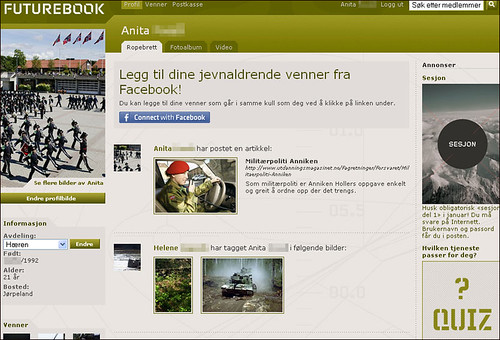
The Norwegian Armed Forces have launched a Facebook-like social network to recruit 17-year olds. The site called Futurebook is made up of 60,000 members that the Armed Forces added to the social network without their permission. The 17-year olds recently received a mysterious letter in which they were invited to some sort of fictitious reunion party. Among other things, the letter that promoted the site stated that “There are thousands of new photos published and maybe you’ve been tagged in some of them”.

The letter included user name and password and once the teenagers logged in to the site, they found that they already had a profile with their name, birth date, location and a friend list of about 20 people, but all other information was fake. Even comments from friends were fake:

“Anyone going to Roskilde this year? Had been cool with a camp for people who actually know how to raise a tent”.

Even the friends lists are populated with friends the teenagers don’t really know.

futurebook

As you would expect, this creative idea didn’t sit very well with the target group. As one mother told VG.no:

– They steal your name. On other sites such as Facebook or Nettby, you would be thrown out for posting a fake profile.

Then she sums it up perfectly:

– We try to teach our kids that they should be careful online and then they get this thing thrown in their faces. It looks like they’ve published the profiles themselves but at the bottom in tiny letters it states that this is fictitious, says June Beth Rovik.

Based on the comments about Futurebook on Twitter and on blogs,the site seems to create a significant amount of negative reactions. Many react to the fact that birth details for example are published and open for all members to view.

In my view the campaign certainly did start off on the wrong foot by registering 60,000 teenagers without asking them for permission. There is enough pressure on teenagers today to manage their identity online and keep unwanted photos and comments off the net. The Armed Forces and their advisors should probably benefit from reading a few books by Seth Godin, the father of permission marketing. Among other things, Godin writes:

“Real permission is different from presumed or legalistic permission. Just because you somehow get my email address doesn’t mean you have permission.”

Just because the Armed Forces could buy the personal details of all 17-year olds in Norway, doesn’t mean that they are entitled (morally) to hijack their identities and then post it online. That’s not the right way to create positive associations to a brand or organization.

Godin again:

“Permission marketing is the privilege (not the right) of delivering anticipated, personal and relevant messages to people who actually want to get them.

It recognizes the new power of the best consumers to ignore marketing. It realizes that treating people with respect is the best way to earn their attention.”

Creating an opt-out social network just seems to be a really really dumb idea, especially when the target group is teenagers.

Tags: , , , , , . Ping.