The travel industry turns to social media

The travel industry is turning to social media in order to build relations with customers and to promote its services. During the eruption of the Icelandic volcano in April, airlines, airports and travel agencies successfully used social media to communicate with travellers. Twitter was one of the channels that many used to update customers about delays and cancelled flights. Companies that tweeted actively quickly gained a large number of new followers, as seen in the presentation below, which would indicate that customers find it useful to follow companies on Twitter.

Another great social media case from the travel industry is the Twitter application by Lufthansa, called MySkyStatus. The site lets users automatically share flight information via Twitter, Facebook or LinkedIn, while in the air. The site is now open for travellers on all major airlines and everytime someone uses MySkyStatus they are greeted by the message “Powered by Lufthansa”. It’s a great way to add value to travellers and at the same time expose the brand to thousands of potential customers. To date, the site has distributed more than 400,000 status updates (81,000 on Facebook and 21,000 on Twitter).
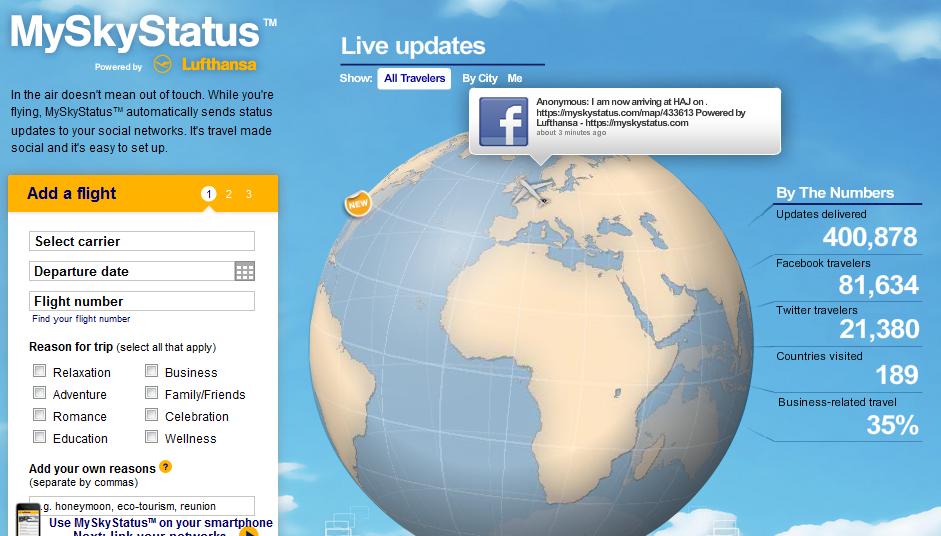
myskystatus

Yet another example, soon to launch, is Topguest.com, a site that rewards travellers that frequently check in on hotels and other places using location based services such as Foursquare or Gowalla. According to USA Today and CNET, Topguest has launched a preview version that includes a co-operation with hotel chain Standard. Guests that check in using Topguest get a discount:

  • Social-media addicts who check into each of Standard’s four hotels in New York, Miami and Los Angeles in the span of one week will earn a free week at any one of the hotels.
  • You could also check in to Standard establishments – whether restaurants, bars, shops or the hotel spa – 10 times and receive 25% off your reservation.

The Swedish travel agencies Ving and Fritidsresor are actively answering questions from customers on their Facebook pages and they use Twitter to distribute promotions. There are many other good cases from the travel industry, which seems to be one of the industries that are most actively embracing social media. Other companies take note.

World Cup 2010: support your team with a Twibbon

On June 11, the FIFA World Cup 2010 in South Africa will kick off with the game between the host country and Mexico. This will be the first World Cup that will have a significant presence in social media as fans will discuss games and cheer on their teams through channels like Facebook and Twitter.

Here is a collection of “twibbons” that you can add to your Twitter avatar in order to show support for your team, one for each of the 32 participating teams.

Algeria:
Algeria

Argentina:
Argentina

Australia:
Australia

Brazil:
Brazil

Cameroon:
Cameroon

Chile:
Chile

Denmark:
Denmark

England:
England

France:
France

Germany:
Germany

Ghana:
Ghana

Greece:
Greece

Honduras:
Honduras

Italy:
Italy

Ivory Coast:
Ivory Coast

Japan:
Japan

Mexico:
Mexico

Netherlands:
Netherlands

New Zealand:
New Zealand

Nigeria:
Nigeria

North Korea:
North Korea

Paraguay:
Paraguay

Portugal:
Portugal

Serbia:
Serbia

Slovakia:
Slovakia

Slovenia:
Slovenia

Spain:
Spain

South Africa:
South Africa

South Korea:
South Korea

Switzerland:
Switzerland

Uruguay:
Uruguay

USA:
USA soccer

FIFA World Cup 2010:
World Cup 2010

Additional versions of Twibbons can be found at the site via AdHack and ITVfootball.

Top five social media risks for businesses

Earlier today I blogged about the trend that brands get hijacked on Twitter. A report released today by ISACA confirms that this is a major risk for businesses. The white paper outlines five major social media risks for business and “brand hijacking” is one of them. Top five risks are:

  • Viruses/malware
  • Brand hijacking
  • Lack of control over content
  • Unrealistic customer expectations of “Internet-speed” service
  • Non-compliance with record management regulations

The full white paper Social Media:  Business Benefits and Security, Governance and Assurance Perspectives” can be downloaded here. [pdf]

Oscar de la Renta to live-stream runway show

oscardelarenta Fashion house Oscar de la Renta will live-stream the designer’s runway show online today, Monday at 1 p.m. EST. The designer himself explains why he is taking the show public on the company live-streaming channel.

“Without a doubt, the role of a runway show has changed. In the past, the show was principally for buyers. While they are still a key constituency, we also show for the media. Online media is increasingly influential in fashion. This allows that group and others that can’t attend in person to see things in real time. It’s evolution.”

“A show is the greatest source of brand content that you have, and to be able to share it on such a large scale — it’s really amazing. I think that this is where the real power of the Internet lies, allowing anyone anywhere to interact with your brand, shifting what has traditionally been kept private to the public space. I suppose it’s a bit like adding more seats to the venue.

The company is active in social media and the corporate Twitter account @OscarPRGirl has more than 7,000 followers. When asked about how social media affects the company and the fashion industry, de la Renta replies:

“The great thing about fashion is that it always looks forward. I would be lying if I said that we understand the complete picture and the long-term effects that social media will have on our company. Right now, we feel strongly that we have to be a part of it. You have to experiment, and our hope is that eventually we will get it right.”

I really like that attitude.

The live-streamed runway show can be viewed here.

Brand-jacking on Twitter new challenge for PR

As if BP didn’t have enough problems in the aftermath of the oil spill in the Gulf of Mexico, the sarcastic tweets from the not-so-official Twitter account @BPGlobalPR has taken the twitterverse by storm. And not only has the person behind the account attracted 130,000 followers, he has also spawned a number of copy cats and started something of a trend. After the Israeli attack on the Flotilla convoy a few days ago, two similar Twitter accounts soon appeared – @IsraelGlobalPR  and @HamasGlobalPR – both using fake Twitter handles to try to influence the opinion.

Of course, it doesn’t end there. Meet @PunchTavernPR, the unofficial Twitter channel for the UK pub group Punch Taverns. It was launched after an incident on Saturday afternoon, when a group from the LGBT Labour Annual General Meeting was turned away from the Greencoat Boy pub in central London, a pub owned by Punch Taverns. The group of around 100 people were allegedly refused service by the manager because they were gay. It didn’t take long before people started to voice their opinions on social media channels, primarily on Twitter. According to the Guardian, the flood of tweets started after @LGBTLabour tweeted about it.

The hashtag #Greencoatboy soon became a trending topic in the UK and other tags that were used were for example #bigotbar and #boycottpunch. Articles about the incident were among the most read on BBC’s website yesterday.

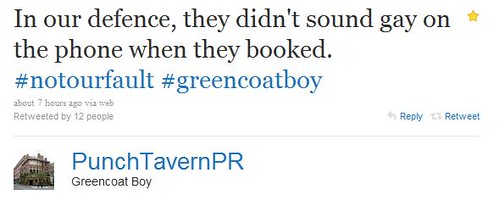
On top of that, someone started the fake Twitter account PunchTavernPR, spewing out tweets like this one:

punchtavern

The negative publicity in both traditional media and social media forced Punch Taverns to apologize in a statement on Sunday.

Brands have been hijacked on Twitter for a long time, remember the fake corporate Twitter account from Exxon Mobil in 2008? But now the blow more often seems to be directed specifically towards corporate public relations in what I can only describe as the digital equivalent to preemtive strike. What better way to get the opposing side in a conflict look bad than to mock the PR departement with silly jokes and ironic remarks? It can be very tricky to defend yourself against humor.

But all in all, this is not a good sign for PR. I get the feeling that this trend has emerged because people are sick of bad public relations efforts during crisis situations. It’s still all too common that when a corporation or an organization is facing a real crisis, it is slow to respond and when it does act, it uses half-truths and stonewalling tactics.

Perhaps it is a wake up-call for corporate PR. My advice would be to study this trend carefully and think through, what would our company do if we got brandjacked on Twitter in a crisis? It’s not an easy task to deal with.

Related about “Twitterjacking”: Zlatan Ibrahimovic on Twitter.

Japanese clothing brand trending on Twitter

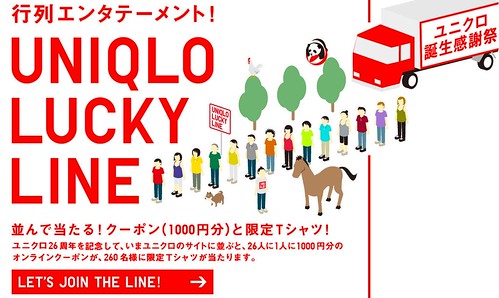
The Japanese retail clothing chain Uniqlo is currently the most tweeted topic on Twitter, thanks to a creative promotion campaign for their 26th anniversary. On Uniqlo’s site users can add their Twitter user name in order to win special gifts. Each participant gets a unique number in a virtual line and has the chance to win based on their Lucky Line Quene Number.

As soon as a person joins the competition, he or she also tweets the line “UNIQLO LUCKY LINEに行列なう。” and their queue number. Currently there are hundreds of tweets per minute and the total amount is currently close to 39,000, and growing very rapidly.

uniqlo lucky line

Not all commenters are positive to the flood of tweets. Some compare it to spam.

More details on Whatthetrend.com.

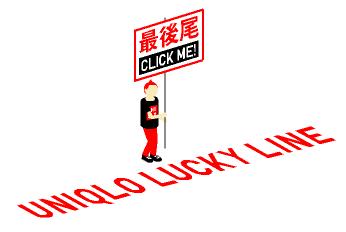
uniqlo2

Update: The volume of tweets is quite extraordinary. The time from tweet #6 to #50,000 is about one day. (haven’t been able to locate tweet #1).