How to lose 5,000 inlinks per month and alienate bloggers

If you have been blogging a few years, you may have noticed a change in the way other bloggers react to your content. Back then when I started, in 2004 and 2005, all you had to do is write a witty comment to some news story and five other bloggers would link to your post, possibly adding a few views of their own. Nowadays, you can spend weeks on research for a specific blog post and “all you get back” are a number of retweets, and maybe maybe one or two blog links. I’m not saying it’s a bad thing, especially for me who have an old blog with thousands of old links to it, I already have a high page rank. And it’s great that Twitter and Facebook have made it increadibly easy for your thoughts to travel across the web. But it was easier back then to get link love and, since a link is a “vote” on your content in Google, thereby building a good page rank for your blog.

So I will try to more often reward really good blog posts with a link back from my blog, not “only a retweet”.

“Good content deserves more than a retweet.”

Here is a good example that ties in well with the link love theme of this post. Simon Sundén, a great Swedish SEO expert, wrote a story the other day about how one Norwegian daily voluntarily turned down 5,000 natural inlinks per month. In short, Dagbladet.no used to use Twingly to show which blog posts link back to a given article. Since this concept is a win-win for both the paper and the blogger, many Scandinavian news sites have introduced Twingly. The news site gets lots of links and some traffic, while the blogger gets traffic back and some recognition.

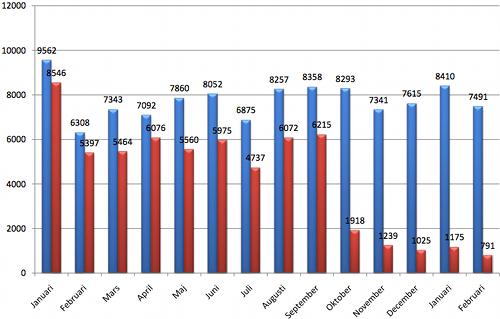
What Sundén noticed was that Dagbladet.no stopped using Twingly some time late in 2009 and as you can see from the red columns in the graph below, the effect was that the number of inlinks per month dropped drastically from 5,000-6,000 to a measly 1,000. Meanwhile, competing daily VG.no kept Twingly and has enjoyed a steady level of links from bloggers (see blue columns below).

In the long run, VG.no will probably become a stronger site from a search perspective, compared to Dagbladet.no because bloggers are more likely to link to a similar article on VG.no than on Dagbladet.no.
twingly-inlinks-vg-vs-dagbl

Image credit: Simon Sundén.
BP Oil Spill and Social Media

BP are now caught in the middle of the worst possible scenario – one of the company’s oil drilling rigs in the Gulf of Mexico exploded on April 22 and sunk, resulting in a major environmental disaster as more than 5,000 barrels of oil leak into the ocean per day. The long term reputation of the company is at stake because of the accident, that in many instances has been labelled “the BP oil spill”. On the EPA site, for example, it is called “the British Petroleum Oil Spill” and even the link to the site is http://www.epa.gov/bpspill/. As the Star Phoenix notes, “in PR circles, if a disaster gets named after your company, this is a bad thing”.

This is obviously a horrible situation, on so many levels, and I don’t envy the people at BP that have to handle communication during this tough time. And nowadays, crisis management has extended into social media and it is a parameter a company need to integrate into its communication strategy.

Oil Spill

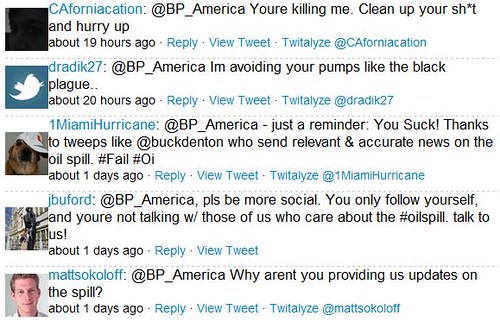
As one would expect, BP is taking a severe beating in social media right now, when consumers vent their frustration with the effects of the disaster. On Twitter, thousands of tweets are currently being published mentioning BP in connection with the oil spill. Many of them are also directly addressing BP’s US corporate Twitter account with angry comments, suggestions and questions.

bp-oil-spill-twitter

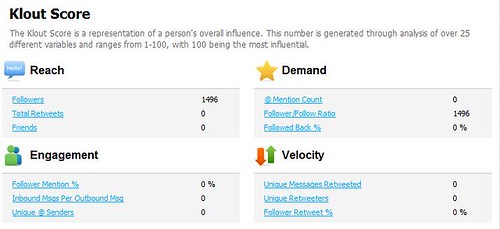
However, BP are not responding to any of those comments. In fact, the company does not communicate much at all via @BP_America. The account does not respond, retweet or follow anyone else on Twitter (see Klout score below), making it a pure one way communication channel. On top of that, the few tweets that are being published are press releases syndicated to Twitter via Twitterfeed. Nothing wrong with that, but if you publish press releases on your site in capital letters, it doesn’t land well on Twitter, where it equals SHOUTING!

bp-oil-spill

I don’t want to point fingers at BP for not using Twitter to its fullest potential in this difficult position. Instead, why not point to other stakeholders in this catastrophe that are doing things well?

BP oil spill

For example, the US Coast Guard has a Flickr account where it publishes photos and images under Creative Commons license. Images are displayed on http://www.deepwaterhorizonresponse.com/ as a slide show. In the menu of the site, there is even a section for “Social Media” which points to the U.S. Coast Guard’s presence on Facebook, Twitter and Flickr. Update: I forgot to mention that this site is being maintained by British Petroleum, Transocean, the U.S. Coast Guard, the National Atmospheric and Oceanic Administration, the U.S. Department of Homeland Security and the U.S. Department of Department.

The US Environmental Protection Agency, EPA, also uses social media. Administrator Lisa Jackson responds on Facebook and Twitter. I’m sure there are many more examples. The problem for a company in a crisis, especially when you are already in the “bad guy” position, is that when you leave an entire arena to your opponents, the damage to your brand in the long run may be worse than it would have to be. Facebook has more than 400 million members and that’s a big channel to leave unattended. If you do a search for “BP oil”, the first hit you get is the group Boycott BP Oil. As a contrast, the BP America Facebook page has not been updated since Feb 18, 2010. In other words, there is room for improvement.

Photo credit: http://www.flickr.com/photos/uscgd8/

Top 10 Twitter Cities in Europe

Twitter Grader analyzes Twitter users’ Location settings and ranks the top countries and cities in the world. Of course, this is a blunt tool since people don’t always reveal their true location and some cities are spelled differently in different languages (Gothenburg vs Göteborg). Nevertheless, it’s still interesting to see the locations with most users. From Twitter Grader’s list of top cities, I’ve created this list of Top Twitter Cities in Europe.

1. London, United Kingdom (over all rank #1)
2. Paris, France (#28)
3. Manchester, United Kingdom (#35)
4. Amsterdam, the Netherlands (#37)
5. Berlin, Germany (#38)
6. Dublin, Ireland (#51)
7. Stockholm, Sweden (#56)
8. Glasgow, United Kingdom (#59)
9. Madrid, Spain (#60)
10. Oslo, Norway (#67)

Footnote: Follow me on Twitter at @kullin

Tags: , , . Ping.

L.A. clubs co-operate on the Social Strip

I had the pleasure of being invited to the Social+Cash conference last week, which focused on how to gain business value through social media. Key note speaker was Chris Heuer, founder of the Social Media Club. One of the things I took away from the day, except meeting up with a lot of good old and new friends, was a case story from Los Angeles. This case was initially presented at SXSW in Austin, Texas, earlier this month.

The Social Strip
It’s the story about the three Sunset Strip clubs the Viper Room, the Roxy, and the Comedy Store, that joined forces to drive business via social media channels. The clubs decided in 2009 to leverage the power of their collective network. The L.A. Times Music Blog writes:

“It all started when Roxy owner Nic Adler saw the Viper Room enter the world of Twitter. He virtually and publicly welcomed his competitor to the space by announcing their virtual presence to the thousands of “followers” interacting with the Roxy via Twitter. That simple gesture of goodwill opened the floodgates of camaraderie that has helped the Roxy increase its business by 30% over last year, Adler said, and has helped the Viper Room see its regulars return.”

By using social media channels the clubs managed to revitalize the legendary bar street. For example, visitors that checked in to the Roxy on Foursquare were upgraded to VIP status. Another initiative was the Tweet Crawl, a web 2.0 version of the old pub crawl, described in the video below.

Sunset Strip Tweet Crawl on KTLA from nic adler on Vimeo.

This way of collaborating with competitors is labelled “coopetition” and you can read more about the case in this presentation on thesocialstrip.us. See also The Social Strip on Facebook.

socialstrip

Nordic communicators are lagging behind journalists in use of social media

PR practitioners and professional communicators at organizations and businesses are often experts in building good relations with journalists and other influencers that can help get their messages across to the target audience. Reading and monitoring traditional media has always been an essential part of the daily routines of PR professionals, we need to know who says what and where. With the strong growth in comsumption of social media, one would assume that most communicators had started to use social media by know, but according to a survey by Cision, there is still room for improvement.

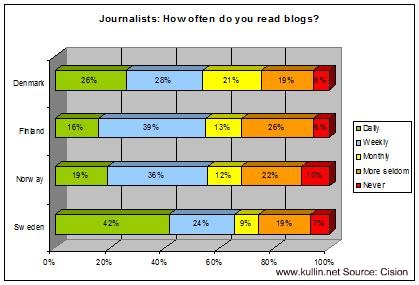
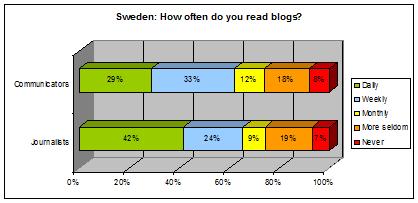
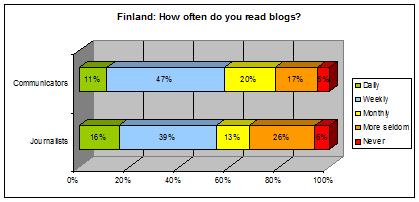
Cision conducted a survey of journalists and professional communicators in Denmark, Finland, Norway and Sweden about their attitudes to and use of social media. The survey revealed that journalists are becoming heavy users of social media such as blogs and micro blogs (like Twitter), especially in Sweden. As many as 42% of Swedish journalists and 26% of Danish journalists read blogs daily. In Norway and Finland the figure is slightly lower, 19% and 16%, respectively.

53% of Swedish journalists read blogs for research and 28% say that they blog as part of their work.

journalists-blogs-chart

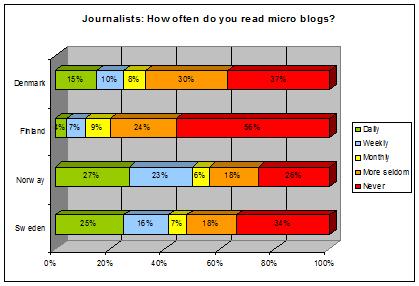
Twitter is a lot more popular among journalists in Norway and Sweden, where one in four read it daily (27% and 25%). In Finland, only 4% read micro blogs daily.

17% of Swedish journalist write on micro blogs daily. When asked “how do you work with micro blogs?”, 36% said that they monitor what is written, 36% follow interesting people, 25% publish news, 21% build relationships and 21% read for research.

journalists-microblogs-chart

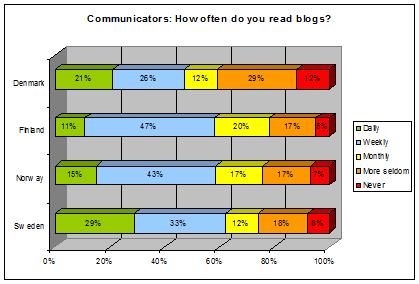
Among communicators, it is more common to read blogs in Sweden and Denmark, at least on a daily basis.

communicators-blogs-chart

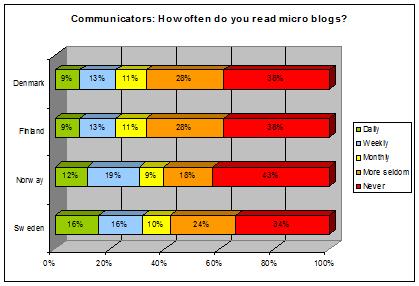
Communicators in Sweden and Norway are the most frequent users of Twitter.

communicators-microblogs-chart

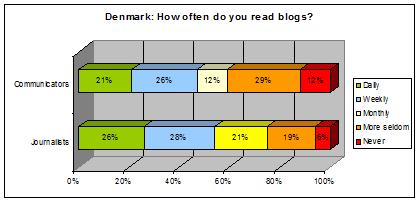
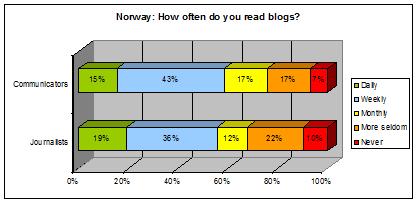
If we compare the use of blogs and Twitter between journalists and communcators in each country, we find that a larger percentage of journalists read blogs on a daily basis. This is quite interesting because it could signal that journalists are better connected to the blogosphere than professional communicators. And if as many as 53% of Swedish journalists read blogs for research (35% of Danish and 33% of Norwegian journalists) then communicators probably should put even more focus on building relations with bloggers.

denmark-chart

finland-chart

norway-chart

sweden-chart

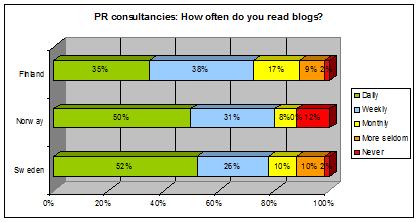
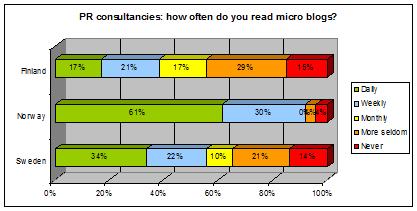
Journalists are also more frequent readers of Twitter than communicators, with the exception of Finland. If for example 50% of Norwegian journalists read micro blogs at least weekly, why are only 32% of communicators doing the same? Shouldn’t they be out there to monitor and connect with influencers on Twitter? Well, I think so. Fortunately for communicators, there are people that they can turn to for advice, namely PR consultants (yes, people like me…). It turns out, not very suprising, that the individuals that uses social media most often are PR consultants. 52% of Swedish PR consultants read blogs daily, 50% in Norway and 35% in Finland (not enough responses in Denmark). As many as 61% of Norwegian PR consultants read Twitter daily, 34% in Sweden and 17% in Finland.

pr-blogs-chart

pr-microblogs-chart

Footnote: The report Cision Social Media Survey 2010 can be downloaded here.

Tags: , , , . Ping.

Top 20 Swedish brands on Twitter

Last weekend I decided to take a deeper look at my list of Swedish brands and businesses on Twitter and see which companies have the most followers. After publishing the list on my Swedish blog “Sociala Medier”, I got some feedback from companies that weren’t on the list. Although this list may still not include every corporate Twitter account in Sweden, here is a pretty good list of the top 20 Swedish businesses on Twitter, based on the number of followers.

1. Spotify – 36020
2. Stardoll – 32252
3. H&M; – 28583
4. Adland – 14551
5. Acne – 5963
6. Ericsson Labs – 4616
7. The Duffy Agency – 4518
8. Propellerhead Software – 3071
9. SJ AB – 2745
10. Sony Ericsson DW – 2719
11. SAS – 2676
12. Ericsson – 2614
13. H&M News – 2309
14. Twingly – 2281
15. Ishotellet Jukkasjärvi – 1940
16. Pacemaker – 1583
17. SAS Group – 1495
18. SF BIO – 1492
19. Piratförlaget – 1478
20. Saltå Kvarn – 1396

Among the top three, H&M; is the account that has the fastest growth in followers, with on average 113 new followers per day during the last 3 months (according to TwitterCounter). Spotify gets 83 and Stardoll 85 new followers per day.

Footnote: Number of followers calculated on March 13, 2010. Follow me on Twitter at @kullin.

Tags: , , , . Ping.