Universal McCann present Wave 5 – the Socialisation of Brands

Universal McCann have just released the fifth installment of their global social media survey: Wave 5 – The Socialisation Of Brands. It is further evidence that social media continues to have a huge impact on brands. This time UM surveyed 37,600 active internet users (that go online every day or every other day) in 54 countries.

Decline for company/brand web pages
Among all the graphs I found the one below to be one of the most interesting. It shows how many of the respondents that visited an official brand or company website during the last 6 months and the percentage is declining quite rapidly. From 85% to 75% in the last two years. It is clear that it is becoming increasingly difficult to get consumers to visit your company website and that brands (also) need to reach out to consumers on social media platforms.

wave 5 fig 20

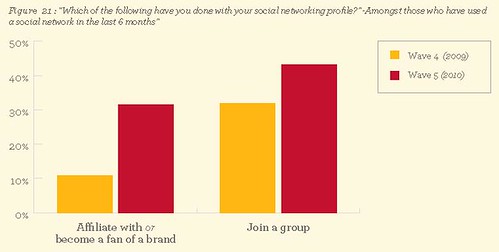
The percentage of internet users who follow or become fans of brands on social networks has increased from about 10% last year to about 30% in 2010.
wave 5 fig 21

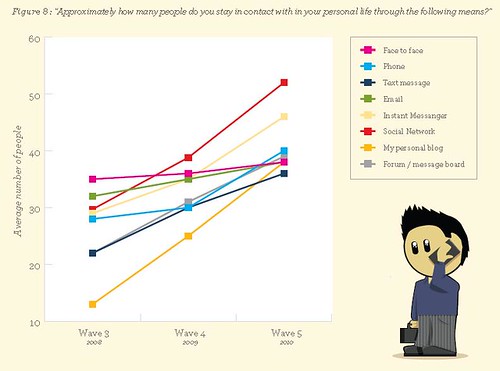
Another interesting conclusion from the Wave 5 survey is that face to face meetings is becoming the least used means of staying in contact with friends. Text messages is still used more seldom but is growing in importance.
wave 5 fig 8

The entire report can be found below.
Social Media Wave 5 – OCT2010 (Universal McCann)

Mino Raiola: Zlatan does not have a profile on Twitter

Once again, a leading news outlet has quoted a fake Twitter account, thinking it belongs to the Swedish football striker Zlatan Ibrahimovic. This time it was the Italian sports paper Gazzetta dello Sport that quoted Ibra, saying he had tweeted about a possible injury but that he calmed fans that he was ok.

Zlatan Ibrahimovic’s agent, Mino Raiola, has categorically denied that his client has an account on Twitter and Milannews.it says that Raiola once again had denied such an account exists.

“Zlatan has no profile on Twitter and, therefore, it may not have been him writing those things,” Raiola supposedly told Sky Sports. (my translation)

The account that had been quoted by Gazzetta dello Sport is @therealZlatan11, a poorly executed prank with clunky English and even some early quotes in Swedish, obviously translated with Google Translate. One tweet has translated the word “calcio” into “kalcium”, which is Swedish for calcium. In another tweet, fake Zlatan says that “the boat will win the Champions League” (“båten kommer att bli mästare i Champions League”).

Previous mistakes in the fake Zlatan category include Sky Italia and AP.

Hat tip to Expressen.

Sky Italia quotes fake Zlatan Ibrahimovic on Twitter

For some celebrities, social media has proven to be very useful communication channels that reach fans directly. They can communicate their point of view without running the risk that traditional media misinterpret or distort the message. When actor Jim Carrey announced that he and Jenny McCarthy would break up, he didn’t issue a press release. Instead, he simpy tweeted:

“Jenny and I have just ended our 5yr relationship. I’m grateful 4 the many blessings we’ve shared and I wish her the very best! S’okay! ?;^>”

With a simple tweet, he could reach millions of readers before traditional media had time to react. But not everything on Twitter is what it seems to be. Carrey has a verified account on Twitter, which certifies that it is actually The Jim Carrey that is tweeting (or someone he has hired to do so). So if a celebrity doesn’t have a verified Twitter account, you should probably think twice before you assume it is the real thing.

zlatan ibrahimovic twitter

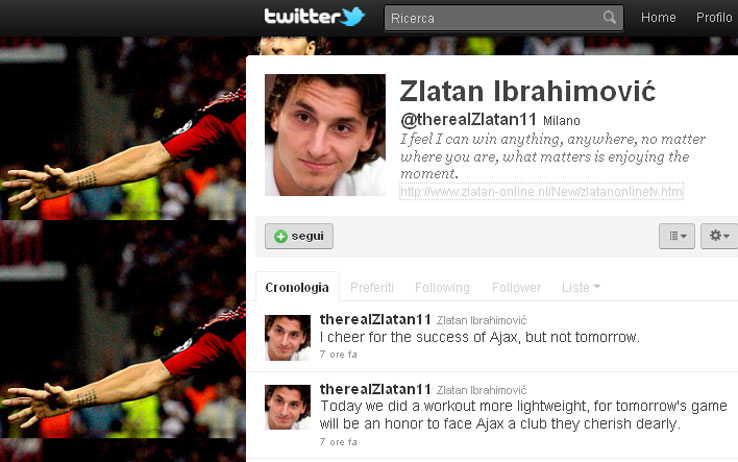
I have blogged before about how AP, Al Jazeera and a bunch of other media quoted a fake Zlatan Ibrahimovic account on Twitter. It didn’t take much work to prove it was fake. And yesterday it happened again as media started to cover the Champions League game tonight between AC Milan and Zlatan’s old club Ajax. Italian tv channel Sky Italia quoted @therealZlatan11 in an article that suggests that “Ibra” had tweeted “I cheer for the success of Ajax, but not tomorrow”.

Of course this is not the real Ibrahimovic. He has never been active online and certainly not on Twitter. You would only need to click on the link in the Twitter bio to see that the link is not to an official site, but to a rather poor fansite from the Netherlands.

If traditional media are going to use celebrities in social media as sources for news, they need to put a little more effort in to research to verify that the source is correct. Otherwise they will look pretty foolish.

Footnote: Thanks to http://twitter.com/ItalianMeetup for the scoop about Sky Italia.

Don’t mess with Sweden on Twitter

Now and then we read stories about businesses that use Twitter in ways that are creative, but not considered to be according to Twitter etiquette. Perhaps you remember when Habitat UK spammed several Twitter hashtags like #iPhone or #Mousavi, a tag associated with the Iran election, with tweets promoting their furniture? It created an uproar among Twitter users and gave the company lots of negative publicity.

Update: After a conversation with @dohop and checking the ID numbers of each tweet, I see that the tweet from @swedense came seconds before the first tweet from @dohop, giving this story a slightly different meaning. In other words, the tweet from @swedense was not directed to @dohop at all, but to several other comments on Twitter. Sorry that I hadn’t discovered that before.

Sweden on Twitter
Today I found another interesting example (hat tip to Johan Hedberg) from a website called Dohop.com, a “flight search engine”. It tried to generate business out of a very sensitive topic, namely the Swedish election. On Sunday last week, Sweden for the first time elected an anti-immigrant party into the Swedish parliament. The Sweden Democrats got 20 seats in the parliament, sending shock waves through the entire Swedish society, and the election results are not even final yet. So obviously this is not a topic that Swedes would take lightly, but it did not stop @dohop from publishing the following tweet.

twitterdohop

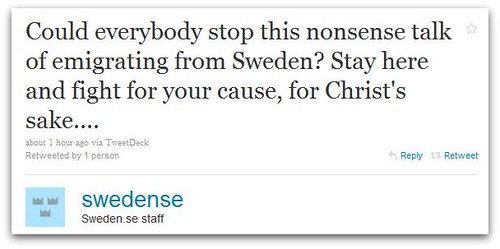
However, Sweden.se, the official web presence of the Swedish Institute, would not take that kind of tweeting about our beloved country. So it sent out this rather upset tweet.

twitterswedense

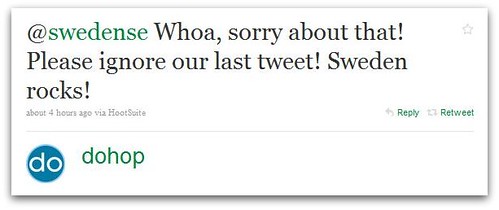
Which got picked up by @dohop, who apologized.

twitterdohop2

I don’t know if there is a moral to this story, but if you are trying to be funny on Twitter on someone else’s expense, be prepared that they might be listening and talk back. Way to go, Sweden.se!

Zlatan Ibrahimovic is not on Twitter

As the Swedish football striker Zlatan Ibrahimovic this weekend declared that he is leaving FC Barcelona for AC Milan, my blog posts about the fake “Ibra” on Twitter” has gotten tons of traffic. I guess it’s a natural reaction nowadays – a player is discussed frequently in the media and fans want to know if he is on Twitter so that they can follow his updates directly.

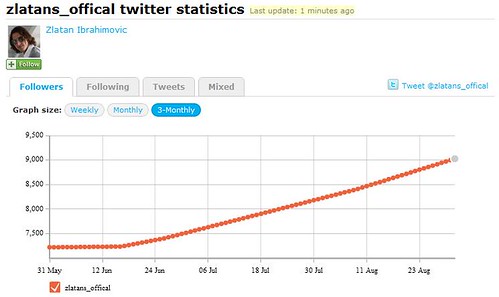
However, the first result in a Google search is a Twitter account: “@zlatans_official”, but is not the real “Ibra”. Now that doesn’t stop 9,000 people from following the fake account on Twitter. The prankster got almost 600 new followers yesterday and has gained more than 1,500 new followers in the last two months. And the account is not even active. I think that demonstrates the strong demand among consumers for direct communication from celebrities. That, and the fact that we’re all very easy to fool. (Ping AP!)

zlatan-twitter-account

Stats from Twittercounter.com. I’m @kullin on Twitter by the way. I might not be spectacular, but I’m real.

Why we follow brands on Facebook and Twitter

In April this year, I conducted the fifth annual survey of Swedish bloggers and blog readers. The survey called BlogSweden 5, included a total of 2,251 respondents, out of which  94% had at least one blog. One of the new questions this year was about why people choose to follow brands on Twitter and become a fan, or like, brands on Facebook.

Last year Razorfish surveyed 1,000 “connected consumers” about, among other things, why they “friended” brands or followed them on Twitter. The responses indicated that the primary reason was to get exclusive deals or offerings. The respondents in my survey also included internet users under the age of 18 and over 55, which the Razorfish study did not.

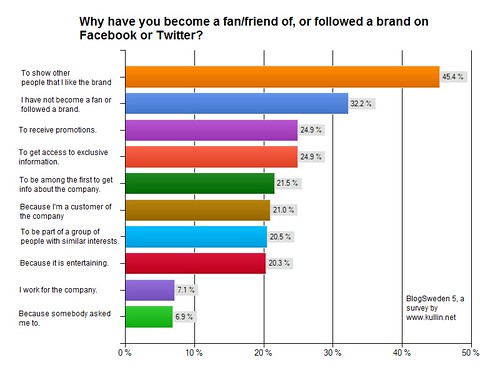
The most common response to why people become friends with or follow a brand on Twitter or Facebook is “To show other people that I like the brand”. I had expected that more tangible benefits such as getting exclusive information or promotions, would be the most common responses. Then again, we use brands to create or strenghten our identity and showing our support for a brand on Facebook might just play the same role as wearing it on a T-shirt. It tells others about who we are. Remember what Jack Trout wrote:

“People want to express themselves through brands – brands express a person’s personality and the people they like to be with.

why we follow brans on Facebook and Twitter

But we also follow brands on Twitter or Facebook to get deals or information before other people. Although the feeling of exclusivity might get lost if you are one of a million fans of the same brand, it still is a very good sign for marketers. The responses suggest that people who follow your brand on social media are already loyal customers or are interested in becoming customers.

Consumers are telling brands that they wamt to buy from you and they want to get more information about your company and products. So marketers should take note and start using social media as channels for building engagement among key audiences.

A third (32.2%) of the respondents in the survey had not become a fan of or followed a brand on Twitter or Facebook.