The Nobel Prize 2009 announced on Twitter and Facebook

Social media makes Swedish companies frustrated, according to an article in Computer Sweden this week. The companies that CS talked to all know that you can do a lot of smart things with social media, but few know where to start or have had time to come up with any specific plans. One company says it can’t afford to lead the way and “it expects more things to happen in 2010 anyway”.

I’d say that those excuses aren’t valid any longer. Blogs and other forms of social media have been around for many years now and there are plenty of examples of businesses that have used these digital channels to their advantage. It really doesn’t have to be very complicated. I like this example. The Nobel Foundation is the Swedish foundation that manages the Nobel Prize. It knows it has stories that many people around the world are interested in. That’s not new. But they are modern enough to realize that media consumers today may want that information directly from the source, through new channels like social media. Today, many get breaking news via for example micro blogs.

So as a complement to traditional reporting, consumers this year can choose to get the news about the Nobel Prizes through Twitter, Facebook, RSS or a number of other ways, including a widget that you can post to your blog.

The first announcement will be tomorrow, when it will be official who wins the Nobel Prize in Physiology or Medicine (Monday, October 5, 11:30 a.m. CET at the earliest). Just follow http://twitter.com/Nobelprize_org and you will get the news right into your Twitter stream.

Not all businesses have news of the magnitude that the Nobel Foundation has, but almost all companies have stories to tell that are of interest to a number of stakeholders. Social media can be one channel to use. So businesses need to stop hiding behind arguments like “we haven’t got time to engage in social media”. Start experimenting now. A curious and learning organization will always be better at managing change. If you always wait to next year, you will never get off the ground.

Tags: , , , , , . Ping.

Is TweetDeck the first victim of Twitpocalypse Redux?

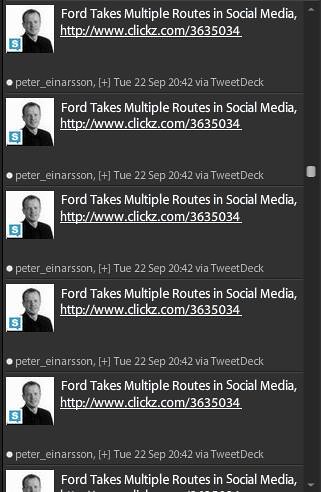
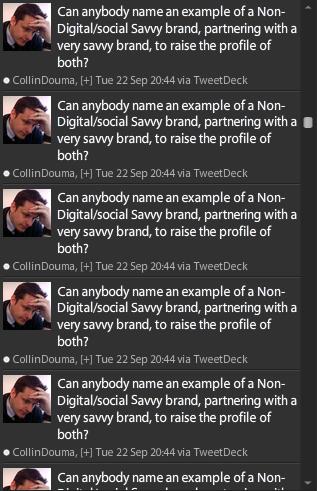
An incident labelled the Twitpocalypse (see TechCrunch for explanation) occurred this summer, when the unique identifier for a tweet on Twitter hit the number 2,147,483,647. It caused problems for several Twitter applications, among them Twitterrific, TweetDeck and Destroy Twitter. A similar incident occured today when the second Twitpocalypse, or Twitpocalypse Redux happend at 18.34 GMT. That’s the time when the unique identifier reached the number 4,294,967,295. At first, everything seemed ok, but when I looked at TweetDeck I noticed something strange. At 19.45 GMT and as far back as I could go in my list of friends (only a few minutes), TweetDeck seemed to repeat all tweets 11 times. See screen shots below.

Could it possibly be an effect of the Twitpocalypse Redux?

I have not the latest version of TweetDeck installed (it won’t install the latest version). My version is 0.25.1b.

Has anyone else noticed this?

twitpocalypse2

twitpocalypse4

twitpocalypse3

Footnote: Twhirl 0.9.2 seems ok.

Tags: , , , , . Ping.

Three Swedish blogs on AdAge Power 150

Here is a new analysis of the AdAge Power 150 list, broken down into country of origin and with a focus on non-US blogs. I haven’t blogged that frequently the last few months, so my rankings have been slipping. Still it’s great to see that Adland, Blog of Ronnestam and Media Culpa defend the Swedish colours, placing Sweden among the top non-English language countries.

AdAge Power 150 is a ranking of the world’s most influential marketing blogs.

Tags: , , , , , . Ping.

Twitter is babble, Jaiku is mundane – so what?

jaiku_logo
Here we go again. We have just recovered from the Pear Analytics study that revealed that 40% of all tweets are pointless babble. And now there is a new study out that says micro blogging is “mundane”. Researchers from Helsinki Institute for Information Technology (HIIT), Google and Elisa have studied 400,000 updates on the Finnish micro blog Jaiku and the conclusions are that:

As a consequence of the pressure to publish, most postings are mundane; The top 5 most frequent postings are “working”, “home,” “work”, “lunch” and “sleeping”.

Jaiku is a shadow of what it used to be before Google bought it and then abandonded it but either way, what if researchers find that most micro blogs are used mainly for seemingly trivial content? The personal and sometimes trivial nature is just part of what makes social media “social”, in contrast to traditional media.

In Wikipedia the term “social” is described like this. “The adjective “social” implies that the verb or noun to which it is applied is somehow more communicative, cooperative, and moderated by contact with human beings, than if it were omitted.” That means that micro blogs have a social dimension to them that make them more humane, more personal and more private than other forms of media. And that is part of what makes social media so interesting in my view. Yet another form of traditional media would not have caused this online revolution that we currently are witnessing.

And in spite of all this nonsense, micro blogs still have an impact on many aspects of business and our private lives. There are plenty of examples of people that find breaking news stories on Twitter first, and then on traditional news sites. To take another example, Twitter has a Page Rank of 9, which makes it very influential. Information that is published on Twitter is placed high in a Google search for example. So when research from Pennsylvania State University suggest that 20% of all tweets are brand related, you can imagine the impact it has on a brand’s online reputation.

A large portion of the updates on micro blogs is probably quite trivial, but with about 21,000 tweets per minute, there is still enough important content to have a serious impact on the online community.

Tags: , , , , , . Ping.

Many U.S. newspapers still don’t use common digital channels

This is quite astonishing. The American Press Institute surveyed 2,400 newspaper executives and asked if their papers “provide access to stories or information such as sports scores, headlines, stock quotes, etc via Twitter, Facebook, Email alerts, Mobile/PDA, YouTube, Kindle, Flickr, e-readers, etc.” As many as 24% indicated that they do not provide this type of content on any of the listed digital delivery channels.

The full presentation can be viewed below.

API ITZ Belden Revenue Initiatives Surveyhttp://static.slidesharecdn.com/swf/ssplayer2.swf?doc=apiitzbeldenrevenueinitiativessurvey-090914111423-phpapp01&stripped_title=api-itz-belden-revenue-initiatives-survey

View more documents from NiemanLab.

Tags: , , , . Ping.

Visit Denmark pulls fake YouTube video

There has been some buzz the last few days about a video titled “Danish woman seeking”, posted on YouTube featuring a woman holding her small child. In the video, the woman called Karen claims she had a one-night stand 18 months ago with a man which led to the birth of her son. She is now looking for the father and along the way in the video, she keeps mentioning how great Denmark is. The video has been viewed more than 800,000 times and generated more than 3,500 comments.

http://www.youtube.com/watch?v=1HCPV3-bPXQ

Karen also has a website with photo albums and guestbooks where visitors have commented for example that they have shared her story on their blogs.

But the whole thing is fake from start to finish and is a campaign by the tourism board Visit Denmark. At least until yesterday, Visit Denmark found the campaign to be a success.

– We have increased the knowledge of Denmark as a travel destination and communicated that this is an open and free society. We wanted to place Denmark on the world map and this is a good story, says Dorte Kiilerich, Director at Visit Denmark.

Naturally, I could not agree less. Deceiving people is no better in social media than anywhere else. And as expected, the video has caused a lot of controversy in Denmark where for example the Danish Women’s Association even says the video encourages prostitution.

– We promote Denmark as a free place with space. We are happy that so many people around the world have chosen to see that. We know that there are true and false stories on YouTube, and it is that message we play with when we tell this positive, sweet and rather harmless story, Dorte Kiilerich continues.

I’m amazed that the fact that there are fake stories on YouTube is taken as an excuse to come up with yet another untrue story. So it is great to see that the video has now been taken down from YouTube. The fake website is also deleted. But the spoofs remain, thank God. Check out this “reply” video called “Swedish father seeking”.

Updated: The real video found via Kristofer.

Update 2: Visit Denmark has pulled this video too. It’s odd that they are now so eager to delete a video they recently found to be such a good idea.

Tags: , , , . Ping.