Consumers use social media to put pressure on brands

Canadian singer Dave Carroll became an instant hit on YouTube when he recorded and published the song “United Breaks Guitars”. The video describing how United Airlines broke his guitar, has been viewed 5.8 million times and has become a great case story for how consumers are putting pressure on businesses via social media.

To add insult to injury, apparently United once again managed to mess up a trip for Carroll. The New York Times writes that United lost Carroll’s bag on a recent trip to Denver.

In an interview, Mr. Carroll said that for more than an hour on Sunday, he was told he could not leave the international baggage claim area at Denver International Airport, where he had flown from Saskatchewan. He said he had been told to stay because his bag was delayed, not lost, and he had to be there to claim it when it came down the conveyor belt.

“I’m the only person pacing around this room,” Mr. Carroll said, recalling how he was caught between an order from United staff members to stay and collect his bag, and a federal customs official telling him he had to leave the baggage claim area. The bag never showed.

A United Airlines spokeswoman, Robin Urbanski, said, “We will fully investigate what regretfully happened.”

Social media like blogs and Twitter enable individual consumers to voice their opinions against brands and companies. From a consumer perspective I think this is mainly positive because it gives consumers more power in a relationship that previously was dominated by companies. David is closing in on Goliath. And most incidents where bloggers write really negative comments about brands, they are doing it as a last resource. They’ve tried all the normal routes for customer complaints without success and eventually make a final effort by taking their anger out on their blogs.

Norwegian blogger Vampus today blogged about the Carroll/United kerfuffle. She writes that social media can be used as black mail against politicians, businesses and organizations, but where only part of the truth is revealed. That may very well happen from time to time, which is why companies must not automatically surrender to criticism just because it is published on a blog. The customer is not always right and if you believe the blogger does not have a case, you should say so.

A terrific example of an organization that faced serious allegations from a blogger, and handled it well, is the TSA, the U.S. Transportation Security Administration. In a blog post headlined “tsa agents took my son”, a blogger claims her son was taken away from her during several minutes by TSA agents at Atlanta Hartsfield-Jackson airport. But the TSA did not just apologize or admit wrong-doing just like that. Instead it investigated the accusations and published the findings on its blog, with CCTV footage and everything (first one video, then nine other from different angles), which showed that the claims were not true. As a result, the blogger backed down and apologized.

I think TSA would not have been able to respond so cleverly if it had not had a blog, so if you are looking for arguments why your organization should start a blog, that might be one. All in all, consumer complaints on blogs and other social media channels are going to increase (a new example today in Sweden from a blogger attacking the bank Nordea). Businesses need to monitor such comments and manage some, but there is no need to panic. With a decent strategy in place you can even survive an attack from a blogger.

Tags: , , , , . Ping.

Flickr reaches 4 billion photos

The photo sharing site Flickr today reached 4 billion photos. The growth continues to be steady and over the last 2.5 years the site has grown with half a billion new photos every six months.

Photo number 4,000,000,000 can be viewed here.

Previous milestones for Flickr:

22 Oct 04: 1,000,000
20 Apr 05: 10,000,000
15 Feb 06: 100,000,000
22 Sep 06: 250,000,000
15 May 07: 500,000,000
19 Jul 07: 850,000,000
06 Oct 07: 1,500,000,000
13 Nov 07: 2,000,000,000
17 May 08: 2,500,000,000
03 Nov 08: 3,000,000,000
04 May 09: 3,500,000,000
11 Oct 09: 4,000,000,000

Tags: , , , . Ping.

A majority of tweets positive to Obama’s Peace Prize

Share photos on twitter with Twitpic The unexpected decision by the Norwegian Nobel Committe to award U.S. President Barack Obama the Nobel Peace Prize 2009 caused a flood of reactions on Twitter. Several people in my Twitter stream were highly critical and for example Simon Sundén noted that the deadline for the Peace Prize nomination was only 12 days after the inauguration of Barack Obama. Simon also posted this photo of the front page of the Swedish newspaper Aftonbladet today. Headline “What a joke!”.

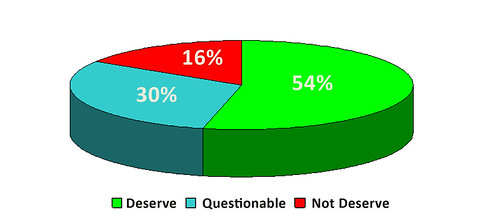
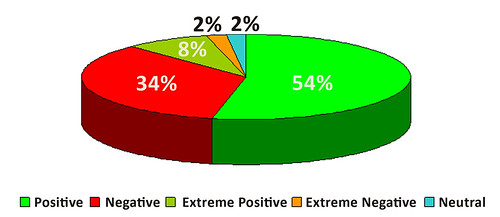
Then again, you might only see what you want to see, so it’s interesting to read this fresh study from a company called Attensity. They analyzed some 25,000 tweets about the Prize and found that a majority, or 62%, of tweets were positive.

ObamaSlide3

According to the analysis, 54% of the tweets felt Obama deserved the Peace Prize.

ObamaSlide4

I don’t know whether the results from the analysis are accurate or if they include several languages or not. But either way, it is a good example of how you can use the Twittersphere as a giant focus group. If you have the right tools, it’s possible to quite quickly take the temperature on how people react to a news story. Sure, Twitter users are not representative of the entire population but they are the ones who are vocal and influence others so it might be good to know their reactions.

Update: On the other hand, Mashable also looked at what people tweeted and found that a majority of those tweets “didn’t get it”. It is however not disclosed what methodology Mashable used. Did they just analyse those four phrases, or what? (hat tip to @Daria)

The conclusion is that there is a vast amount of data on Twitter to be analyzed, but you need to know what you’re doing, or you might just as well turn to palm reading.

Tags: , , , , , , . Ping.

Think before you retweet

It has become a standard practice to promote new cool online services by sending out invites to a lucky few users. They in turn get to invite some more and soon you’ve created a buzz online with people who are desperate to be on the bleeding edge, doing whatever it takes to get an invite. The latest craze concerns Google Wave (no, I have not been invited yet). Everyone in my Twitter stream seems to be screaming after invites to the degree that they’ve lost all sense of judgement.

On Oct 1st I tweeted “I’m just waiting for someone to use this invite craze for spam purposes #invitefatigue” and I didn’t have to wait long. There are hundreds of people currently retweeting this information:

“RT @waveinvite Just requested my Google Wave Invite! Get yours at http://waveinvite.co.cc”

The problem is that the site contains adult material and does not hand out Google Wave invites at all. In fact, the site states that it has 293 invites to give out, but that has been the case all day.

It’s amazing how many people that let themselves be fooled by this (and I admit I retweeted a similar post earlier, not this one however). The link to waveinvite.co.cc is currently the most retweeted link on Twitter. According to Tweetmeme, the item has been retweeted as many as 2789 times, and counting.

googlewave-invites

How did you suppose that you would be sent these invites in the first place when you did not supply any email address? As users of sites like Twitter, we need to be a little more suspicious to schemes like this or we run the risk of actually spreading some seriously bad stuff. The next time you see some get rich quick scheme on Twitter, please take a moment to check it out before you retweet. Do a Google search on the story, check how many others that are tweeting. Maybe you will save yourself the embarrasement of tweeting links to adult sites.

Tags: , , , , , . Ping.

10 most popular Swedish businesses on Twitter

Swedish-businesses-on-twitter

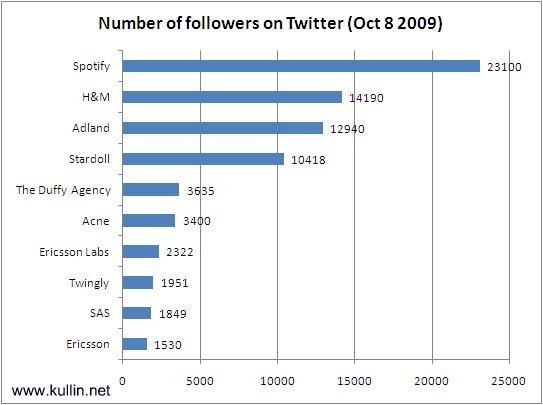
More and more Swedish businesses are joining Twitter. In a recent study (in Swedish), I checked the corporate accounts with most followers and came up with this top ten list. The graph above was updated today and the company with most followers is Spotify, followed by H&M;.

Although it’s good to have a large following, of course the number of followers is not everything. Equally important is how the accounts are managed and if companies are engaging in conversations with others.

In the study I found that the active companies are actually quite good at maintaing a dialogue with followers. Roughly speaking, 80% of the tweeting companies post updates about news or announcements. Almost as many, 74% use Twitter to respond to feedback, answers questions or handle customer complaints. 32% use it for promotions and 6% use Twitter for rectruiting/HR purposes. This is quite a contrast to the notion that a large portion of tweets are pointless babble. At least businesses are trying to add meaningful information to Twitter.

Footnote: Stardoll and Ericsson Labs were not included in the initial analysis, but were added today. Hat tip to @beantin for the pointer to Ericsson Labs.

Update: A list of more than 160 Swedish corporate Twitter accounts can be found here. Feel free to add to the wiki.

Update Oct 8: Added Adland to the top list. Thanks @dabitch.

Tags: , , , , , . Ping.

Ideal length of breaking news tweets is 120 characters

About one hour ago, the Nobel Foundation announced that Elizabeth H. Blackburn, Carol W. Greider and Jack W. Szostak received the Nobel Prize in Physiology or Medicine, 2009. As I blogged yesterday, the Nobel Foundation announced this via Twitter, as a complement to other channels.

nobelprize2009

I think it’s great that the foundation wants to experiment with social media. But regarding the tweet, I have one tiny comment and that is, if you know you have something to announce, that many people will retweet on Twitter, you should ideally make room for that in your original post. Otherwise you are forcing people to change your message, in ways you might not want. For example by deleting the link to the original post.

The tweet above is 136 characters long. For someone to retweet this with the @nobelprize_org included, the new tweet will be at least 155 characters, including “RT” and spaces. This is of course too long, the maximum is 140 characters. In other words, the ideal length of a breaking news tweet is about 120 characters.

Tags: , , , , , . Ping.