Participation in social media increases but Sweden is lagging the US

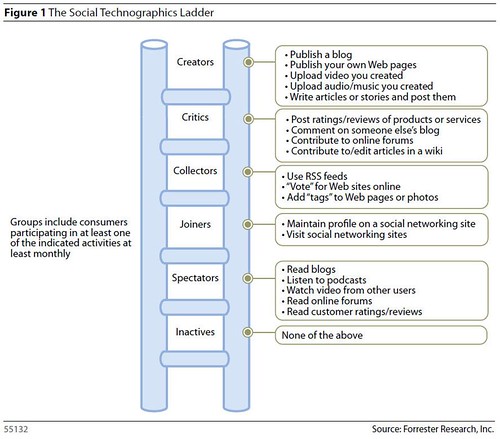
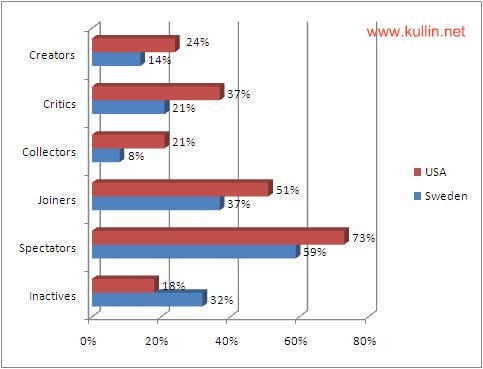
Forrester Research has just published its third annual study about consumers’ participation in social media. The data from the US is available and indicate that the digital divide is closing. Consumers who are participating the most in social technologies are labelled Creators, Critics and Collectors and all three groups have either grown moderately or are at the same level as last year. Instead the inexperienced groups called Joiners and Spectators grew rapidly. As many as 73% of online Americans are now in the group Spectators, which means that they read blogs, listen to podcast or watch videos from other users.

The inactive group decreased from 25% to 18% of the online US population.In the age group under 35 only 10% are Inactive.

social ladder by Forrester

According to the research data for Europe, “The Netherlands and Sweden have the most participation, Italy has the most Creators, and social networks are most popular in the UK.” But Sweden and Europe is still lagging the US. A comparison between Sweden and the US looks like this:

socialladdersweden

Participation in social technologies are growing fast and as author Josh Bernoff at Forrester writes: “Marketers, if you’re not doing social technology applications now, you’re officially behind.”

You can also check the data for individual contries on this widget.

Tags: , , , . Ping.

Controversial captchas

A captcha is a sort of form that visitors fill in on sites in order to stop responses generated by computers. Different distorted passwords are generated as either a combination of words or just a series of symbols. Sometimes though, the automatically generated captchas are somewhat unfortunate. This is what I got yesterday when signing on to Twitter.

eugenics

To say that eugenics is controversial is an understatement.

Tags: , , . Ping.

Unofficial pages attract Usain Bolt fans on Facebook

I spent the weekend in the archipelago on the Swedish east coast and drove for about three hours to get back home on Sunday evening. We arrived only five minutes before the start of the 100 metres final in the World Championships in Athletics in Berlin. I sat with my two oldest kids and watched the amazing new world record (9.58) set by Usain Bolt and it was a magical moment that I will remember for many years.

Usain Bolt When we get to experience such an amazing performance we sometimes like to show our graditude and support for the athlete. After 9.58, more people will become fans of Usain Bolt and search for information about the fastest man on earth. His own website is of course one such place, but people will also want to become fans of Bolt on Facebook for example. But there are as many as 62 pages for Usain Bolt on Facebook, which one is the official page? Well, there is one page with more than a million fans and it appears to be some kind of official page. It contains a lot of information and it can be reached via the personalized URL http://www.facebook.com/Usain, so it appears to be legitimate.

Another fanpage has managed to attract 127,000 fans, and there are several others with a few thousands Bolt fans. Others are piggybacking on celebrities by “borrowing” their names on different social networks. For example, someone called Jimmy Hawarny has managed to get the personalized URL http://www.facebook.com/UsainBolt for his personal page. And there are several Usain Bolts on Twitter, none which seems to be the real one. While Twitter has tried to solve the problem with fake accounts by creating verified accounts, to my knowledge, Facebook has no such indicator that a page is “official”.

One the other hand, creating fake fan pages is a violation of Facebook’s terms:

Fake Pages and unofficial “fan pages” are a violation of our Pages Guidelines. If you create an unauthorized Page or violate our Pages Guidelines in any way, your Facebook account may be disabled.

Unofficial fanpages may not be a huge problem, in fact they may even become the biggest asset for a brand or a celebrity. The biggest fanpage for Coca-Cola on Facebook has attacted well over 3 million fans, and it was started by two regular Facebook members who had trouble to find a legitimate Coke page. The page has also been embraced by the Coca-Cola Company.

In the case of Usain Bolt, it’s not extremely hard to find the official page, even though hundreds of thousands have become fans of unofficial pages. But when there are so many unofficial pages, maybe it is time for Facebook to launch some form of Verified Pages? Just so that you know what’s what.

Update: In a Google search, the page with 1 million fans and the page with 127,000 fans are both presented as official: “Welcome to the official Facebook Page of Usain Bolt. Get exclusive content and interact with Usain Bolt right from Facebook.”

Tags: , , , , , . Ping.

Hey TechCrunch, Sweden is not the worst greenhouse gas emitter

Tjörn bridge, Sweden. Photo: Fredrik Stålhandske, Sweden.se 2008

A blogger writes a provocative post with claims that turn out to be completely false. It happens every day, why should I care? Well, if the blog in question is no other than TechCrunch, things start to get a bit problematic. The site is so influential that its content reaches many thousands of people. As you may have read in my previous post, TechCrunch posted an article on July 31 claiming that Sweden and Canada are among the worst emitters of greenhouse gases in the world. This turned out to be at least partly bogus but TechCrunch shows no interest in correcting the misleading information.

Actually I don’t really care if people lose trust in TechCrunch, but when disinformation about my country keeps on spreading across the web, I feel I need to raise my voice. The false article is bad enough, I could live with that. But due to the authority of TechCrunch and the behaviour of its readers, the false statements continue to have an impact for a very long time. Here’s why:

– As seen on Techmeme, Twitter users are still retweeting links to the article so the lies keep reaching new people. In total at least 220 retweets so far.

– The article has been dugg 110 times on Digg and I’m sure it has been shared on many other different platforms during the last few days.

– All this sharing helps place this story high on Google. For instance, in a search for “worst country greenhouse gas” the TechCrunch article comes up first. A search for “Sweden greenhouse gas” shows the article on top as a news result, with three more mentions in the first ten results. There is an obvious risk that the false facts will stay around and influence people’s opinions and views about Sweden.

There is really no need to add more proof, all the arguments and links are clearly available in the comments to the TechCrunch article. But just to point out how ridiculous statements like “So who are the worst offenders? Topping the list is Sweden!” are, I have compiled two tables below.

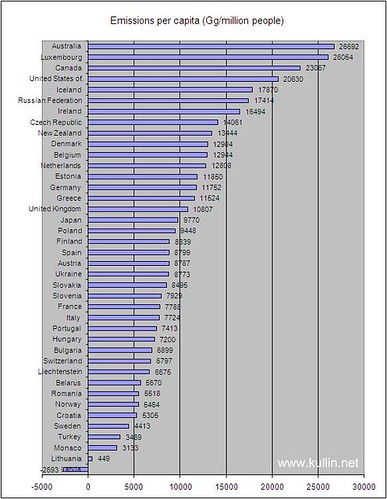
As TechCrunch actually noted further down in the article, USA is the country among the 42 in the report that emits most greenhouse gases. But a more fair comparison of course is to look at how much gas each country emits per capita. So I took the liberty of compiling a table of the 42 countries, based on the total emissions for 2006. Population numbers from the Population Reference Bureau (pdf).
tc1

The tables show that Australia is topping the list, which is due to a high reliance on coal to generate electricity. The US is in the top along with Canada, with Sweden at the very bottom.

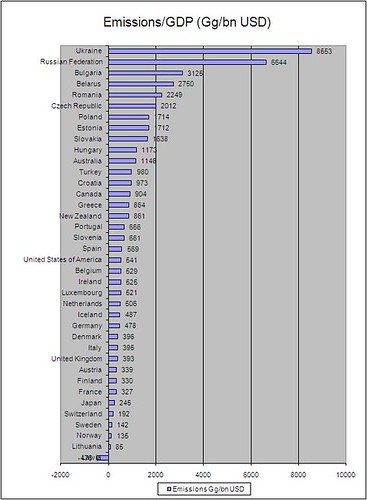
Another way to illustrate how much greenhouse gas a country emits is by looking at the amount of emissions divided by GDP. That could illustrate the ability of a country to generate wealth with a small impact on the global environment.

In the following table, countries in Eastern Europe are the worst, while again Sweden is at the very bottom.
tc2

If you feel like I do, please continue to comment the article. You can also blog about greenhouse gas emissions and link to a trusted source (like some of the links above) so that the correct information climbs in the Google results. You can tweet about the story and include the hashtag #techcrunchfail.

Don’t sit back and let this insult stand unchallenged.

Additional links:
Sweden does the most of any country for tackling emissions of greenhouse gases.

Updated Swedish data: (zip file).

Photo credit: Fredrik Stålhandske, Sweden.se 2008

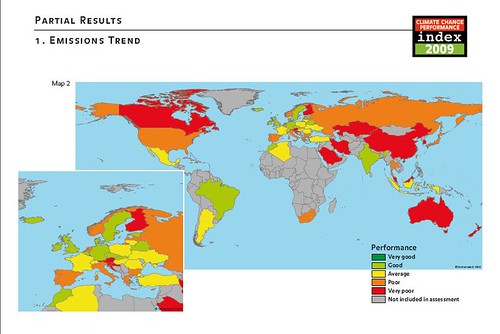
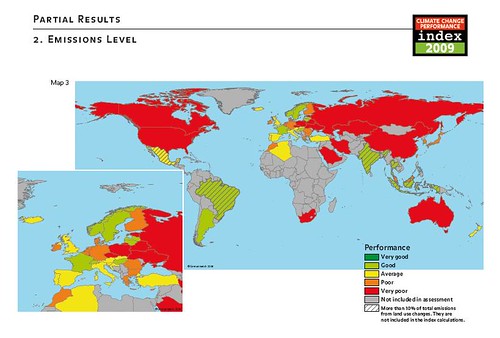
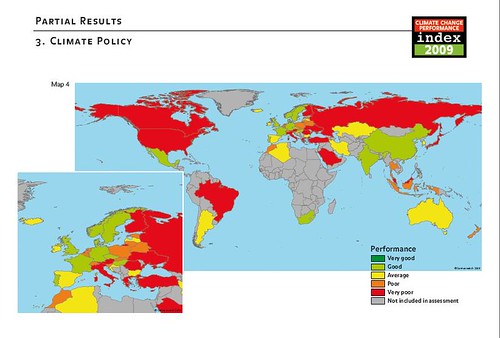
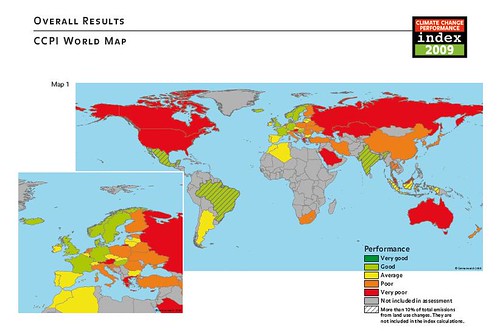
Updated with graphs from Sweden tops the Climate Change Performance Index 2009 (pdf).
climateindex09a
climateindex09b
climateindex09c
climateindex09d

Tags: , , , , , , , . Ping.

Can you trust TechCrunch enough to share their stories?

TechCrunch is the second most influential blog on the planet according to Technorati and with such authority comes a huge responsibility. Thousands of readers read the content and spread links to newsworthy articles to even more readers via Digg, Delicious, Twitter and so on. Unfortunately many people only scan headlines and quickly read the through the content which means that if a story is not correct, misleading information quickly spreads across the web.

TechCrunch yesterday published a story with the headline “Google Maps Don’t Lie. Sweden And Canada Among Worst Greenhouse Gas Emitters.” How sensational, those self-righteous Swedes are worse than Americans. Yay, I can keep my Hummer. Such a provocative headline obviously appeals to a lot of people who share the story with their friends. Tweetmeme has tracked 166 tweets about the article so far and most of them just recycle the headline and the link. The problem is that the entire story is bunk for several reasons.

First of all, the data that the article is based upon shows that Sweden has had the highest increase (in percent) in green house gases from 1990 to 2006 (with 110%). While that indeed looks bad it does not mean that Sweden a) emits most of all countries or b) emits most per capita. To the contrary, a quick look at the data reveals that the US and many other countries emit many times more per capita than Sweden.

Second, as is revealed in the comments, the map is based on incorrect data. Sweden has produced a new report with updated data that show that Swedish emissions in 2006 were at level with 1990 (zip file). In other words, not even an increase compared to 1990.

The first point above is just the result of poor journalism by TechCrunch, but the second point is harder to foresee. But readers quickly pointed out the first mistake that the writer Erick Schonfeld had made so it wouldn’t have been especially hard to correct the misleading headline and content. But Schonfeld apparently didn’t see it that way, instead he posted denigrative responses to reader comments.

“Do you dare question a Google Map?”

“Where did you learn to read, Sweden?”

“That is the default map. Go petition the UN (or Google) if you think it is misleading.”

Instead of doing the right thing and using the input from readers to improve a poor article, TechCrunch chose to leave incorrect statements up on their site. Instead of subscribing to Dan Gillmor’s view that “my readers know more than I do”, TechCrunch apparently think that their readers are idiots (and that Swedes can’t read).

Any leading publication today, be it a blog or a traditional newspaper, must take responsibility for the content they publish if they want to keep any sort of credibility. Everone makes mistakes, but news is shared at lightning speed today and if you are the source of incorrect information that spread across the web, you should do everything in your power to stop the false information from spreading any further. If not, how can anyone trust you in the future?

I didn’t expect this kind of behaviour from a leading blog in 2009. Big fail.

Tags: , , , , , , , . Ping.

AP quoted fake Zlatan on Twitter

What do Associated Press, Al Jazeera, SVT (Swedish television), Sydsvenskan and Shanghai Daily have in common? They were all fooled by a prankster pretending to be Zlatan Ibrahimovic, the Swedish football striker, on Twitter.

AP seems to be the origin of the story which spread across mainstream media last night. Sydsvenskan writes that “according to AP, Zlatan is quite talkative on his twitter-blog” and quotes one tweet saying “I have won everything in Italy, its time to move on! I want the champions league title!”.

Shanghai Daily writes: Ibrahimovic appeared prepared to accept the move after writing “time to learn Spanish” on his Twitter page.

But if you have any knowledge about Ibrahimovic, you would do at least a little research before assuming that he is on Twitter. Microblogging would be a very un-Zlatan like thing to do since he keeps his private life to himself and for years have not have had a decent official webpage.

The first thing you would do is check if the Twitter account is a Verified Account. Sure, verified accounts have just recently been introduced for Twitter but it is a good way to secure that celebrities are the ones actually tweeting.

The second thing to do would be to search for Zlatan and Twitter on Google. That would immediately have revealed my blog post from June 22nd, which shows that in fact the Zlatan account is fake. For example, the “mobile photos” that he has posted are taken from a photo agency and from a TV documentary on YouTube.

This morning, Italian media write that Zlatan confirms that it is not him on Twitter. A Google translation of an article in Correire dello Sport:

“Zlatan Ibrahimović denies that he wrote the message on Twitter in which he expressed the intention to leave Inter. Swedish – as reported by the press Inter – said that they had not written anything on the site of microblogging. Ibrahimovic aims to trace the author of the ‘post’ ( ‘I have won everything in Italy, and’ Time to change. I want the Champions League! ‘) And see if there are means for obtaining financial compensation.”

Hat tip: Robert Laul and David Hylander.

Tags: , , , , , . Ping.