This press release made me curious. The Swedish National Tax Board (Skatteverket) will host a press conference tomorrow to report about the first year results of a three year project regarding e-commerce. One of the topics during the meeting is “new risk areas such as sms loans and bloggers” (Nya riskområden som sms-lån och bloggare). Should be interesting to hear how bloggers could be of interest to the tax authorities. The handful of bloggers that actually make money from blogging should not be too hard to identify, but maybe this could be a growing problem?
Author: kullin
BloggSverige 3 – unga kvinnor tar över
Mellan den 1 och 2 januari genomförde jag en online-enkät där 1000 svenska bloggläsare och bloggare svarade på frågor kring bloggar och sociala medier. Rapporten BloggSverige 3 är den tredje i ordningen och en uppföljning på BloggSverige 1 och 2 från 2005 och 2006.
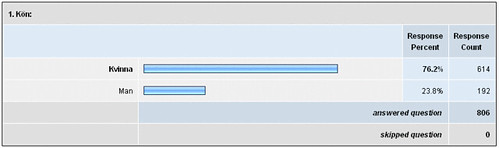
Här redovisas nu svaren från de personer som själva har minst en egen blogg (totalt 806 personer).
Den typiska svenska bloggaren i enkäten är:
• kvinna
• 16-20 år gammal
• läser 1-5 bloggar dagligen
• spenderar 1 timma per vecka med att läsa bloggar
• läser oftast bloggar på kvällstid (ca 18-24)
• använder aldrig en RSS-läsare för att läsa bloggar
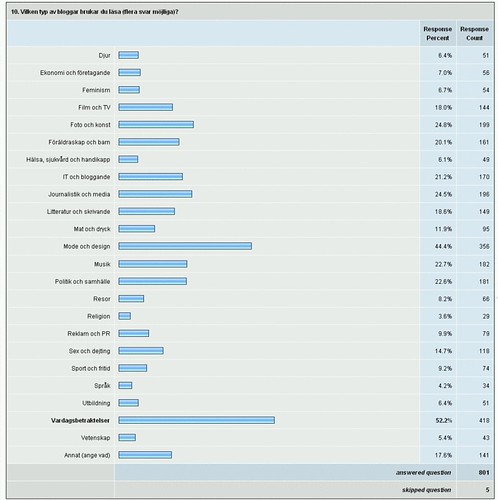
• läser helst bloggar om vardagsbetraktelser
• läser bloggar för att bli underhållen
• har aldrig klickat på en annons på en blogg
• är medlem i ett socialt nätverk för att hålla kontakt med kompisar
• har de senaste 12 månaderna laddat ner musik från internet, lyssnat på radio eller podcast på internet, tittat på eller laddat ner video från internet, har gjort bilder tillgängliga för andra på internet, har kategoriserat innehåll på internet
• har de senaste 12 månaderna inte gjort videofilmer tillgängliga på internet, sparat länkar med hjälp av bokmärkessajter eller besökt virtuella världar
• bloggar för att hon gillar att skriva
• uppdaterar sin blogg varje dag
• har inget emot att bli kontaktad av företag i sin egenskap av bloggare
• är inte anonym
• har inte egna annonser på sin blogg
Kvinnorna är nu i klar majoritet bland bloggarna.
När bloggare bildar sig en uppfattning om ett företag så anser de att ”en person som jag själv eller en vän” är den mest trovärdiga talespersonen. En annan bloggare anses lika trovärdig som företagets egna vd.
En av tre bloggare har köpt en vara som en följd av rekommendationer på en blogg. Lika stor andel har avstått från att köpa en vara. En av tre har efter att ha läst information på en blogg vidtagit en åtgärd i syfte att påverka ett företag eller en politiker i en viktig fråga.
Vardagsbetraktelser är fortfarande den typ av bloggar som flest är intresserade av, men modebloggarna har gått starkt framåt och är den klart mest populära kategorin bland kvinnliga bloggare och bloggläsare.
Rapporten BloggSverige 3 finns att ladda ner i pdf-format här. Diskutera gärna de olika frågeställningarna i Media Culpas grupp på Facebook, där även en del bilder redan ligger uppe.
Fotnot: Lägg gärna till etiketten “bloggsverige3” till eventuella blogginlägg som rör enkäten.
Tags: social media, surveys, enkät, sociala medier, bloggsverige3, bloggar. Ping.
One in two teens have been harrassed online
Kairos Future have studied youth between 14 and 18 and their views about online integrity on behalf of the Swedish Data Inspection Board. Some interesting findings include:
– About half of the respondents 51 % say they have been thinking about information concering their private life.
– 54 % say that someone has written nasty things about them online.
– They are more willing to reveal religious and political views than personal information like who they are in love with.
– Girls are more active bloggers than boys.
– Girls are more reluctant (71%) to reveal other personal information than their names online, than boys are (58%).
– 17 % of Facebook users regret they have put up a text or a photo on the social network. It is more common among girls than among boys.
Full report here, in Swedish.
Consumers produce commercials for Apollo
The Swedish travel operator Apollo invited consumers to produce commercials for Apollo. The best video clip has now been chosen and awarded a gift voucher worth 35,000 kronor (3,700 euro). More than 100 videos were uploaded to the campaign site during the competition.
One film got as many as 5,959 views and a total of 736 blogs and 132 people on Facebook referred (“hänvisade”) to the site, according to the press release. However, these figures are very hard to verify. Searches on Knuff.se and Technorati only show two or three links to the site.
Aftonbladet to launch Facebook-like community
The Swedish tabloid Aftonbladet is about to launch a new community on its website, reports Dagens Media. Readers will get their own Facebook-like profile pages where all activities will be visible. In the future, profile pages will for example contain users’ comments to articles (Aftonbladet.se does not currently allow comments to articles, but does show links to blog posts). According to Andreas Aspegren who is responsible for the project, the profile pages will include a guestbook, a messaging feature and a photo album.
Advertisers will be offered the possibility to purchase targeted ads on user pages. Due to recent security issues (Aftonbladet was the victim of a hacker attack recently) the community has been delayed. A possible launch date is within the coming two months.
Aftonbladet is also working on a new advertising model in which revenue would be shared with bloggers, like the free daily Metro already does.
More trust in business than in government says Trust Barometer
The international PR agency Edelman today released their ninth Trust Barometer which showed that the respondents (3,100 representatives of the “opinion elite” – college-educated, wealthy, well-informed individuals in 18 countries) have more trust in business than in government, in 14 out of those 18 countries.
“Global companies headquartered in Sweden, Germany, and Canada are the most trusted; companies headquartered in China, Mexico, and Russia are on the bottom of the list”, the press release says.
The entire study will be presented at the World Economic Forum that opens on Wednesday in Davos. Another interesting finding is that “a person like myself” is the most trusted source for information (58% trust “me”, slightly above financial/industry analysts at 57%, academics at 56% and healthcare specialists at 55%). Respondents also have more trust in a regular emplyoee than in the company CEO.
If you bear with me for a few more days I will give you the views of Swedish bloggers on the same topic. In my BlogSweden3/BloggSverige3 survey of 1,000 Swedish blog readers I also asked who they trust most as a spokesperson for a company. I am soon done with the report, so stay tuned.