Zlatan Ibrahimovic is not on Facebook, but his fans are

Portuguese footballer Cristiano Ronaldo uses both Facebook and Twitter to connect with fans. His official fan page on Facebook just reached 20 million “likes”, which is an amazing number. His Twitter account has close to 1.8 million followers.

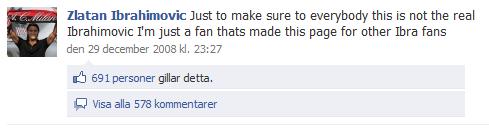
The Swedish footballer who is closest to Ronaldo’s star status is AC Milan striker Zlatan Ibrahimovic, but as I have blogged before, he is not active on Twitter. Apparently he and/or his agent don’t bother too much about protecting the “Ibra” brand online. By the looks of it, he is not in control of the domain name zlatanibrahimovic.com and he has left Twitter open to a range of imposters. So what about Facebook? Well, for starters, he has not grabbed the vanity URL www.facebook.com/zlatanibrahimovic. It belongs to one Aymen Ak. An official page is nowhere to be found.

As is often the case, fans take matters into their own hands and create “fan” pages. The largest one currently has 725,000 fans and a community page has more than 100,000.

Zlatan Ibrahimovic facebook fan page

I don’t know if Ibrahimovic is just not interested in talking to his fans, is satisfied with his current “level of stardom” or if he has the wrong advisors. Either way, I am convinced that he could strengthen his brand even further if he would start to engage just a little with his millions of fans through social media. Better to start now, than after the career has ended.

Twitter census finds 91,000 users who tweet in Swedish

In June 2009, I estimated that there were 75,000 Twitter users in Sweden, based on data from a survey by Sysomos. Since then, no one has had a good answer to the question “how many Swedes use Twitter”. Until now, that is. This morning, Intellecta Corporate presented a Twitter census in which they had crawled Twitter in order to collect all users that tweet in Swedish.

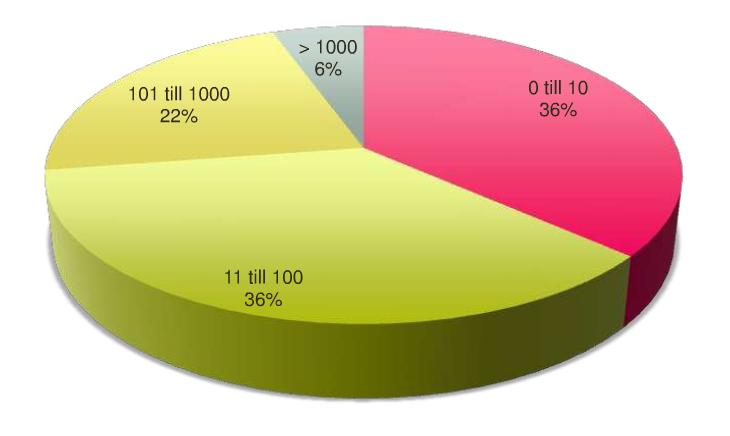
According to the report, there are 91,000 Twitter users (or rather, accounts) that tweet in Swedish, out of which only 36,000 were counted as active (at least one tweet the last 30 days and at least three tweets in total). These numbers don’t include protected accounts or users that tweet in English or any other language. That means that for example the top 9 Swedish corporate Twitter users are not included. They all tweet in English and have almost 300,o00 followers in total.

These users have tweeted a total of 25 million tweets, or on average 275 tweets per account.

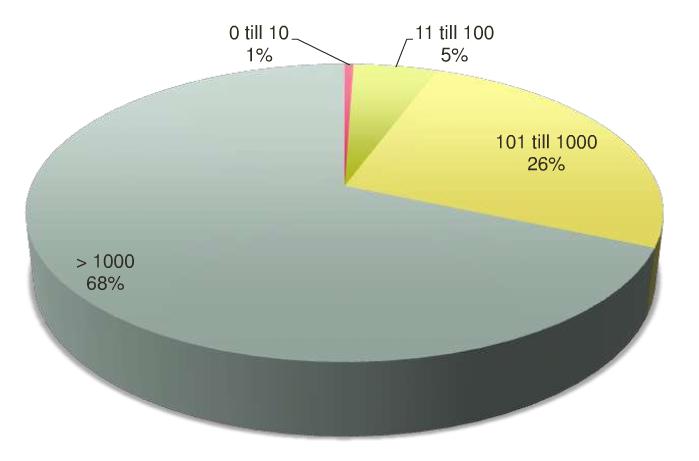
The core of the Swedish Twitterverse consists of 11,200 users who tweet at least once a day on average and have one tweet during the last month. A small portion of the users also produce the bulk of all tweets, 6 % of the users have tweeted more than 1,000 times which is 68% of all tweets from the 91,000 accounts.
Another intersting fact from the report is that there seemed to be a peak in new joiners in January 2009, but the report has no explanation to the reason behind the sudden interest in Twitter (see graph below – number of new accounts per month).
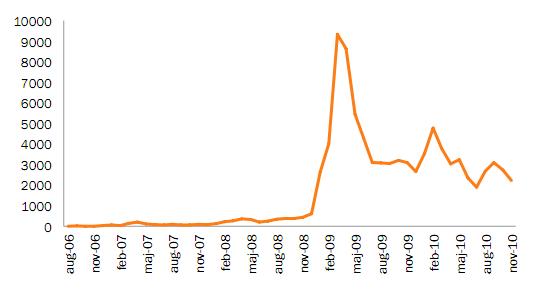
graph when joined twitter

If I can add a theory to why so many people joined Twitter this month, one reason may be the sudden shift away from the competing micro blogging platform Jaiku, which was popular among early adopters back then. In January 2009, a large portion of the Swedish Jaiku community suddenly moved away from Jaiku to, among other things, try out the new local micro blog Bloggy. I blogged back then that Jaiku over a weekend suddenly got deserted by many Swedes. It is not unlikely that this move got several influential opinon leaders to try out Twitter and/or more aggressively promote Twitter, and in turn giving it a lot of attention which encouraged others to join.

So is this a likely result? Well, it is the best we’ve seen so far and it ties in well with my previous estimate of 75,000 accounts in June 2009. According to the graph, slightly less than 40,000 new accounts have been registered since June 2009 which would make it about 115,000 today, which may not be all wrong considering that Intellecta does not count foreign language tweeters and protected accounts. These numbers are more likely to be accurate than previous estimates that said 515,000 Swedes are on Twitter.

Small but influential channel
Once concern I have from these stats is that some may conclude that Twitter is too insignificant to have any real value. To draw that conclusion can be a big mistake, since we have seen numerous cases where Twitter is extremely influential as a tool for quick distribution of information.

The results from the census can be found in the presentation below in Swedish.

Graphs courtesy of Intellecta Corporate. Full report in Swedish here in pdf.
Logo or no logo – How to brand your company on Twitter

In a recent post on the {grow} blog, Mark Schaefer discussed if brands should use a logo or a face as avatar on Twitter. The post “Your company’s single biggest mistake on Twitter” argues that brands would be better off by being more personal and use a photo of a person instead of a logotype. That would make it easier for followers to connect to the company on Twitter.

“If all you want to do is broadcast press releases, than go ahead and “go logo.” But if you want to create some authentic connection with your audience, I strongly recommend you put a face on the account.”

For larger companies or brands, I don’t think that’s a good idea. It might work for really small companies or for accounts that have a certain niche, like R&D or some other expert, but not for the main corporate account. Todd Defren yesterday published an email conversation about this topic that he had with his colleagues, and several of these arguments sound reasonable to me.

“I think a face is weird because it’s a company/entity not a person and as you say, people leave/change.  And some logos are iconic and memorable … My son knew companies by their logos before he could read, and now he is probably a Starbucks lifer.  But I might just be the oddball here.”
– Cathy

“Personally I identify with logos as well. It’s brand recognition. I don’t like Comcast or Pfizer more because they have a face or several faces (which can be confusing in itself!) associated with their Twitter handle. People identify with meaningful content, messages and customer service. That’s my two cents.”
– Melanie

“Agree on logos having a place. You can still be personable (and a person) within that brand. Consumers need to identify with you and the company that you represent.”
– Louise

The largest Swedish corporate accounts
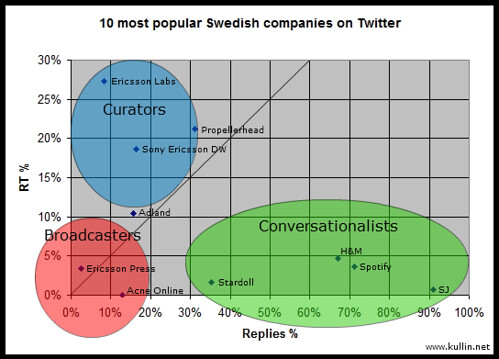
I don’t believe at all that it is not possible to engage in conversation with customers if you have a logo as avatar. Let’s have a look at some of the most popular Swedish corporate accounts. The account with most followers is H&M (@hm). As much as 67% of its tweets are replies, which shows a high degree of conversation with other users. The second most followed account is Spotify (@spotify). 71% of its tweets are replies. Another example in the top ten is SJ (@sj_ab) with 91% replies.

As a comparison, both Mark Schaefer and I have a lower share of replies: 42% of our tweets are replies to others. Of course, that is no evidence that one strategy is better than the other, but I think it shows that is is possible to engage with customers on Twitter and still use a corporate logo.

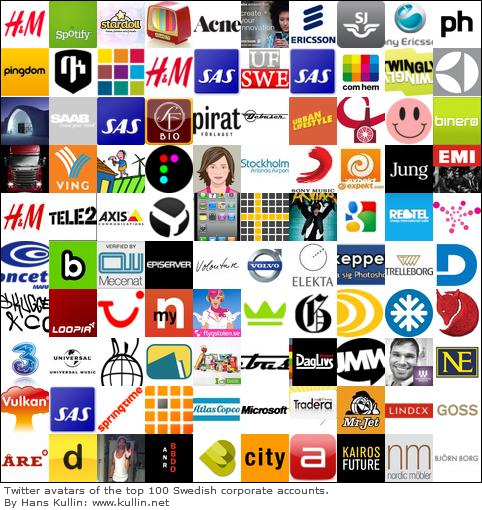
The image below shows the 100 Swedish corporate Twitter accounts with most followers, from H&M (#1) to Björn Borg (#100). Only two of them have a photo of the person behind the account. A few use an image of the product (the Ice Hotel and Scania Group), but the vast majority use a logo.

Twitter avatars

Here is our list of more than 440 Swedish corporate Twitter accounts.

Footnote: Stats of %replies from Tweetstats.com

The Star: “The Customer Is Always Writing”

More and more businesses are starting to not only monitor mentions of their brands on Twitter, but also responding to customers. This weekend I was interviewed for an article in the Toronto daily the Star, which covered that topic. The paper that is referenced in the article can be found on SlideShare and is also mentioned in this blog post, headlined “Broadcaster, Curator & Conversationalist: How businesses use Twitter”.

twitter logo

Broadcaster, Curator & Conversationalist: How businesses use Twitter

Yesterday I published a short white paper on how Swedish businesses use Twitter for their official corporate accounts. I looked at more than 350 corporate accounts and especially at the ones with most followers. These top accounts behaved in very different ways and I sorted them into three different categories, labelled Broadcasters, Curators and Conversationalists.

Broadcasters

Mainly use Twitter to publish messages, often with automated feeds from other sources, such as Facebook or press releases. Rarely engage in conversations, answer questions or retweet other users’ tweets. Low share of retweets and replies.

Curators

Actively filter and select the most interesting content on certain topics and share with their followers. Are thought leaders who mix their own expertise with retweets of other sources in the community. High share of retweets.

Conversationalists

High degree of interactivity with other users. Often use Twitter as a tool to help customers, answer questions and engage with the community. High share of replies.

Twitter graph

Depending on which of these categories a corporate account falls into, the way the company staffs its Twitter account also varies. I would imagine that it doesn’t take a lot to become a Broadcaster, just add a number of your own sources that automatically feeds into Twitter, plus the occasional manual entries and you are all set to go. To become a Curator, you would possibly need a person or a team that are some kind of thought leaders, who are interested in the company, the products and the industry. People who read a lot, who like to be in the forefront and lead the way forward. For Conversationalists you typically need a team that can be online constantly and are able to network within the organization so that they quickly can find the answers to customers’ questions.

What other skills do you think are necessary for each of these types of Twitter profiles?

Curators and Conversationalists – a study of 350 Swedish corporate Twitter accounts

Twitter is one of the most popular and fastest growing social media services. As more and more people share information in real-time on Twitter, the more important it becomes for businesses to have a presence on Twitter. According to research, it is more common among Fortune Global 100 Companies to use Twitter than Facebook, YouTube and corporate blogs. Now that more and more Swedish businesses start to tweet, it gets interesting to study how they use Twitter. For that reason, I have compiled a list of more than 350 Swedish corporate Twitter accounts and studied the most popular ones.

Summary
An analysis of 350 Swedish corporate Twitter accounts reveal the average number of:

  • followers: 1,240
  • following: 480
  • tweets: 710

First registered account: Fleecelabs (@fleecelabs) which was registered on Jan 29, 2007.

Account with most followers: H&M (@hm) – 82,100

Account that follows most other accounts: Spotify (@spotify) – 16,500

Account with highest Klout score (influence): SJ (@SJ_AB) – 65

Account with most tweets: Ving/sistaminutenARN: (@sistaminutenARN) – 24,300

Account with highest followers/following ratio: H&M (@hm): 1,400 times more followers than following back.

60 accounts have more than 1,000 followers.

The ten most popular accounts, in terms of number of followers are:

  1. H&M (@hm) – 82,100
  2. Spotify (@spotify) – 72,000
  3. Stardoll (@stardoll) – 51,100
  4. Adland (@adland) – 21,400
  5. Acne Online (@acneonline) – 14,600
  6. Ericsson Labs/Tor Bjorn Minde (@ericssonlabs) – 10,800
  7. Ericsson Press (@ericssonpress) – 6,100
  8. SJ (SJ_AB) – 5,900
  9. Sony Ericsson DW (@sonyericssondev) – 5,900
  10. Propellerhead (@propellerheadsw) – 5,700

For a full list of live data with Swedish companies on Twitter, go here: http://twitterlists.toolboxr.com/swedish-companies/ . The list currently has 391 Twitter accounts. Also see the Social Media Wiki: http://socialmedia.wikidot.com/twitter-se

Read the report: