Millions becomes billions becomes deleted article

While we are still puzzled over why Dagens Media has closed its blog, we can find another example today of an online publication that deletes an article that didn’t turn out the way it was supposed to.

DagensPS made a re-write of an article in Dagens Industri (not online, but reported here by Dagens Nyheter, and no, not all media in Sweden are called something with ‘Dagens’, only half of them are…). The article in DI talks about the re-branding of FöreningsSparbanken to Swedbank and how the bank had invested 46.5 million kronor (about 5 million euro) in Q4 2006 in advertising. But DagensPS got it wrong and wrote that the bank had invested 46.5 billion kronor, a sum that is 50 percent higher than the total of all advertising spending in Sweden during 2006 (30 billion kronor).

“Swedbanks nya varumärke har kostat banken mångmiljarder
Swedbanks namnbyte har kostat 46,5 miljarder kronor i medieköp.”

When the mistake was discovered the article was simply deleted from the site, although a plug for the article was still visible on the front page. When I check back just before lunch a new version of the article is up here.

Dagens Media closes blog – info still available via RSS

After the article by and about Niclas Rislund in today’s Dagens Media, the paper’s blog Köksveckan mysteriously has been closed. Two blog posts about the Rislund kerfuffle can no longer be accessed (although Researcher has the screen dumps). If the blog has been closed “for renovation” because several journalists on the photo have left the paper, the timing couldn’t have been worse. And if it is an attempt to delete the comments made by the reporters, they haven’t done a very good job. The articles can be read in Dagens Media’s RSS feed and you can still click on the link at the bottom of each post that says “comments” and it’s all available here:

First and second article.

UPDATE: The blog is up and running again. According to a comment on Researcher it was down for technical reasons, something the paper could have been much better at communicating in order to avoid conspiracy theories like my own.

Tags: , , . Ping.

Lufthansa to sponsor Washington Post’s blog ad network

In January, Washington Post invited local D.C. bloggers to participate in a blog advertising network where the Post would share revenues with bloggers from ads sold by the paper’s sales staff. Now Mediapost reports that Lufthansa has signed up as a sponsor of the travel category and Lufthansa’s ads will run on all 100 travel blogs in the network. This makes the airline the first advertiser to sponsor an entire vertical category.

Monkey business at Västerbottens-Kuriren

Yesterday Eniro bought Bubblare.se, today local Swedish daily Västerbottens-Kuriren announced that it had acquired 51 percent of Apberget.se (“Monkey Mountain”) for 10 MSEK. Apberget, which was launched in 2003, is a local community site with presence in four northern Swedish cities. It is aimed at the 12–25 age group and is currently one of the ten most visited sites in Sweden with 33 million page views per week.

The other guy blinked – how bloggers “won” the news war

Last week I compared three different tools for tracking blog links, Twingly, Technorati and Knuff. Twingly is a new service that for example the daily newspapers Dagens Nyheter and Svenska Dagbladet use to show most blogged articles.

Since Twingly was so new, my last post did not do the service justice. Primelabs, the company behind Twingly, now say that the numbers visible on DN.se should be more accurate. And a new search shows that Twingly tracks as many posts as Knuff.se, and far more than Technorati. The articles listed below are the five most blogged articles at DN.se as of yesterday.

Blogs posts tracked
Article Twingly Technorati Knuff
“V försöker kringgå las” 30 17 29
“Lagrådet ger grönt ljus till avlyssning” 25 13 27
“Upphovsmän kan få jaga fildelare” 35 28 35
“Fortsatta turer kring Anna Nicole Smith” 23 20 22
“Arkeologer hittade 6.000 år gammal kram” 21 8 11

Please note that these numbers only reflect links visible on DN.se. There could be links that Twingly track but are not publicly visible for one reason or another.

It would have been interesting to include Bloggportalen.se in the table above, but I have not found a way to easily calculate how many links there are to a specific article. Maybe Sigge can bring some light on the matter?

The introduction of blog tracking at DN.se and SVD.se has caused quite a stir in the Swedish blogosphere, and most bloggers support the initiative. Some raise concerns that bloggers will increase the number of links to Dagens Nyheter and Svenska Dagbladet in order to drive traffic to their blogs. I can’t see that this is neither surprising or very negative. Bloggers who’s main goal is to have a lot of visitors and be on top of different top lists will do whatever they can to add a few hundred readers to their stats. Others will manage their brand and build a reputation based on their integrity and link to these papers when they feel a need to do so, while refraining from doing it when it is not in line with the theme of their blog. None of these choices, or variations in between, are wrong in my view. These are just citizens that exercise their newfound rights to speak their mind. So instead of critizising bloggers who pimp for visitors, let’s rejoice at the fact that the leading newspapers of this country voluntarily invite YOU to be a part of the dissemination of news.

Maybe you’ve read Roger Enrico’s book “The Other Guy Blinked: How Pepsi Won the Cola Wars”, about how the invincible cola giant Coca-Cola was pressured into changing the formula to the much disliked new Coke, a gigantic fiasco. Well, I think you can look at the introduction of Twingly and similar services (like Aftonbladet/Bloggportalen) as a historic shift where media as the sole gatekeeper has become a thing of the past. With the introduction of blogs and other social media, resisting to invite readers/bloggers into the conversation in the end was meaningless. This is what we’ve been waiting for all along – the breaking up of MSM’s monopoly of news distribution. MSM blinked, in a positive manner of speaking. Sure, a lot of crap will float to the surface, but readers will learn over time where to go and who to skip (as they do when they read blogs in general), and Twingly’s ranking system might help bring the most relevant links to the top of the lists.

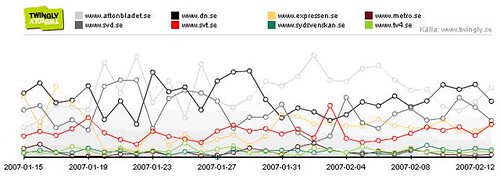
And regarding the supposed increase in links to DN and SVD, among the top blogged articles, a majority are from DN and SVD according to Knuff. But according to Twingly, there does not seem to be a huge increase in links to these two sites. So, no need for panic just yet.
twingly13feb

The newspaper is not pushing up the daisies yet

Who killed the newspaper?, the Economist asked last year. This was just one of many death sentences the last few years for the newspaper as we know it. But WAN, World Association of Newspapers, is not ready to throw in the towel. New data from WAN show that newspaper circulation is growing and new newspapers are being launched “at a remarkable rate”.

– Global newspaper circulation up 9.95 percent over five years and 2.36 percent over twelve months
– Daily newspaper titles surpass 10,000 for first time in history
– More than 450 million copies sold daily
– In excess of 1.4 billion paid-newspaper readers
– Total free daily circulation more than doubles in five years

Tags: , , . Ping.