Are PR agencies ready to rule web 2.0?

Swedish companies invest 288 million kronor (45.5 million USD) per year in social media campaigns. Well, actually they don’t. But it is an intriguing thought, if they did. According to a survey by Coremetrics called ‘Face of the New Marketer’, US marketing professionals spend 7.8 percent of their online marketing efforts on social media campaigns in Q3 2007.
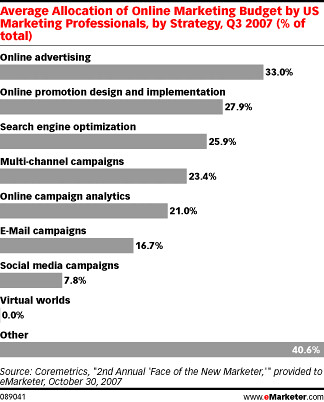
social media investments

During the same period, Swedish companies invested 924 million kronor (146 million USD) in online advertising (pdf). If the same percentage of the Swedish online budgets were spent on social media, that would be about 72 million kronor per quarter, or 288 million per year. Now, I don’t believe for a second that we are even near those figures yet but you could look at the number as the potential market for these services in the short term. Then you could start asking yourself questions like:

a) How long will it take for us to get there?
b) What will drive marketing professionals to spend on social media?
c) What type of consultants will capture the lion’s share of the spending?

And let me make a quick attempt to answer, just from the top of my head:

a) Probably longer than what is healthy for many brands
b) Communications agencies need to evangelize these services to clients, they need to show ROI and how to measure, and they need to show successful cases
c) I am convinced that PR agencies could be in the driver seat when it comes to social media.

Dagens Media’s editor in chief Rolf van den Brink asks this week whether PR agencies in Sweden are ready to handle the social media landscape. And while I think many agencies lack deeper knowledge about web 2.0, I disagree that advertising agencies should be better suited than PR agencies to tackle relations directly with customers. PR agencies are used to managing relations with different audiences and to deal with messages that aren’t directly in your control. Previously you needed to communicate via gatekeepers (read: journalists) that could distort, praise or ignore your message. In social media, your message is in the hands of the consumers. If any consultant would be able to advise clients on communicating in a transparent, chaotic, conversational media landscape, then it should be PR agencies. I don’t see advertising agencies excel in two way communication, do you?

Björn at JMW adds a few more arguments:
– PR agencies are good at assessing news value, which will also be relevant in new media.
– PR agencies are experts on producing content, which can drive the conversation.

But that’s in theory. How it is in practice, is a completely different ball game. Some agencies are already working with these matters, while others are many steps behind. So, who’s ready to make 288 million kronor?

Tags: , , , , . Ping.

Media execs: 40% of content user generated in 3 years

During the IFRA Expo, the content management company Polopoly asked 3,000 European executives in media about their thoughts on user generated content. The respondents said that they believe that 40 per cent of their content could be user generated within three years (in Swedish here). Earlier this year an Accenture study said that “media and entertainment executives see the growing ability and eagerness of individuals to create their own content as one of the biggest threats to their business”.

Disclosure: I used to work at Accenture.

Tags: , . Ping.

How to jeopardize your brand for $5.98

The US bank Washington Mutual positions itself as an informal, friendly and fun bank. But Shel Holtz’ experience with the bank when he needs to send some cash to his son, who is in the army, is neither friendly nor fun. He concludes his story by saying that “The Stanley Cup Playoffs will be held in hell before anyone in our family has anything to do with WaMu again.”

When the gap between rhetoric and reality becomes too big, today’s consumers spell it out on their blogs or on social networks, which may seriously hurt a brand. Companies, are you listening?

Tags: , , . Ping.

Are Apple spying on iPhone users?

Are Apple spying on iPhone customers? This site claims to have proof that Apple secretly track iPhone usage and IEMI numbers of all their iPhones worldwide.

“Hidden in the code of the “Stocks” and “Weather” widgets is a string that sends the IMEI of your phone to a specialized URL that Apple collects.”

“This let[s] Apple know which app you are using when connecting with your iPhone. Obviously, they know the IP address you were using, the stocks companies you are interested [in], and so they can track down their customers all around the world. This also proves that there are probably other apps that do the same. Weather.app is also acting the same way.”

Of course, from a corporate perspective it is good to know a lot about your customers, but this seems to be a big no-no.

Tags: , , , , , , . Ping.

A few technical changes to this blog

I’ve made some changes to the way this blog gets published. In order for the social bookmarks (below) to work, every blog post now also gets published as a separate page, which they weren’t before. That means that the permalinks now look like this:

http://www.kullin.net/2007/11/media-culpas-top-10-blog-pitch-pet.html

instead of this:

http://www.kullin.net/2007_11_01_mc.html#1862016548464840488

Both new and old URLs seem to work so hopefully you won’t notice any difference. But if you find som bugs, please let me know (I wouldn’t want every link to this blog to become invalid).

Tags: , , . Ping.

Flickr’s second billion took three months

The photo sharing site Flickr launched in February 2004. Yesterday the 2 billionth photo was uploaded to the site. The first billion took about 3 and a half years. The second billion took about three months. Now that’s consumer generated growth!

I made the following chart based on when certain photos were uploaded to the site and double checked with my own photos to see that the dates matched reasonably.

flickr 2 billion graph