Don’t blame the press

Norwegian defender André Bergdølmo blaims the press for Norway’s defeat against Scotland in Wednesday’s World Cup qualifiers.

– Skottene var gode. De visste hvordan vi kom til å spille, mye takket være norsk presse. Åge (Hareide) har prøvd å holde lagoppstillingen hemmelig. Likevel får dere rede på det gjennom ulike kanaler. Og når dere trykker det, føler jeg at dere dolker landslaget i ryggen.

– Det er illojalt, sier Bergdølmo.

The national coach wanted to keep the line-up secret until the very last moment, but the Norwegian press found out and printed it. Bergdølmo means that the Scots took advantage of the information and that it was illoyal of media to reveal what they knew would damage the home team. But it is not the duty of media to censor information because it would harm the national football team.

A common term in Swedish when describing media policies regarding this issue is that journalists should be “konsekvensneutrala” which means media must be neutral to the consequenses of an article. If a story is relevant from a news perspective, the fact that one party might suffer is not reason enough to stop the article. Like in this news policy from Swedish Radio “Ekot”.

Vår grundregel är att nyhetsförmedlingen är konsekvensneutral. Att en part kan vinna eller förlora på vår publicering är inget skäl för oss att avstå. Vi sänder det som är viktigt enligt relevans- och saklighetskraven. Det är inte nyhetsförmedlarens sak att ta hänsyn till vem som gynnas eller missgynnas av en viss nyhet.

Support for the home team is great, but it’s by no means mandatory. Or maybe Bergdølmo expected the same support as the Sun gave the English team before the historic 5-1 win against Germany. The paper hired a bus with a band that went to the German team’s hotel in the middle of the night and woke them up.

PS. Never forget – what Carew does with a football, Zlatan can do with an orange.
Washington Post’s smart use of Technorati

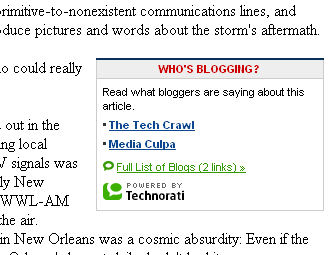
Oh, this is really neat. I only wish I had written something smarter in my previous post. Washington Post publishes links to “what bloggers say” about their online articles. It’s a very clever way of helping readers get more views on a certain topic.

Update: I didn’t realize how new this initiative was. Apparently a press release about the co-operation between Washington Post and Technorati was issued just the day before my post.

“Washingtonpost.com today announced that it has partnered with blog search company Technorati to offer its readers the opportunity to view comments and opinions about washingtonpost.com articles and editorials from around the blogosphere. The service will search millions of blogs for postings and feature links to the most blogged about articles and the liveliest web discussions on washingtonpost.com content.”

Aftonbladet – where are your RSS feeds?

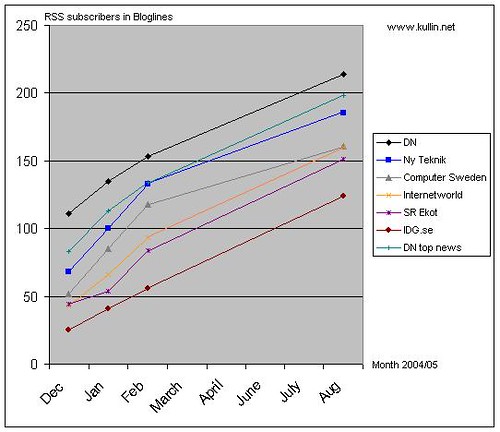
Swedish media have had RSS feeds for quite some time now and the adoption rate seems to be stable. The number of subscribers in Bloglines is growing at a steady rate and the most popular feeds now have more subscribers than the Swedish A-list bloggers do. RSS is apparently a form of consuming news from big media that appeals to a growing part of the population, although the numbers are still very small in comparison to newspapers’ normal circulation.

What amazes me is that Aftonbladet still doesn’t come with an RSS feed (or does it?) apart from a hacked feed created via MyRSS: http://myrss.com/f/a/f/aftonbladetSe32e8bf1.rss91. This little hack has 29 subscribers at Bloglines. Imagine how many subscribers an official feed would have, considering that Aftonbladet.se is the leading news web page in Sweden. Of course, one could argue that there is no economy in RSS (yet) or that the numbers are still insignificant. Sure, but why be the last to jump on the waggon? RSS will grow, I am sure of that.

It’s been a while since I checked last time, but Dagens Nyheter is still the most popular feed, in fact DN has 3 of the top 10 feeds which are (subscribers in Bloglines):

1. Dagens Nyheter (214)
2. Dagens Nyheter Senaste Nytt (198)
3. Ny Teknik (185)
4. Computer Sweden (161)
5. Internetworld (160)
6. SR Ekot (151)
7. IDG.se (124)
8. Expressen Nyheter (101)
9. Dagens Nyheter Ekonomi (88)
10. Expressen (66)

Footnote 1: I’m not counting the feeds from media blogs, only “regular news” feeds. I’m aware that Aftonbladet’s blogs have RSS feeds, but this is a non-blog post.

Footnote 2: I have seen estimates that Bloglines have somewhere between 20-35 per cent of the market. If that is true, multiply the numbers above accordingly and you get an estimate of the total number of subscribers.