A contributor on Fox News reads the address of a terrorist, which happens not to be a terrorist, but an innocent family. The Fox contributor John Loftus, once nominated to the Pulitzer Prize, was fired for the negligence, according to BoingBoing. The family has been harassed ever since, without receiving a public correction or apology from Fox News.
Category: Media & Journalism
Metro abandons Swedish correction style
Metro, the largest daily in the world outside Japan according to themselves, have decided to launch a daily correction column. Corrections in Swedish papers are normally few and not in a fixed column, rather they are published where the original article was published. This is often explained with a worry about the paper’s credibility if corrections were given too much space. The tradition in the US and UK is quite the opposite and Metro in Sweden now welcome feedback from readers so that mistakes can be corrected in “Dagens fel” (“Today’s errors”).
Editor-in-chief, Sakari Pitkänen about the previous practice:
“It is an oldfashioned way of reasoning. It was probably ok before the internet. Today the correct information is spread on blogs, mailing lists and media watchdogs on the web. There is a risk that the reader might find the correction to a mistake everywhere but in the paper that published it. That would really undermine the credibility of the paper.”
Not just another brick in the wall
There has been quite a few articles the last few days in Swedish press about graffiti artist Banksy and his latest “work” on the Israeli wall. The photos can be hard to find on Banksy’s site, but Protein has a series of photos online here. [Via Cool Hunting.]
Update: There are more than 900 photos at Flickr tagged “Banksy”.
Journalist blogs trump traditional articles in Google
You might think that journalist blogs are just a side-kick to their regular paper or online columns, but Google disagrees. These 13 Swedish journalists might soon be better known for their blogs than for their traditional journalistic achievements. In 11 out of 13 cases, a Google search for their names delivers their blogs as number one.
Andreas Ekström – #1
Lotta Gröning – #1
Cecilia Hagen – #1
Håkan Jacobson – #1
Linna Johansson – #3 (this blog has been up just one week, with the exception of one initial post a month ago)
Helle Klein – #1
Olof Lundh – #1
PM Nilsson – #1
Anders Nunstedt – #1
Linda Skugge – #2 (#1 is her personal webpage)
Per Svensson – #1
Ebba von Sydow – #1
Fredrik Virtanen – #1
It is a remarkable development since most of these journalists have been writing for years, but blogging only for a couple of months, or even weeks, but already blogs play the first violin in their digital repertoire. Now, a few questions arise. First, are the texts they publish on their blogs the kind of journalistic product they want to have as their primary association? Some who question the quality of these blogs would say ‘no’, although there are blogs on that list that I read with great interest. Second, is there a way to exploit this phenomenon? Of course there is, and opportunities may even be greater for the journalists than for the media.
A well written blog may even lead to a situation where “some newspaper reporters [will become] better known in some circles for their blogs than for their printed work” to quote Tim Porter. He makes a comparison between the music industry and the media industry. He claims there is a shift from ‘the music business’ to the ‘musician business’ in that consumers gladly pay 100 bucks for a concert ticket but are reluctant to pay 19 bucks for a CD. He quotes the New Yorker: “In the musician business, the assets that once made the major labels so important – promotion, distribution, shelf space – matter less than the assets that belong to the artists, such as their ability to perform live. The value of songs falls, and the value of seeing an artist sing them rises, because the experience can’t really be reproduced.”
What if the journalism business is developing into a journalist business, if journalism produces a commodity we don’t want to pay for but original writing is worth much more? He continues:
“If news is commodity, then in-depth reporting has value. If routine government coverage offers nothing but stenography, then interpretive reporting has value. If the conventions of traditional journalism produce bland and boring copy, then personality and point of view have value. If newspapers have become disconnected from community, then relationships between writer and reader have value.”
Blogs are by nature an excellent channel for building relationships, being personal and interpreting news and events. By exploiting their talents journalists can become thought leaders in their own right. So a question goes out to journalist bloggers – will you seize the opportunity to extend your brand beyond the medium who currently hires you, or are you satisfied with being the journalist who writes about taking the bike to work?
Clueless quote of the day
Blogs are just old homepages according to free-lance journalist Marie-Louise Samuelsson. From Media 8 at TV8 tonight:
Q: Vilken sorts betydelse tror du nyhetsbloggar har för den svenska journalistkåren idag?
Samuelsson: Det är överskattat nu. Det är jättehype kring bloggar men det är som sagt gamla hemsidor.
Translation:
Q: What type of effect do you think that news blogs have today on Swedish journalists?
Samuelsson: It’s overrated now. There is a huge hype around blogs, but like I said, they are only old homepages.
Big Media vs Blogs – the Swedish version
For a long time I have wanted to do a Swedish version of the research performed by Dave Sifry, founder and CEO of Technorati. He has had some interesting posts about the state of the blogosphere and one of these posts covers Big Media vs. Blogs in terms of inbound sources. He writes:
“The number of people linking to you is a very powerful measurement of your influence or authority with those people – because if nothing else, those people are spending some attention on you. Documents are the exhaust of our attention streams – they are a tangible reflection on what we are spending our time and attention on. Negative attention “I hate such-and-such” runs counter to this theory, but empirical evidence shows that people overwhelmingly link to items and objects that they like or endorse, far more frequently than to things they disapprove of […]”
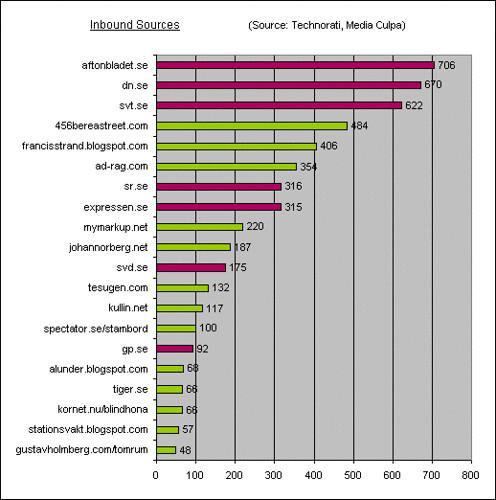
Sifry’s slides tells us that mainstream media are the websites that most bloggers link to (www.nytimes.com on top), but blogs are not that far behind. I have done a “lite-version” of Sifry’s research and looked at the websites of Swedish mainstream media versus the Swedish blogs with most inbound sources and links. The picture is quite similar, although on a much smaller scale.
The first graph is the number of inbound sources and the top three are the websites of Aftonbladet, Dagens Nyheter and SVT, but already in third, fourth and fifth place there are blogs, namely 456 Berea Street, How to learn Swedish in 1000 difficult lessons and Adland (way to go Roger, Francis and Åsk!). I’m at #13. In the graph below, green is for blogs, purple is for mainstream media.
The second graph counts the number of inbound links.
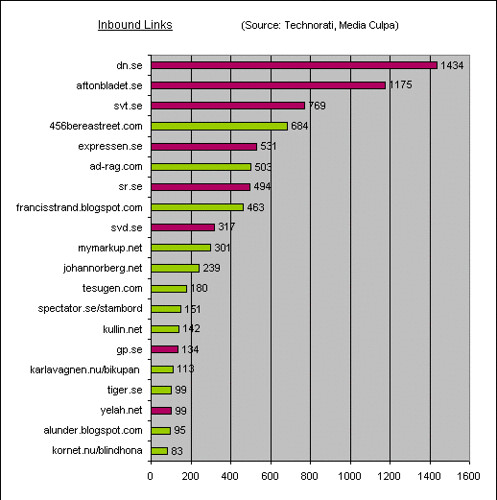
I don’t claim that this is a 100% accurate ranking since there are probably some blogs out there that would fit on the list, but I’ve missed. But I think it still paints a fairly good picture of the influence blogs have recieved in a short period of time. Some of these blogs didn’t exist 12-18 months ago.
As a reference, here are the number of inbound links from a few other leading publications:
idg.se (44)
di.se (33)
nyteknik.se (32)
tv4.se (27)
computersweden.idg.se (26)
internetworld.idg.se (24)
tt.se (21)
sydsvenskan.se (20)
Footnote: Some results for inbound links may be a bit skewed depending on what URL you type in, like mymarkup.net and mymarkup.net/blog gives vastly different results (301/220 vs 164/141) probably due to the fact that the domain hosts several blogs, so the latter numbers might be the ones that should really be in the graphs above. Some blogs may also get more hits by linking to themselves, but I think it is a minor problem.