Spanish blog survey

Via Loic LeMeur’s Wiki I found some excellent research from last year about the Spanish speaking blogosphere (Spain, Ecuador, Chile, Mexico, Venezuela, Argentina and Uruguay). The average Spanish (speaking) blogger seems to be:

– male (77%)
– between 20 and 26 years (graph)
– an experienced internet user (more than 5 years)
(graphs)
– about half have a broadband connection
– rarely shops online, about 80% buys online 1-5 times per year or never
– 33% use Blogger, 24% MovableType (graphs)
– 41% have their own domain name
– 68% have a blogroll with recommendations of other blogs (graph)
– 65% of bloggers have never had to erase a comment
– 89% of bloggers post from home, 37% post from work. (graphs)
– 37% spend half an hour per day on their blog
– 58% launched their blog a year ago, or less
– blogging makes 66% watch less tv and 42% sleep less (graph)
– bloggers think blogs are mainly a form of free expression (graph)
– 28% of bloggers and 19% of blog readers use an RSS reader

Det kom ett mejl från Stig Vig

För ett tag sedan hänvisade jag till det kortlivade bandet Ojj!600 i samband med att min undersökning av bloggare och bloggläsare lockade 600 respondenter. Ojj!600 påstod jag, tog sitt namn från ett rekordlågt gage (600 kr) vid en konsert. Jag är rätt säker på att jag hörde detta på radio när det begav sig i mitten av åttio-talet, men nu 20 år senare har jag alltså blivit upplyst om hur det egentligen gick till eftersom upphovsmannen hittade anteckningen i min blogg.

Igår fick jag nämligen oväntat nog ett mejl från Per “Stig Vig” Odeltorp där han är vänlig nog att berätta om hur bandet fick sitt namn. Ojj!600 kom från ett tärningsspel som heter 10 000 och där man ska få minst 1 000 poäng för att noteras, men oftast stannade man på just 600. Kom sen inte och säg att bloggar inte bidrar till upplysningen i samhället.

Journalist blogs trump traditional articles in Google

You might think that journalist blogs are just a side-kick to their regular paper or online columns, but Google disagrees. These 13 Swedish journalists might soon be better known for their blogs than for their traditional journalistic achievements. In 11 out of 13 cases, a Google search for their names delivers their blogs as number one.

Andreas Ekström – #1
Lotta Gröning – #1
Cecilia Hagen – #1
Håkan Jacobson – #1
Linna Johansson – #3 (this blog has been up just one week, with the exception of one initial post a month ago)
Helle Klein – #1
Olof Lundh – #1
PM Nilsson – #1
Anders Nunstedt – #1
Linda Skugge – #2 (#1 is her personal webpage)
Per Svensson – #1
Ebba von Sydow – #1
Fredrik Virtanen – #1

It is a remarkable development since most of these journalists have been writing for years, but blogging only for a couple of months, or even weeks, but already blogs play the first violin in their digital repertoire. Now, a few questions arise. First, are the texts they publish on their blogs the kind of journalistic product they want to have as their primary association? Some who question the quality of these blogs would say ‘no’, although there are blogs on that list that I read with great interest. Second, is there a way to exploit this phenomenon? Of course there is, and opportunities may even be greater for the journalists than for the media.

A well written blog may even lead to a situation where “some newspaper reporters [will become] better known in some circles for their blogs than for their printed work” to quote Tim Porter. He makes a comparison between the music industry and the media industry. He claims there is a shift from ‘the music business’ to the ‘musician business’ in that consumers gladly pay 100 bucks for a concert ticket but are reluctant to pay 19 bucks for a CD. He quotes the New Yorker: “In the musician business, the assets that once made the major labels so important – promotion, distribution, shelf space – matter less than the assets that belong to the artists, such as their ability to perform live. The value of songs falls, and the value of seeing an artist sing them rises, because the experience can’t really be reproduced.”

What if the journalism business is developing into a journalist business, if journalism produces a commodity we don’t want to pay for but original writing is worth much more? He continues:

“If news is commodity, then in-depth reporting has value. If routine government coverage offers nothing but stenography, then interpretive reporting has value. If the conventions of traditional journalism produce bland and boring copy, then personality and point of view have value. If newspapers have become disconnected from community, then relationships between writer and reader have value.”

Blogs are by nature an excellent channel for building relationships, being personal and interpreting news and events. By exploiting their talents journalists can become thought leaders in their own right. So a question goes out to journalist bloggers – will you seize the opportunity to extend your brand beyond the medium who currently hires you, or are you satisfied with being the journalist who writes about taking the bike to work?

A survey of Swedish bloggers and blog readers

It has almost become an established truth that the Swedish blogger is 1) man, 2) writes about politics and social issues and 3) has right-wing preferences. But these are just assumptions. So in order to get more facts about the Swedish blogosphere, I initiated a blog survey between May 12 and 16, 2005 where 600 blog readers answered a number of questions.

Here is a summary of the results:

Bloggers: The average Swedish blogger is:

· man
· 26-35 years old
· has a college/university degree
· both parents are born in Sweden
· does not know what party to vote for if there was an election today (largest party was Folkpartiet – the liberal party)
· blogs because he likes to write
· blogs in Swedish
· is not anonymous
· reads 6-10 blogs daily
· spends 6-10 hours per week reading blogs
· often or sometimes uses an RSS reader to read blogs
· reads blogs because it is more personal than other media
· finds new blogs via links on other blogs

Blog readers: The average Swedish blog reader (including those who have their own blogs) is:

· man
· 26-30 years old
· has a college/university degree
· both parents are born in Sweden
· would vote for Moderaterna – the moderate party – if there was an election today
· has his own blog
· reads 1-5 blogs daily
· spends 2 hours per week reading blogs
· never uses an RSS reader to read blogs
· reads blogs to get different views on news
· finds new blogs via links on other blogs

Other interesting results from the survey:

· Blog readers vote to the right. The right-wing parties get 62.4% of all votes.
· Bloggers vote (slightly less) to the right. 52.6% of bloggers vote for the right-wing parties while 47.6% would vote to the left.
· Male bloggers vote to the right (57.4%).
· Female bloggers vote to the left. (s), (v), (mp) and (fi) get 55.4% of the votes.
· Among blog readers who don’t blog themselves, the moderate party (m) is the dominant party. More than a third (36.8%) of this group would vote for (m).
· Many bloggers do not know who to vote for, but female bloggers are more uncertain than male (29.8% of female bloggers, 18.5% of male bloggers)
· Women blog anonymously (60.6%), men reveal their identity (69.4%)
· Most women don’t use an RSS reader to read blogs, but most men do.
· Female bloggers have slightly higher education than male bloggers.
· Male bloggers more often blog to influence others and to become famous, than female bloggers do.
· Those who use an RSS reader, read more blogs than those who don’t use an RSS reader.
· 96.9% of respondents who read 26 blogs or more daily, use an RSS reader (often or sometimes).
· Bloggers read more blogs and spend more time reading blogs than blog readers who don’t have a blog of their own.
· Half of all blog readers spend 4 hours or more per week reading blogs, which is 34 minutes or more per day. Compared to the average Swede who spends 28 minutes per day reading a daily newspaper.

The entire report can be downloaded here (pdf 429kb) in English or here (pdf 311kb) in Swedish.

In addition, here are a few of the graphs from the report in jpg-format. The first is a graph showing reasons why bloggers started blogging.
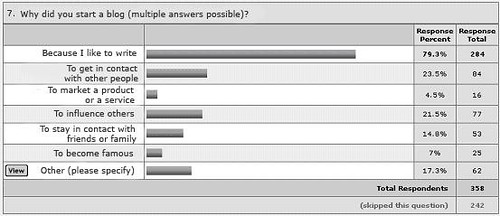
Why bloggers start blogging

The second shows the reasons why blog readers choose to read blogs.
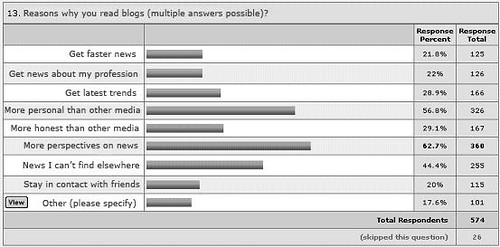
Why blog readers read blogs

It is also interesting to compare the last graph with the corresponding question in Blogads US survey earlier this year. The results are not extremely different.

Blognapping common in Poland

Kaye Trammell has a excellent podcast about blog research that I recommend that you listen to. Some of her comments in regards to what motivates people to blog are:

– Bloggers are mostly motivated by self expression – a will to share thoughts and feelings with others.

– People who give feedback in form of comments are motivated by social interaction – a desire to interact.

– People who give feedback in the form of trackbacks are motivated by information – a will to share interesting information.

I believe this graph is associated to this research.

Dr. Trammell also mentioned a Polish blog survey that found that bloggers in Poland are more often female than male and that female bloggers are more motivated to blog by social interaction reasons than male bloggers. Polish blogs are often password protected so they are not open for everyone to read. It is also common in Poland that people steal others blogs, which means that they try to find out their login and password and then take over the blog.