Flickr reaches 3 billion photos

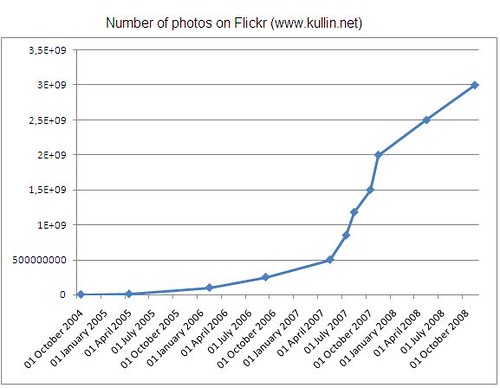
The popular photo sharing site Flickr reached 3 billion hosted photos this afternoon (at about 6 PM CET), at least if the numbering of the photos accurately reflect the actual amount of photos on the site. The growth has been steady during the last 12 months. It took six months between 2 billion and 2.5 billion, and then another six months to reach 3 billion photos.

Photo number 3,000,000,000 can be found here.

flickr 3 billion graph

Previous posts about the growth of Flickr: 2.5 billion and 2 billion.

Data set used:

22 Oct 04: 1000000
20 Apr 05: 10000000
15 Feb 06: 100000000
22 Sep 06: 250000000
15 May 07: 500000000
19 Jul 07: 850000000
20 Aug 07: 1180000000
06 Oct 07: 1500000000
13 Nov 07: 2000000000
17 May 08: 2500000000
03 Nov 08: 3000000000

Update: Confirmed by Flickr.

Tags: , , , . Ping.

Old data in new study on Swedes and blogs

SOM-institutet, the SOM Institute at Göteborg University, has released the results of a study about blogging – “Bloggers – who are they?”. In my view, the researcher Annika Bergström has had a somewhat skeptic attitude towards the role of blogs in previous comments. In an interview in Dagens Nyheter in 2006 she said about our media consumption that “there are changes, but they are slow, there will be no revolution”. She also commented to IDG.se that the differences in blog adoption between Sweden and the USA is due to strong Swedish tradition to read newspapers.

– Swedes turn to traditional dailies online for information. And we don’t get more time just because new media appear.

A year ago she said that “not many people read blogs, and the ones that do are often the ones that blog themselves”.

This skepticism is visible also in the “new” study. I write “new”, because the data was collected during the fall of 2007. In the report, Bergström writes:

“The survey was conducted during the fall of 2007 and it is likely that the use of blogs have increased slightly since then, but if we look at what we know from the development of other areas of online behavior we should expect only small changes.”

The study says that only 2 percent of Swedes wrote a blog each week and that 15 percent read a blog weekly. Good for us then that the World Internet Institute the other day released it’s fresh report about how Swedes use the internet, so we have figures for 2008 to compare with.

WII says that 5 percent of the population blog and 26 percent read blogs, which according to me is more than just a “small change”.

When respondents in the SOM survey were asked if they had read a blog during the last 12 months, 39 percent said yes. Still the final comment in the report reads:

“The previously mentioned debate about the importance of blogs, is to a high degree about what a small portion of the population engage in. With that said, there is nothing that says that single blogs can have a larger influence in society.”

This old data seems to appeal to TU, the Swedish Newspaper Publishers’ Association. On its site TU comments on the “latest figures” on blogging like this:

“Nowadays it seems like everyone is blogging. But it is not entirely true. Two percent of Swedes blog each week. And 15 percent reads what they write. The so called blogosphere is, in other words, smaller than the impression we get from the media attention.”

Stats from WII suggests that 1.9 million Swedes read blogs so I think it is safe to say that blogs are starting to reach a significant portion of the population. In my view, this study is based on data that is too old to really have any real value, and it doesn’t do newspapers any good to take these figures as a sign that blogs and other online channels are no big threat to them.

Tags: , , , . Ping.

Launch video unavailable when YouTube opens up in Sweden

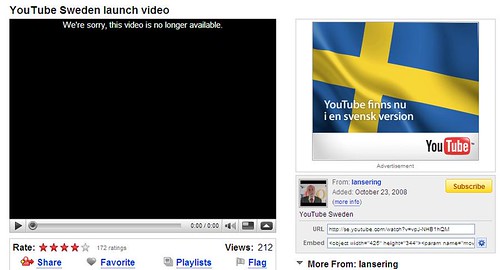
As expected, YouTube today opened up a Swedish version of the site. A launch video is posted on the site in which a number of celebrities welcome YouTube to Sweden, including Google’s Chief Internet Evangelist Vint Cerf; Mona Sahlin, leader of the Social Democrats and Ulf Ekberg of pop combo Ace of Base. The video is also promoted on the front page of the Social Democratic Party webpage (!).

For some reason YouTube has made it very hard to embed this launch video and it took me a while to find the embed code.

What the video does not reveal is how a Swedish version is any different than using the global site. Everything on the site is still in English, a language most Swedes handle very well.

On top of this, the launch video is suddenly unavailable. Probably temporarily, because as I type this the video comes back up, becomes unavailable again, then up again.

www.youtube.se

Tags: , , , , . Ping.

Laughing baby video makes the Queen giggle

For some reason a large amount of people suddenly arrive at my blog through different links to the world famous Laughing Baby video, the amateur video with Swedish baby William. After a few Technorati searches I found what might be the reason behind this sudden interest. Apparently Queen Elizabeth and the Duke of Edinburgh visited the UK headquarters of Google a few days ago and were shown the video, which according to reports made the royal couple giggle.

The Queen thought it most amusing. “Lovely little thing, isn’t it?” the Queen said. “Amazing a child would laugh like that.”

Maybe that was a great distraction from a somewhat embarrassing moment when Google staff were unable to show the location of their own office to the Royal visitors using Google Earth.

The video has to date been viewed 64 million times and is among the top ten most viewed YouTube videos of all time. Little William has even become a character in South Park.

http://www.youtube.com/watch?v=5P6UU6m3cqk

Tags: , , , , , . Ping.

Almost 2 million Swedes read blogs

Following up on my previous post, I have now read through parts of the World Internet Institute’s new report about how Swedes use the internet.

Some of the more interesting findings are:

– 350,000 Swedes have a blog (estimate), or 6% of the online population.
– 1,900,000 Swedes read blogs (estimate), or 33% of the online population. That means that there are more than five times as many blog readers as there are bloggers. Possibly a good argument against the common view that “nobody reads blogs”.
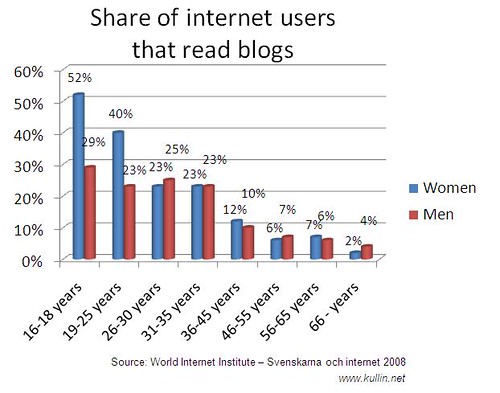
– Young women between 16 and 25 years are frequent blog readers, see graph below. As many as 52% of all girls 16-18 years that are online, read blogs.

swedenblogreaders

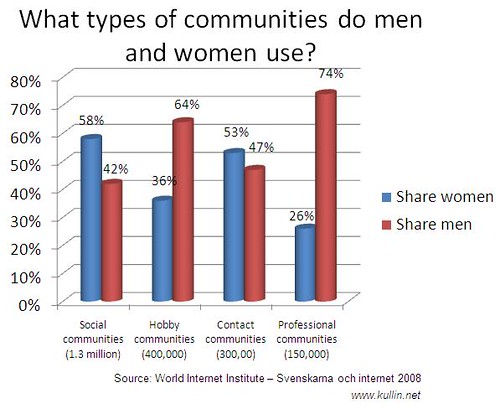
– There is a big difference in which types of communities that attract women and men. Women are more frequent users of social communities while men are more frequent users of hobby and professional communities, see graph below. In my BlogSweden 3 survey the responses indicated that women are more motivated by social interaction than men, which was also a result from a study by Kaye Trammell: “Female bloggers, however, were somewhat more motivated by social interaction (67.1%) than were their male counterparts (51.3%).”

swedencommunities

Tags: , , , . Ping. Följ min blogg med bloggkoll