Two girls, aged 15 and 16, were today sentenced in Gothenburg, Sweden, for defamation of 38 teenagers on Instagram. The two were responsible for posting photographs of mostly girls on Instagram, calling them out as “sluts” with claims of different sexual activities. More than 200 teenagers claimed to have had their photographs published on the “hate accounts” on Instagram, which at one point led to the so called Instagram riots outside the Plusgymnasiet high schoool in Gothenburg late 2012. The case eventually involved 38 plaintiffs where the evidence were strong enough to press charges against the girls.
The younger of the two admitted to publishing the photos, but the older girl had denied that she has been involved. During three days in December 2012, the Instagram account “Gbgsorroz” published names and photos with slanderous comments of more than 200 teenagers. The convicted girls asked others for tips, photos and comments via the messenger serivce Kik, and then published this information on Instagram.
The two girls have now been convicted and sentenced to youth care and youth service. In addition, they shall pay damages to each of the plaintiffs to the amount of 15,000 SEK, or 570,000 SEK in total (85,000 USD).
The information about who was behind the account was obtained from Microsoft and local internet service provider ComHem, according to the district court. They then tracked who used the actual IP number that had been assigned to one of the accused parents, according to SVT.
Tonight is the first semi-final of the Eurovision Song Contest 2013 in Malmö, Sweden. The contest is sure to spark an enormous amount of activity in social media and below you can find an extensive list of official Twitter, YouTube, Facebook, MySpace, Instagram accounts and more. Don’t forget to vote and tweet your support for your favourite songs.
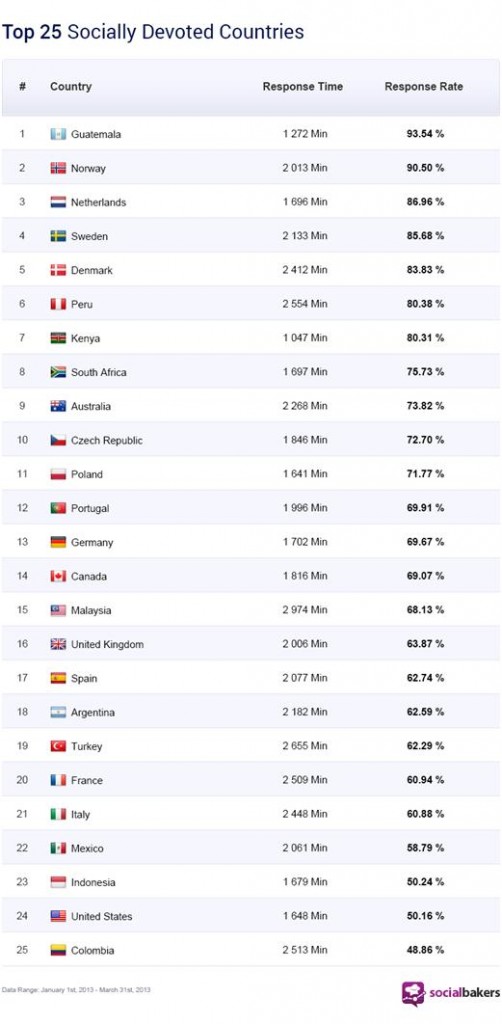
Socialbakers have introduced a concept called “socially devoted“, aiming to describe brands and pages on Facebook that excel in fan engagement and social customer care. That same label has now been applied on a country basis to see what countries are the most socially devoted. It turns out that Guatemala is ranked first in Q1, 2013, with an average Response Rate of 93.54% for local brand pages.
Norway is ranked second, followed by the Netherlands and Sweden in fourth place. The complete Top 25 country rankings, based on percentage of answered questions, can be found below:
This week, I had the opportunity to attend the Engage 2013 conference in London, courtesy of Socialbakers. Among the top speakers, we got to listen to Lionel Lassalle, Social Marketing & Co-Branding Manager at KLM who talked about KLM’s journey to transform social users into customers.
KLM has been working actively with social media for quite some time, and the airline’s presence in social media jump started with the crisis management during the Eyjafjallajökull eruption in April 2010. It was not until then that the company really started to take advantage of social networks in communicating with customers.
“The ash cloud changed everything”, said Lassalle.
According to Lassalle, one of the key factors in becoming a social business is to be able to break down the silos and start to co-operate between different parts of the organisation. Also, for KLM, customer service is the backbone of the organisation in social media. The airline has the ambition to answer questions in social media within 1 hour and to solve customer service issues within 24 hours. Currently, KLM answers within 15 minutes (on average) and solves issues within 9 hours. Impressive.
The experience from the ash cloud crisis management led to the establishment of three principles that guide KLM in social networks.
KLM’s three leading social pricinciples:
Service is sales
Be cool to hang out with
Don’t push, create stuff worth sharing
Social media can drive sales
One of the main take aways for me during the day was that we saw several examples where social media can actually drive sales. One project for KLM in the Netherlands increased sales with 30%. Also, Bruce Daisley of Twitter UK told us how sponsored campaigns on Twitter had shown that there can be a strong correlation between Twitter ads and sales. Some campaigns had been more than four times as effective as spending that additional amount on traditional advertising.
Becoming a social business
KLM has the ambition to be a social business and by relying less on stand-alone campaigns and working more with long term solutions, the airline has come a long way towards that goal. Here are a few more quotes about their social media strategy, from Lionel Lassalle’s presentation.
“We are connecting social media to our core business, which is flying.”
“We are heading to become a social business.”
“Social media is no longer a platform, it is integrated throughout the whole organisation.”
“From one side it makes our customer’s life easier, but it also constantly helps us to improve the quality of our service.”
And finally, about return on investment: “Is it worth the money? Hell, yeah!”
Below you can watch the entire presentation from Engage 2013.
Socialbakers have just released statistics for the top Facebook pages in Sweden for February 2013. Some notes about the report:
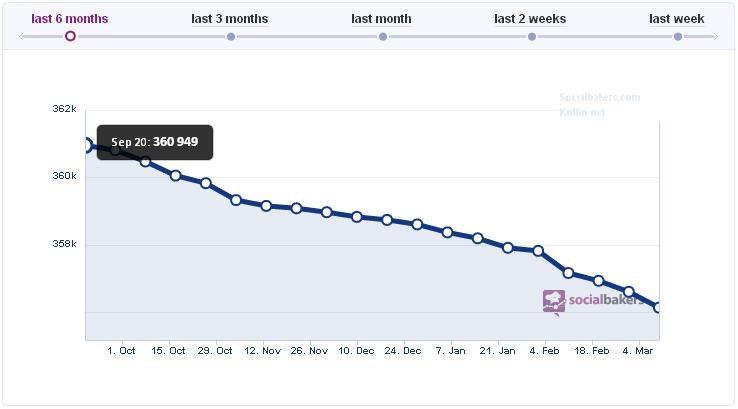
– One of the top ten brands is actually seeing a decreasing number of fans: the candy Hallonlakritsskalle. It has seen a steady but slow decline for the last six months.
– Just like in January 2013, three out of five top brands by post engagement rates are car brands.
– Four out of the five most socially devoted brands are telecom brands, compared to three last month.
– The #1 media brand by local fans, Vakna! Med The Voice, has lost more than 1,000 fans since the last report in January.
– The number of Swedes on Facebook is down from 4.9 million in January to 4.8 million (monthly active users).
Earlier this week, the official Twitter account for Burger King was hacked and turned into a McDonald’s feed. Now, the same thing has happened to @Jeep. The Jeep logo was replaced with a Cadillac logo and the hackers tweeted things like “We got sold to @Cadillac because we caught our employees doing these in the bathroom” with an image of a bottle of prescription-only pills. Jeep soon got control of the account and deleted the tweets tweeted by the hacker.
For a brand, crises like these are of course serious, but handled correctly they can also become an opportunity. Often an account that is involved in a similar incident gains a lot of followers, thanks to the increased attention.
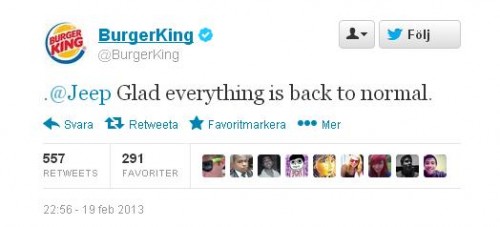
This time, both Burger King and Jeep turn the hacks into a PR opportunity by posting some clever tweets. Burger King seized the opportunity to send their wishes to a brand that was the victim of the same type of crisis, which showed a human side of the brand.
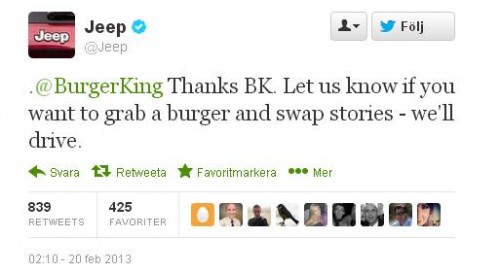
Jeep cleverly responded with this tongue in cheek tweet.
As you see, both tweets got loads of retweets and were marked as favourite by many followers. Also, note the dots before the Twitter handle, enabling all their followers to see the tweets, not only the ones that follow both accounts.
 Two girls, aged 15 and 16, were today sentenced in Gothenburg, Sweden, for defamation of 38 teenagers on Instagram. The two were responsible for posting photographs of mostly girls on Instagram, calling them out as “sluts” with claims of different sexual activities. More than 200 teenagers claimed to have had their photographs published on the “hate accounts” on Instagram, which at one point led to the so called Instagram riots outside the Plusgymnasiet high schoool in Gothenburg late 2012. The case eventually involved 38 plaintiffs where the evidence were strong enough to press charges against the girls.