Locking in articles about social networks is crazy

The Swedish tabloid Aftonbladet has been very successful in attracting visitors to its website. Aftonbladet.se is Sweden’s second largest website, second only to MSN.se. It was one of the first papers (although not the first) to take blogging seriously, both with their own blog service and the acquisition of the blog portal Bloggportalen.se. But when other major media sites like the New York Times are unlocking content that was previously subscription only, Aftonbladet.se has chosen the opposite direction.

“What changed, The Times said, was that many more readers started coming to the site from search engines and links on other sites instead of coming directly to NYTimes.com. These indirect readers, unable to get access to articles behind the pay wall and less likely to pay subscription fees than the more loyal direct users, were seen as opportunities for more page views and increased advertising revenue.

“What wasn’t anticipated was the explosion in how much of our traffic would be generated by Google, by Yahoo and some others,” Ms. Schiller said.”

Today, Anders Westgårdh writes a column on Aftonbladet.se in which he states that Facebook is a fad that will soon disappear. Quite obviously, this is the kind of article that readers would blog about, comment, post to social networks etc etc which will attract new readers. But the article is behind a pay wall so none of that will happen.

Sure, its just one article, but to me it indicates that Aftonbladet is determined not to follow the path of the New York Times and the others. Personally I am not convinced that it is the correct thing to do, but then again I don’t have access to Aftonbladet’s site statistics.

Tags: , , , . Ping.

Social networks and integrity

The debate about integrity and social networks continues in Sweden, but surprisingly without much participation from Facebook. Maybe that’s why Facebook is looking to hire a Manager, Corporate Communications to:
– Protect and enhance the reputation of Facebook’s technologies and platform
– Educate users, analysts, journalists and bloggers about Facebook products and platform
– Drive positive coverage in the business and technology press

Helsingborgs Dagblad has digged deeper into the topic and reviewed the terms of use for a number of social networking sites, but without drawing any conclusions from the information. Read more in Swedish here.

Furthermore, ENISA, the European Network and Information Security Agency, recently presented a paper called Security Issues and Recommendations for Online Social Networks. In the paper the agency lists a number of potential threats that may arise for users of Social Networking Sites (SNSs) and suggests actions to address them:

• Recommendation 1.1 Encourage awareness-raising and educational campaigns
• Recommendation 1.2 Review and reinterpret the regulatory framework
• Recommendation 1.3 Increase transparency of data handling practices
• Recommendation 1.4 Discourage the banning of SNSs in schools
• Recommendation 1.5 Promote stronger authentication and access-control where
appropriate
• Recommendation 1.6 Implement countermeasures against corporate
espionage
• Recommendation 1.7 Maximise possibilities for abuse reporting and
detection
• Recommendation 1.8 Set appropriate defaults
• Recommendation 1.9 Providers should offer convenient means to delete data
completely
• Recommendation 1.10 Encourage the use of reputation techniques
• Recommendation 1.11 Build in automated filters
• Recommendation 1.12 Require consent from data subjects to include profile tags
in images
• Recommendation 1.13 Restrict spidering and bulk downloads
• Recommendation 1.14 Pay attention to search results
• Recommendation 1.15 for addressing SNS spam
• Recommendation 1.16 for addressing SNS Phishing
• Recommendation 1.17 Promote and research image-anonymisation techniques
and best practices
• Recommendation 1.18 Promote portable Social Networks
• Recommendation 1.19 on research into emerging trends in SNS
[Via Adam Erlandsson]

And while we are on the subject of Facebook, Anders Mildner, Sydsvenskan, earlier this week wrote an interesting piece about friends and “friends” on Facebook (in Swedish).

Tags: , , , , . Ping.

Join the Media Culpa group on Facebook

media-culpa Just a quick note to those who might be interested. Media Culpa now has its own Facebook group and you are more than welcome to join and discuss how digital media affect traditional media and public relations. Posts have so far just been in Swedish but the aim is to expand the dialogue to English as well. Welcome.

Tags: , , , , , . Ping.

The state of the Swedish blogosphere – Q3 2007

Primelabs issued a new report (pdf) this week about the Swedish blogosphere, ranked by number of incoming links from other blogs. Twingly Report Sweden outlines the most influential Swedish blogs between May 1st and Aug 31st, 2007. Among other things it shows that 13 of the 20 most linked to blogs are about politics, 4 blog about everyday life experiences, 3 write about media and 2 about culture.

The ten sites that Swedish bloggers link to most are:

1. Dagens Nyheter
2. Svenska Dagbladet
3. Aftonbladet
4. YouTube
5. Swedish Wikipedia
6. English Wikipedia
7. Expressen
8. Flickr
9. Internet Movie Database
10. Technorati

Only four out of ten are MSM, and five (YouTube, 2*Wikipedia, Flickr and Technorati) could be categorized at user generated content sites.

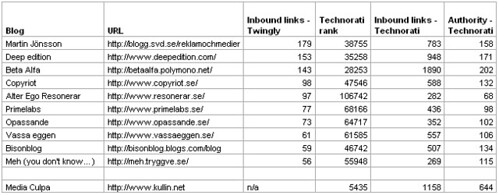
Listed below are the ten most influential Swedish media blogs. And since influence isn’t easy to measure, I added these blogs’ Technorati rank, inbound links via Technorati and Technorati authority (a higher number means more authority). To my knowledge, Twingly/Primelabs do not measure international blog links but are mainly tracking pure Swedish blogs. I also added Media Culpa as comparison at the bottom of the table and as you see it has higher authority than any of the blogs on the list.

Swedish top media and pr blogs

Tags: , , , , , . Ping.

Aftonbladet shows blog links

Aftonbladet today started to link to blog posts that link to online articles (example here). But unlike all the other Swedish dailies which show blog links via the Twingly service, Aftonbladet chose to use its own blog portal Bloggportalen.se. On the site it says that the five most relevant comments are shown and to see all comments you need to go to Bloggportalen.se. It would be interesting to find out what factors that decide this relevance. [UPDATE: I didn’t read properly. Lotta Holmström writes that it is decided after how many incoming links a blog has.]

And since Aftonbladet.se is Sweden’s second largest website (MSN.se is no 1 according to KIA index) with close to 4 million visitors (unique web browsers) per week, prepare to see a major increase in blog links to Aftonbladet the coming weeks.

Tags: , , , , . Ping.