Bloglines folders reveal knitting image

Chris McEvoy has performed an analysis of people’s RSS subscriptions and found some interesting stuff. He has searched 16,121 Bloglines users with more than ten public subscriptions and compiled a list of the most popular folder names people use. Apparently bloggers are really into knitting (at #37 and #70).

Top five are:
1. Blogs
2. News
3. Tech
4. Technology
5. People

Here’s the full list: Bloglines Top 100 Folder Names. This page also contains a graph that compares the number of subscriptions with number of folders.

Over at his blog Confusability, McEvoy has published the stats in an Excel spreadsheet with the data from all the subscribers, including some well known PR and communications bloggers like Elizabeth Albrycht and Darren Barefoot ( I assume) in places 365 and 344 respectively. I’m not in the list because I realized I hadn’t made my subscriptions public, until now. There are several subscribers with more than 400 subscriptions and the question McEvoy asks – how many RSS feeds can one person consume – is highly relevant. I currently have 334 subscriptions but about 70-80 are different media feeds that I rarely read. I keep them mainly to study the development of feeds from MSM. Somehow I feel I’ve reached a limit and I have started to unsubscribe to some feeds when I add new ones.

Technorati tag:

50,000 blogs talk about the iPod each day

Few products the last few years can show the same phenomenal growth rate as the iPod. The PR success of this tiny gadget is demonstrated over and over again, yesterday in an article in the Norwegian marketing publication Propaganda. They write about a media analysis by media monitoring company Retriever which shows the brands with most publicity in Norwegian media during 2004. The iPod is on top, ahead of older brands like McDonald’s, Playstation and Nokia.

If we look at the number of times the iPod have been mentioned in the blogosphere, the numbers are equally impressive. For example, iPod comes out on top ahead of the world’s number one and two most valuable brands Coca-Cola and Microsoft. The iPod is talked about in half a percent of all blogs and since Blogpulse tracks 10 million blogs, that means that 50,000 blogs talk about the iPod every day. If that’s not a PR success, I don’t know what is.

Technorati tags: , , ,

Da-la-la-da

Some artists’ brands are so closely tied to one monster hit that you only need to hear a drumbeat or a few notes to recognize them. Or what about this description for the upcoming May concert in London with Sweden’s number one poodles – Europe:

“Da-la-la-da Da-la-la-da-da Da-la-la-daa-da It’s the final countdown… to Sweden’s finest son’s return to the London stage. Rock!”

PR speak translated

Here’s a lesson for PR professionals. As a result of Adobe’s acquisition of Macromedia the PR departement has produced a FAQ, completely soaked with words devoid of any real meaning. That becomes painfully obvious when Daring Fireball translates PR speak to plain English. Example:

Q:Do you anticipate a reduction in force as a result of this transaction?

A: When two successful growing companies join together, the result is a combined organization that creates new and exciting opportunities. The combination will lead to powerful new areas of innovation, new products and solutions, and an acceleration of our respective growth agendas. At the same time, there will be some duplication of employee functions between the two companies, and upon the close of the transaction, we anticipate some level of reduction in force. While we anticipate the integration team will identify opportunities for cost savings, the primary motivation for this acquisition is to continue to expand and grow our businesses into new markets.

Translation: Yes.

No-one under 15 reads Vecko-Revyn?

In its latest edition, Swedish publication Vecko-Revyn has a competition where three lucky winners will get an injection of Restylane, a gel that is used in lip sculpting. This highly controversial competition did not sit well with readers, in part due to the magazine’s leading standing with young girls. And after being critized in some of the largest dailies, Vecko-Revyn’s chief editor Charlotta Gustafsson today wrote an article in Expressen where she said the competition was a mistake, but that they will still go through with it. She claims that the majority of their readers are over 20 and mature enough to make their own choices about different beauty treatments.

“Detta eftersom vi riktar oss till kvinnor mellan 20 och 25 år.
Enligt Orvesto (en Sifoundersökning som mäter samtliga tidningar i Sverige), så är 67 % av VR:s läsare över 20 år. Snittåldern på våra läsare är 28,4 år.”

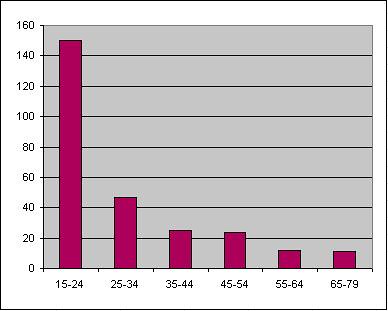
But a journalist at Östgöta Correspondenten had this argument with Gustafsson in December 2004 and bothered to investigate her claims. According to Linn Rittmalm-Glimne, the Orvesto survey only asks respondents aged between 15 and 79 (see yourself here). This means that no girls (or boys) under the age of 15 are asked if they read Vecko-Revyn. If 33% of all readers are between 15 and 19, and 67% between 20 and 79, there’s a pretty good chance that a significant number of very young readers are missing from the survey. How convenient. Especially since Sifo had told Rittmalm-Glimne that the response rate in the age group 15-19 is very low, or 52%, so the results may not be very reliable.

Here is a graph of Vecko-Revyn’s reach in different age groups (thousands of readers).
Vecko-Revyn

The TV news show Rapport had asked a number of retailers what age group buys Vecko-Revyn, and the response was “12 to 18”. This might not have any statistical relevance but adds to the suspicion that their readers are younger than they claim.

Dagens Nyheter wrote an article in 2000 (Eva Härnbäck, 2000-01-09, registration required) about this subject and citing a few different surveys (Mediebarometern, Nordicom-Sverige 1998 och 1999. Barnmediaindex 1997, Egmont) DN writes:

“35 procent av alla unga svenska kvinnor i åldrarna 15-24 läser Veckorevyn. Målgruppen, säger Veckorevyns redaktion, är 18-25-åriga tjejer. Men betydligt yngre flickor, 13-15 år, läser i ännu högre grad Vecko-Revyn: uppemot 40 procent.”

Translated this means that Vecko-Revyn at that time reached 40% of all girls between 13 and 15 years of age, an age group only partly surveyed by Sifo.

Worth noting is that this is the same magazine that only a few years ago stopped promoting the Swedish leg of the Miss World pageant – Fröken Sverige. Then chief editor Emma Hamberg said that competing in looks sucks: “Att tävla i hur man ser ut och vinna en resa om man är tillräckligt snygg anser Hamberg vara för ”jävligt”. Veckorevyn handlar också om skönhet men är inte en tävling i vem som är snyggast.” (see pdf page 27).