This is a new and innovative (or weird, if you wish) way of using blogs in PR. Almega, an organisation that supports service companies in Sweden, has its own blog and Almega today issued a press release to promote a blog post. Sounds like the blog isn’t the right channel for this message if you need to support it with a press release, but then again, it made me go and read it…
Category: PR
Milk PR stunt turns sour
Mjölkfrämjandet is an organization sponsored by the milk industry and that promotes milk consumption in Sweden. They recently made a PR survey of fifteen-year-olds’ drinking habits in school, the results were then split into different Swedish provinces. And the PR stunt was very successful with media coverage in many local newspapers. But some of these journalists must know something about math that I don’t, because how can kids in both Halland, Gotland, Medelpad, Jämtland and Norrbotten all be the ones who drink most milk? Check this out, five headlines from five different regions claiming they have the students who like milk the most:
Hallandsposten:
Halländska killar dricker mest mjölk
15-åriga killar i Halland dricker mer mjölk än jämnåriga i övriga delar av landet. Det visar en undersökning som Mjölkfrämjandet gjort genom den populära webbplatsen Lunarstorm. […] 59 procent av killarna dricker mjölk, av tjejerna väljer bara 44 procent mjölk till maten.
Gotlands Allehanda:
Gotländska elever toppar “mjölkligan”
81 procent av killarna och 58 procent av tjejerna på Gotland dricker mjölk till skolmaten. Därmed dricker fler gotländska elever mer mjölk än eleverna i övriga landet.
Sundsvalls Tidning:
Ungdomar i Medelpad etta på mjölk
Hela 75 procent av 15-åringarna i Medelpad dricker mjölk till skolmaten. De
siffrorna visar att ungdomarna är bäst i landet på den vita, näringsrika drycken.
Sveriges Radio Jämtland:
Jämtländska killar är bäst i Sverige på att dricka mjölk.
I varje fall om man får tro en undersökning på ungdomssajten Lunarstorm om dryckesvanor i skolmatsalen. Mjölk är den överlägset populäraste måltidsdrycken bland 15-åringarna i Jämtland, och allra mest dricker alltså killar. 92 procent av dem säger att de dricker mjölk till skolmaten, vilket kan jämföras med bara 61 procent av tjejerna i Jämtland.
Norrländska Socialdemokraten:
Norrbottens unga toppar mjölkligan
Ungdomar i Norrbotten dricker mer mjölk än ungdomar i övriga landet. Det visar en färsk undersökning från Mjölkfrämjandet. […] 72 procent av pojkarna och 55 procent av flickorna väljer mjölk till måltidsdryck
But the kids in Närke was “worst”:
Sveriges Radio Örebro:
Eleverna i Närke är sämst i landet på att dricka mjölk till skolmaten.
Det visar en undersökning som ungdomssajten Lunarstorm, på internet, har gjort. 41 procent av eleverna i Närke dricker mjölk i skolan. Genomsnittet för hela landet är 54 procent.
The confusion continues, but it seems that (pdf) kids in Medelpad are the heaviest milk drinkers (75%) while boys in Jämtland drink milk more often than any other region, so Sundsvalls Tidning and SR Jämtland seem to be the two that got it right.
I don’t know if the different press releases implied that all regions “won” or if it was sloppy journalism, but it’s not rare that headlines overinterpret an article to the extent that the claim is false.
Ogilvy checks out blogs
I’m glad to see that my blog is one of seven blogs about branding that the good people at Ogilvy PR are reading. “The Ogilvy PR BlogFeeds are our feeds from some of the most influential blogs out there. The ones we’re reading every day.”
Here is the description:
Mea Culpa: Two Swedish Eyes on Media and Public Relations
This Swedish blog from two public relations professionals offer good reports of what’s out there and a valuable international perspective, including posts on topics like Chinese brands you should know and PR Blogging in Iran.
Two tiny corrections about the presentation though. The title of this blog is Media Culpa, nothing else. And it’s written by me. Two eyes, one guy.
H&M flip-flops on Moss
A new chapter seems to be written each day in H&M;’s relation to Kate Moss. Today, H&M;’s CEO Rolf Eriksen tells Dagens Industri’s online edition that they will not rule out the possibility to use Moss in future campaigns.
“You never know what might happen if she changes attitude. The important thing is that she is not a part of this campaign.” [The launch of H&M;’s Stella McCartney collection]
“Kate Moss is one of the most talented models in the world and we hope that she will get help with her problems.”
Back to a softer approach again? What about the potential law suit?
Why suing Kate Moss is a really bad idea
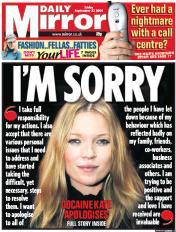 I read in Expressen that H&M; are investigating the possibilities to sue super model Kate Moss for damages. H&M; are looking at recovering some costs that came as a result of the recent cocaine scandal. From a PR perspective this seems like a very very bad idea. Here’s why:
1. She’s sorry. She made a stupid mistake and admitted it. She apologized to everyone that might have suffered from her behaviour. Going after someone who is truthfully apologetic does not give your company a sympathetic image, even if you technically are entitled to do it.
2. You forgave her. H&M;’s initial reaction to the story was to give Moss a second chance. By suing her, H&M; make a 180 degree turn and does not come out as a company with a clear strategy on this matter.
3. Big vs small #1. H&M; is a huge company, partially owned by one of Sweden’s richest men. It has all the resources one can wish for, whilst Moss is an individual, a small woman, albeit wealthy and big enough to snort cocaine. Nevertheless, readers are more likely to side with David than Goliath.
4. Big vs small #2. Does it not look somewhat greedy for a company that last year made a net profit of SEK 7.2 billion to sue an individual for damages? Um, yes it does.
5. Addiction is a disease, even if self inflicted. Moss is obviously sick. She needs help, not law suits. Sure, she caused the situation herself, but then what? Do H&M; want to destroy her?
6. Enough already. The more H&M; talk about the incident, the longer it will continue and they run the risk of being associated with a drug addict. Just drop it and focus on your new campaign. Use the massive attention to do something positive.
7. The story broke on 15 Sept. First they forgave her, then H&M; didn’t communicate that they are dropping Moss until 20 Sept. I can understand that H&M; feel they are in a business relation with Moss and that she broke the contract and cost H&M; some serious money. But had the company had a clear strategy from the beginning it might even have gained credibility and brand recognition from the story. Now, it is more likely that the brand will suffer from whimsical public relations than from the cocaine scandal itself. (H&M; now claim they decided to drop Moss on 17 Sept. Which is worst, having trouble deciding or not being able to communicate what they have decided?)
PR knowledge for free
There is some truly great stuff being produced over at the Global PR Blog Week 2.0 event blog. Check out for example Tom Murphy’s article about pragmatic PR and Dee Rambeau & Chris Bechtel’s great piece about online media relations.