Forced swith to new Blogger creates havoc

Blogger users have had the option to convert to new Blogger for a while, but about three weeks ago Blogger started to force some users to switch to the new version. So although I had resisted as long as I could, I had to take the plunge this weekend.

I have been afraid to switch because many bloggers have experienced major problems with new Blogger. At the Blogger Help Group you can find hundreds and hundreds of posts where people ask for advice because they are unable to publish or something isn’t working properly. This blogger even compares new Blogger with new Coke.

And unfortunately my worries were well-founded. After the conversion my permalinks don’t work anymore, either in the Atom feed or on the blog. Posts used to be archived in a folder called ‘arkiv’ and the permalinks to each post previously looked like this:

http://www.kullin.net/arkiv/2007_02_01_mc.html#654503616037586102

But now the /arkiv/ part is missing and I don’t know how to change it. The new URLs (that don’t work) look like this:

http://www.kullin.net/2007_02_01_mc.html#654503616037586102

I really hope I can solve this, but at the moment I don’t know how. The only solution I’ve found so far is to give all the 1,000 blog posts a new unique URL. That will mean that any incoming links to one of my blog posts will stop working and I will lose my Google Page Rank (PR6), Technorati rank and any other blog rank worth its salt.

Any help with this issue is much appreciated.

When I looked for solutions to the permalink problem, I noticed that several bloggers have found themselves, at least temporarily, thrown out of Google after upgrading. Apparently Blogger had inserted a “NOINDEX,NOFOLLOW” tag to every page of this blog. Check this and this.

Tags: , , . Ping.

The other guy blinked – how bloggers “won” the news war

Last week I compared three different tools for tracking blog links, Twingly, Technorati and Knuff. Twingly is a new service that for example the daily newspapers Dagens Nyheter and Svenska Dagbladet use to show most blogged articles.

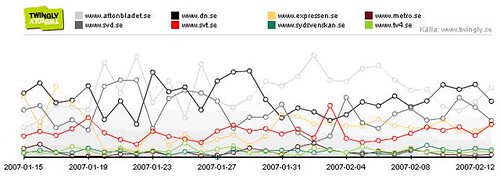
Since Twingly was so new, my last post did not do the service justice. Primelabs, the company behind Twingly, now say that the numbers visible on DN.se should be more accurate. And a new search shows that Twingly tracks as many posts as Knuff.se, and far more than Technorati. The articles listed below are the five most blogged articles at DN.se as of yesterday.

Blogs posts tracked
Article Twingly Technorati Knuff
“V försöker kringgå las” 30 17 29
“Lagrådet ger grönt ljus till avlyssning” 25 13 27
“Upphovsmän kan få jaga fildelare” 35 28 35
“Fortsatta turer kring Anna Nicole Smith” 23 20 22
“Arkeologer hittade 6.000 år gammal kram” 21 8 11

Please note that these numbers only reflect links visible on DN.se. There could be links that Twingly track but are not publicly visible for one reason or another.

It would have been interesting to include Bloggportalen.se in the table above, but I have not found a way to easily calculate how many links there are to a specific article. Maybe Sigge can bring some light on the matter?

The introduction of blog tracking at DN.se and SVD.se has caused quite a stir in the Swedish blogosphere, and most bloggers support the initiative. Some raise concerns that bloggers will increase the number of links to Dagens Nyheter and Svenska Dagbladet in order to drive traffic to their blogs. I can’t see that this is neither surprising or very negative. Bloggers who’s main goal is to have a lot of visitors and be on top of different top lists will do whatever they can to add a few hundred readers to their stats. Others will manage their brand and build a reputation based on their integrity and link to these papers when they feel a need to do so, while refraining from doing it when it is not in line with the theme of their blog. None of these choices, or variations in between, are wrong in my view. These are just citizens that exercise their newfound rights to speak their mind. So instead of critizising bloggers who pimp for visitors, let’s rejoice at the fact that the leading newspapers of this country voluntarily invite YOU to be a part of the dissemination of news.

Maybe you’ve read Roger Enrico’s book “The Other Guy Blinked: How Pepsi Won the Cola Wars”, about how the invincible cola giant Coca-Cola was pressured into changing the formula to the much disliked new Coke, a gigantic fiasco. Well, I think you can look at the introduction of Twingly and similar services (like Aftonbladet/Bloggportalen) as a historic shift where media as the sole gatekeeper has become a thing of the past. With the introduction of blogs and other social media, resisting to invite readers/bloggers into the conversation in the end was meaningless. This is what we’ve been waiting for all along – the breaking up of MSM’s monopoly of news distribution. MSM blinked, in a positive manner of speaking. Sure, a lot of crap will float to the surface, but readers will learn over time where to go and who to skip (as they do when they read blogs in general), and Twingly’s ranking system might help bring the most relevant links to the top of the lists.

And regarding the supposed increase in links to DN and SVD, among the top blogged articles, a majority are from DN and SVD according to Knuff. But according to Twingly, there does not seem to be a huge increase in links to these two sites. So, no need for panic just yet.
twingly13feb

Swedish dailies track [some] blog links

Sweden’s leading daily newspapers Dagens Nyheter and Svenska Dagbladet have started to include links to blogs who comment on articles on the papers’ websites, Washington Post-style. Blog posts are tracked via a tool called Twingly and a list of the most blogged articles at DN can be found here. Example at SvD here. Twingly was just recently launched and has currently indexed about 2.8 million blog posts, which of course is a small number compared to the 1.6 million blog posts that the blogosphere spits out daily. The accuracy will of course improve over time as more and more blogs are tracked by Twingly.

Currently, the Swedish blog portal Knuff is far better att tracking blog links than both Twingly and Technorati. Here is a comparison between the three services and how they track the five top blogged articles at Dagens Nyheter.

Blogs posts tracked
Article Twingly Technorati Knuff
#1 24 19 26
#2 1 10 23
#3 2 2 18
#4 0 6 13
#5 2 4 10

UPDATE: The comparison above is a bit unfair, as Martin from Primelabs explains in the comments to this post. Apparently DN does not show all the incoming links that Twingly has in its database. In the Help section on the site, DN writes that you can find “a list of all blogs that link to an article on DN.se”. For some reason DN chooses to list only a selection of links. If this process turns out to filter out negative articles, then I expect an uproar in the blogosphere when bloggers find out they are being “censored”. Should DN continue to leave out a large part of the conversation they will most certainly open up for criticism.

Tags: , , , , . Ping.

The world’s oldest blogger has been dethroned

“It’s a man’s man’s man’s world”, sang James Brown back in 1966, but when we look at the online world it is increasingly becoming a woman’s world. In the US as much as 64 percent of online gamers are women, according to research by Nielsen Entertainment. In my own surveys (pdf) of the Swedish blogosphere I noticed that female bloggers are now in majority (albeit with a very slim margin) in Sweden and a recenty study of social networks (pdf) by Pew Internet revealed that among online teens, 58% of the girls had created profiles online, but only 51% of the boys. In the age group 15-17 the difference was even greater (70% to 57%).

With that in mind maybe it is just fair that Allan Lööf, who was previously the world’s oldest blogger, has now been dethroned by a woman, 95-year old Maria Arelia from Spain. According to an article in Sweden’s Aftonbladet, she got her blog as a gift from her grand children on her 95th birthday. Maria Arelia was born on Dec 23, 1911 and she writes on her blog that she has already been interviewed by radio and tv. [Hat tip to BetaAlfa 2.0]

Maybe we should settle this competition once and for all by giving a blog to Emiliano Mercado del Toro from Puerto Rico, currently the world’s oldest living person (born August 21, 1891).

UPDATE: Sadly, Mr. del Toro has now passed away.

Tags: , , , , . Ping.

Wishes for 2007

Christmas has not only been a period away from work, but also away from blogging. But Lotta at Citizen Media Watch has tagged me with a challenge – to list five things that I hope or know will happen in 2007. So here are five personal wishes for next year:

1. That a family member will get well.

2. That I to a greater extent will have the opportunity to meet with companies and organisations to hold speeches and give advice on PR and social media related topics.

3. I am going to be on paternal leave for six months which I hope will be a rewarding experience for both me and my daughter.

4. I wish that the summer house we are planning to build will be everything we dreamed of. And on budget.

5. That I get to travel to Brazil, although it is unlikely that it will happen.

Here are five others that I would like to answer this challenge: Andreas Ekström, Goesta & Aaron, Göran Thorstenson, Jonas Söderström and Sakine.