Now you can “anklopfen” on Facebook

While traditional media gloatingly proclaim the death of Facebook, the social networking giant does what it can to get closer to users. Yesterday a German version of the site was launched and it was done through a crowd-sourcing initiative in which 1,000 members helped translate the site in just two weeks.

“Users who added the Facebook translation application were allowed to submit translations inline while browsing the site. Facebook users then approved all translations through a voting system. For example, users agreed on ‘anklopfen’ to describe the Facebook-coined term ‘poke’.” 

According to the press release, the person who was the most frequent translator was responsible for more than 1000 of the winning sentences. Over 40 contributors translated 100 sentences or more.

Oh, and by the way, there is an error in the article at IDG.se about Facebook stats. The article claims that 400,000 UK members left the site the last two months while in reality the only known fact is that it had 400,000 less unique visitors in the UK in January.

BlogSweden 3 – third annual Swedish blog survey

Between January 1 and 2, 2008, a total of 1,000 Swedish blog readers responded to an online survey about blogs and social media. Of these respondents, 806 are bloggers and it is mainly their answers that are being presented in this report. The report, BlogSweden 3, is a follow up to BlogSweden 1 and 2 from May 2005 and June 2006.

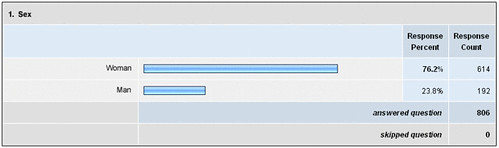
In the survey, three out of four bloggers are women. Here are some more key findings.

Bloggers: The typical Swedish blogger in the survey is:

• Female
• 16-20 years old
• reads 1-5 blogs daily
• spends 1 hour per week reading blogs
• often reads blogs in the evening (6 PM to 12 PM)
• never uses an RSS reader to read blogs
• likes to read blogs about everyday life experiences
• reads blogs to be entertained
• has never clicked on an advertisement on a blog
• is a member of a social network in order to stay in touch with friends
• has during the last 12 months; downloaded video online, listened to radio online or downloaded podcasts, viewed or downloaded video online, have made photos accessible to others online, and has tagged information online.
• has not during the last 12 months; made videos accessible online, saved links via social bookmarking sites or visited virtual worlds.
• blogs because she likes to write
• updates her blog every day
• has nothing against being contacted by companies in her role as a blogger
• is not anonymous
• does not have ads on her blog, from which she gets part of the revenue

In fact, as many as 76.2% of the bloggers in the survey are female.
1e

There are still some major differences between the way male and female bloggers behave:

• Women more often blog anonymously than men (49.2% compared to 34.0%).
• Male bloggers blog to a higher extent than female bloggers to market a product or a service, to influence others, to strengthen their brand, to create an archive of information and because there is a need for more voices in the public debate.
• Female bloggers blog to a higher extent than male bloggers to get in touch with others and to stay in touch with friends and family.
• 66.5% of all bloggers update their blog every day. Female bloggers update their blogs more often than male bloggers (74.1% at least once a day, compared to 42.6% of male bloggers).
• Male bloggers more often than female bloggers have ads on their blogs (14.3% compared to 7.4%).

When a blogger forms an opinion about a company, she thinks that “a person like me or a peer” is the most trustworthy spokesperson. “A blogger” is as trustworthy as the company CEO, according to bloggers.

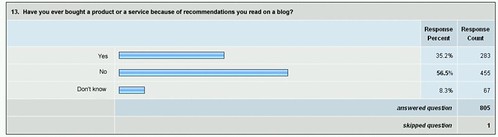
One in three bloggers have bought a product after reading about it on a blog. An equally high proportion of bloggers have refrained from buying a product after reading information or opinions on a blog. One in three have, after reading information on a blog, acted in order to influence a company or a politician on an important topic.
13e

There are also significant differences between how female and male blog readers behave (all respondents in the survey):

Female blog readers prefer reading blogs about:
• Fashion and design (53.0%)
• Everyday life experiences (51.6%)
• Photography and art (26.6%)
• Parenthood and children (24.3%)
• Music (22%)
• Literature and writing (17.2%)
• Movies and tv (16.9%)
• Journalism and media (16.7%)
• Sex and dating (16.5%)
• Politics and society (14.4%)

Male blog readers prefer reading blogs about:
• Politics and society (49.2%)
• IT and blogging (45.8%)
• Journalism and media (45.3%)
• Everyday life experiences (39.4%)
• Advertising and PR (25.8%)
• Movies and tv (25.4%)
• Music (23.7%)
• Photography and art (19.5%)
• Literature and writing (18.6%)
• Economy and entrepreneurship (15.7%)

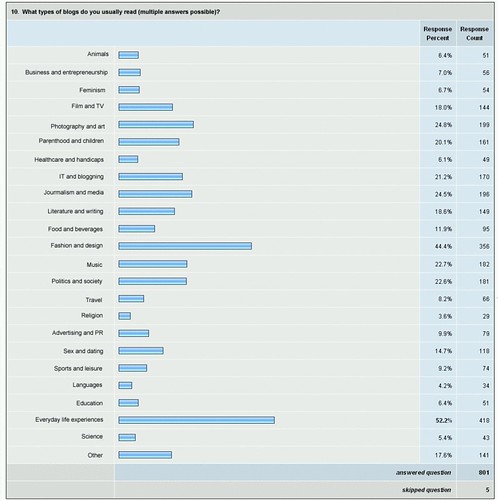
Over all, the favorite topics of blog readers are blogs about:

• Everyday life experiences (48.6%)
• Fashion and design (44%)
• Photography and art (24.9%)
• Journalism and media (23.8%)
• Politics and society (23%)

Here is a table of the most popular blog categories among bloggers:
10e

The report BlogSweden 3 is free to download under a Creative Commons license and if you would like to discuss the findings you can join Media Culpa on Facebook or find me on Twitter. More graphs can be found at Flickr.

Footnote: The respondents were chosen through a convenience sample which means that the results from this survey is only representative to the respondents of the survey and not necessarily reflect the profile of all Swedish bloggers and blog readers.

Tags: , , , , , , . Ping.

Lunarstorm lost half of its visitors in one year

Ekonominyheterna.se reported in November last year that the Swedish online community Lunarstorm suffered from the success of Facebook, MySpace and other social networks. In November, the number of unique visitors to Lunarstorm had dropped by a massive 42%, down to 617,000 weekly visitors.

And the drop continues. Now we can see that the traffic has dropped by 50% compared to the same week last year. A year ago Lunarstorm had 989,733 weekly visitors (unique web browsers) and last week the number was down to 490,289 which is just above a 50% decline.

According to Ekonominyheterna, visits to Lunarstorm peaked in March 2006 with 1.6 million visitors.

Footnote: Stats from KIA-index.

Tags: , , , . Ping.

Bad conscience as business concept

Do men shop? I don’t know about you, but I sure do sometimes. Women (in Sweden) do spend more on stuff like personal hygiene, shoes and clothes, books and magazines than men do. Men on the other hand spend more than women on sports, hobbies and eating out.

The reason I bring this up is because Täby Centrum, Sweden’s largest shopping mall, just published its first customer magazine called Glow. And the magazine is not a bit shy about what customers are its targets – women! The editor-in-chief welcomes her readers with the salutation “Hello, all you glorious women!”.

One would assume that the strategy behind a customer magazine should be in line with the core brand values of the business. Admittedly, shopping is associated more with women than with men, but isn’t it a stretch to leave men out of the picture all together?

When you visit the mall it is clearly not only for women. There are many stores that appeal to both men and women and there are stores that predominantly have male customers, such as Clas Ohlson, affectionately called “gubbdagis”, or “male kindergarten”. So why the magazine explicitly targets women is beyond me. It would of course have been possible to produce a fashion publication that included male consumers.

And while we are at it, the magazine paints a sad picture of the life of a woman. From the frontpage headlines (“The secret behind Keira Knightley’s pout mouth”) to the interview with the self-declared shopaholic, singer Charlotte Perelli, we men get a sense of what supposedly makes our women tick. One gets in a radiant mood from “a luxurious gold dress, delicious boots and nice sunglasses”. Another dreams about high heels, if only her body would cope and she could afford them. Manolo Blahnik is apparently god (“you cannot have too many shoes”).

Even when the magazine writes about more “gender neutral” products such as webcams and cell phones, it cannot resist giving the readers (the glorious women, remember?) a bad conscience for their bodies. “Does the GI diet stop you from putting candy in the easter egg? Give the family something you can use all year instead.”

In the column by Hanna Widell we are getting closer to what the theme of this publication is all about. Widell is divorced and leads a double life, which she loves. One week she is a successful glamouros professional, the next she is a not as glamouros single mom. And when her latest date bumps into her on the wrong week (i.e. as a mom), she concludes that she is not at all surprised that he never called again, the way she looked. In other words, you women aren’t perfect, so if you want to find a decent guy you need to go to the mall and make sure you look fantastic.

This is bad conscience and self-confidence as business concept.

Tags: , , , , . Ping.

Visits to Facebook fell in Europe – February may be even worse

According to data released yesterday by Nielsen Online, the number of unique visitors in the UK visiting Facebook fell in January. The tremendous growth of the social networking site has come to a halt, and the question is whether this is a temporary hiccup or a sign that the glory days are over.

Nielsen Online says that 8.5 million unique users in Britain spent time on Facebook in January, down from 8.9 million in December. MySpace and Bebo are also seeing declining stats.

Alex Burmaster at Nielsen Online says:
– MySpace peaked in April 2007, with 6.8 million unique users, while Bebo peaked in July with 4.6 million.

The number of unique users also fell slightly in other European countries, but Facebook is still growing in the U.S. However, the numbers for February do not look promising. Not that I trust data from Alexa to be 100% accurate, but a graph of the daily pageviews of Facebook show a dramatic drop during the first days of February, a drop that is in the 20-25% range which is very high. It will be very interesting to study Nielsen’s data for February. [Alexa graph here]

UPDATE: Facebook sees decline in the U.S. as well. According to comScore, Facebook attracted 33.9 million unique visitors in January, 2008, down 2 percent from 34.7 million in December, 2007.

Tags: , , , . Ping.

Social media drives traffic to Electrolux

The Swedish based global kitchen appliance company Electrolux is more and more looking like the local leader when it comes to corporate use of social media. And maybe it can be the 800-pound gorilla that is needed to get more businesses to try out this space. The company has a social media news room, a presence in Second Life and is also present on Facebook via the Lunch Club application. In an interview on Resumé tv, Electrolux’s global Director of Communications Lars-Göran Johansson reveals that the company has a staff of 20 people that work with online projects, including social media.

Johansson describes how Electrolux has experimented with adding photos of the main office building on Google Earth. He also said that half of the members of the executive board are now members of Facebook. So, you might wonder, what are the results of these initiatives. Well, according to Johansson, 7 out of 10 customers search for information online before a purchase and one goal of many of these features is to drive traffic to the site. Last year the traffic increased by some 70-80% which must be considered a great achievement, although social media probably is not the only reason behind the success.

I recommend that you keep a close eye on Electrolux for further good examples on how corporates can embrace social media.

Tags: , , , , . Ping.