Magazines and papers are opening their vaults

Online newspaper advertising in the U.S. rose by 18.8 percent in 2007 to $3.2 billion, according to the Newspaper Association of America [via Mindpark]. And although advertising on newspaper web sites have seen double digit growth for thirteen consecutive quarters, the increase in Q4 was the lowest in the last eight quarters, “only” 13.6 percent.

However, we should not be surprised if this is a temporary dent in the curve. Many news organisations have begun to exploit a resource that has remained largely untouched up til now, namely their archives. About a week ago, Sports Illustrated introduced the Vault, a free part of SI.com that contains all the articles that Sports Illustrated has ever published, many of the images, and some video material. The Vault is expected to account for 5 percent of SI’s online revenue in its first year and then continue to grow.

Other sites have done the same and the experience from for example the New York Times is that the archives drive a significant amount of traffic, with increased ad revenue as a result. When NYT removed its pay wall last September, visits to the archive grew quickly.

– Since then, search traffic to archive pages has more than doubled, and the archives now represent 10 percent of the page views on NYTimes.com, said Diane McNulty, a spokeswoman.

In other words, as more newspaper sites follow the same route, advertising revenue will continue to increase. And with those numbers in mind, it will be interesting to follow how sites like Swedish tabloid Aftonbladet will manage to keep content behind a pay wall. Aftonbladet.se has indeed seen an increase in the number of unique visitors during the last 12 months by about 12 percent, according to KIA Index, so they’re not doing so bad after all.

Tags: , , , . Ping.

DagensPS to add Twingly and host blogs in redesign

Media Culpa can reveal that the Swedish business online publication DagensPS is planning to introduce blog links via Twingly and social bookmarking features in a new redesign. That’s the conclusion after we got access to two versions of the site at dagensps.se. The new site design, which was labelled “DEMO” just a few days ago, is not yet launched. It has a much simpler feel to it with less (and fewer) colours and lighter fonts. For example are serifs introduced for the largest headlines instead of sans-serifs.

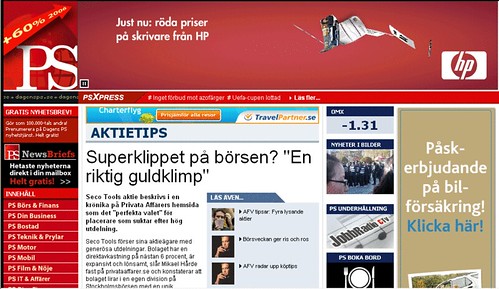
The current design below:

dagensps_old

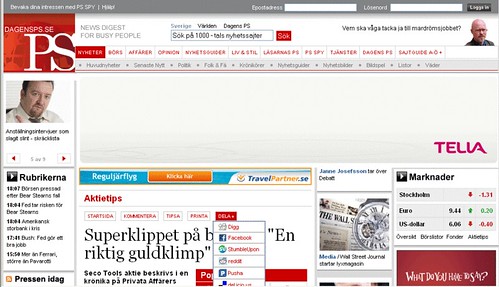
The demo design below includes such features as “sharing”, i.e. you can save and share articles via the social bookmarking sites Digg, reddit, StumbleUpon, Pusha, del.icio.us, Ma.gnolia and of course via Facebook.

dagensps_new

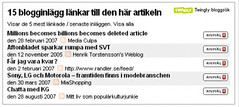
The new site will also link to blog posts via the Twingly service (DagensPS is not listed yet as a partner of Twingly).

dagesps_twingly

Under “Services” the site is set to include for example a blog hosting service (“create a blog”).

dagensps_blogg

The redesign does not seem to be ready for launch just yet since articles with the old fonts appear further down on the pages. But by the look of it the site will make better use of social media tools and have a more appealing design. Definitely a step into web 2.0.

Tags: , , , . Ping.

10 easy ways to piss off a blogger

Rohit Bargava ran a conversation with about 70 participants at the SXSW with the purpose of establishing a list of “10 Easy Ways to Piss Off a Blogger”. I think the group did an excellent job. Here’s the list:

1. Invite bloggers to participate in something and don’t give them a chance to talk about themselves. This was what I opened the session with, followed by letting people around the group introduce their name and their blogs. A list of people who chose to share their names and blogs is at the end of this post.
2. Pretend to be a “long time reader” when you actually just visited the blog once and read a few posts.
3. Use a blogger’s content or identity without giving proper attribution
4. Send irrelevant information that exhibits no understanding of what they care about or fail to personalize it
5. Add them to a PR list and don’t let them get off of it
6. Make it hard for them to link to something by hiding your content behind usernames/passwords, giving them uncertain directions or requiring them to take multiple steps
7. Ask for favors as part of your first outreach to them without building a relationship or earning the right to ask them to help you
8. Fail to identify yourself or falsely represent yourself as something or someone you are not. This includes failing to mention something about your or your employer that is relevant.
9. Set an unreasonable expectation for a blogger and expect things in an unreasonable amount of time … i.e. sending information and expecting them to post within a few hours. Quick poll of our session showed that for the vast majority of bloggers, it’s not their day job.
10. Get the journalism relationship right. Some bloggers consider themselves journalists and others don’t. It was clear from the participants that this is a tricky subject, as some people also noted after the session.

Tags: , , . Ping.

Is Fredrik Reinfeldt anti-Facebook?

Fredrik Reinfeldt, the Swedish Prime Minister, held a speech on February 26, 2008 to students at the The London School of Economics and Political Science. The theme was “The New Swedish Model: A Reform Agenda for Growth and the Environment”. When I read through the speech I was somewhat baffled by the following comment in the introduction:

“It is a pleasure to be here at LSE. Anybody who wants to study globalisation should start at this institution. I believe you have the highest proportion of international students in the world.

And you are smart.

I am told that you borrow four times as many books as the average UK student. Obviously you do not spend too much time on

Facebook
YouTube
MySpace”

So, books=smart and social networks=not as smart? Books are obviously important in education, that’s a no-brainer, but social networks aren’t necessarily just a distraction. They are great tools if you want to build a network of contacts, participate in a community and explore new technologies, business models and ideas. In a networked world you have to be connected.

If Sweden is going to stay competetive in an increasingly integrated world economy we need to participate where new ideas emerge. I believe that Sweden is a net exporter of both music and film and I can see no reason why we should not be able to have the same position in the social media space.

In Reinfeldt’s own words: “Sweden must therefore be a country that better accommodates those who dare to take risks, develop their ideas and spread their wings to become self-employed.”

Some of the smartest people I know are participating in this new arena, and of course, I think they’ve read a few books too. Besides, remember that Facebook initially was restricted to students of Harvard and soon expanded to all Ivy League schools including MIT and Boston University.

Maybe I am excessively positive, but I’ll take that chance. Social networks can of course be huge productivity thiefs, but it’s more complicated than that. Instead of assuming that social networks are just a form of procrastination, we should encourage Swedes to participate in this new landscape so that we will become the most networked people on the planet. If we do that, I am sure many great new companies will emerge.

Footnote: The LSE network at Facebook has 19,698 members. I haven’t found the total number of students (or alumni) at the school, but it sure sounds a lot to me.

Tags: , , , , , , . Ping.