Flickr reaches 3.5 billion photos

The popular photo sharing site Flickr today reached 3.5 billion hosted photos. The growth has been steady the last 2 years with almost exactly half a billion new photos added to the site every six months.

Photo number 3,500,000,000 can be viewed here.

Previous milestones for Flickr:

22 Oct 04: 1,000,000
20 Apr 05: 10,000,000
15 Feb 06: 100,000,000
22 Sep 06: 250,000,000
15 May 07: 500,000,000
19 Jul 07: 850,000,000
06 Oct 07: 1,500,000,000
13 Nov 07: 2,000,000,000
17 May 08: 2,500,000,000
03 Nov 08: 3,000,000,000
04 May 09: 3,500,000,000

My previous post about Flickr reaching 3 billion, 2.5 billion and 2 billion.

Tags: , , , , . Ping.

Growth in Fortune 500 corporate blogs

A new study (pdf) by the Society for New Communications Research (SNCR) has found that the percentage of Fortune 500 companies that have public-facing corporate blogs have increased. Now 81 (16%) of the corporations listed on the 2008 Fortune 500 have a corporate blog which has been updated with a new post in the past 12 months. Three of the top five corporations (Wal-Mart, Chevron and General Motors) have blogs while Exxon/Mobil and Conoco Philips do not.

This is up from 14.8% of Fortune 500 companies found in a study (see below) by Burson-Marsteller (where I work) a year ago. But it still a significantly lower percentage than the Inc. 500 (the fastest-growing, private companies in the US), of which 39% have external blogs.

The industry with most blogging corporations was “Computer Software, Peripherals, Office Equipment” with 8 companies followed by Telecommunications (5) and Food Production, Services and Drug Stores (5). The study also showed that the adoption was greater among the largest companies, 38% among the top 100, compared to 10% among 400-500.

Mere than 90% of the Fortune 500 blogs take comments, have RSS feeds and
take subscriptions and 23 companies (28%) linked to a corporate Twitter account.

Data was compiled in March 2009.

Figures from the B-M 2008 study can be found here:

The Fortune 500 Blogging Indexhttp://static.slidesharecdn.com/swf/ssplayer2.swf?doc=fortuneblogwhitepaper-1214292271795886-9&stripped_title=the-fortune-500-blogging-index

More corporation on the Fortune 500 are blogging than among the largest Nordic listed companies. A study I did with my colleagues last fall showed that only 9.1% of the corporations on the Large Cap list (the largest listed companies in Sweden, Norway, Denmark and Finland) had external corporate blogs. White paper here (pdf).

Corporate blogging among Nordic listed corporationshttp://static.slidesharecdn.com/swf/ssplayer2.swf?doc=nordic-large-cap-blogging-4-1227082244290388-9&stripped_title=corporate-blogging-among-nordic-listed-corporations-presentation

View more presentations from Hans Kullin.

Tags: , , , , , , , , . Ping.

De läser modebloggar – ur BloggSverige 4

Från min undersökning BloggSverige 4, se mer detaljer här, har jag tagit ut svaren från de 749 personer som angett att de läser modebloggar. Såhär ser alltså den typiska modebloggsläsaren ut i Sverige.

Kön:
Kvinna: 94,1%
Man: 5,9%

Ålder:
0-15 år: 17,0%
16-20 år: 58,1%
21-25 år: 15,1%
26-30 år: 5,9%
31-35 år: 1,7%
36-40 år: 0,7%
41-45 år: 0,9%
46-50 år: 0,4%
51-65 år: 0,3%
66 år eller äldre: 0,0%

Hur många timmar per vecka spenderar du normalt med att läsa bloggar?
0: 0,0%
1: 6,3%
2: 16,3%
3: 14,6%
4: 11,5%
5: 15,9%
6-10: 23,8%
11 eller fler: 11,6%

Läser helst bloggar om:
Mode och design: 100,0%
Foto och konst: 56,6%
Vardagsbetraktelser: 51,1%
Musik: 27,0%
Föräldraskap och barn: 25,1%
Journalistik och media: 16,2%
Sex och dejting: 16,2%
Film och TV: 13,2%
Mat och dryck: 13,0%
Litteratur och skrivande: 12,7%
IT och bloggande: 12,4%
Annat: 11,3%
Resor: 8,5%
Politik och samhälle: 7,5%
Hälsa, sjukvård och handikapp: 7,1%
Sport och fritid: 6,4%
Feminism: 5,3%
Djur: 5,2%
Reklam och PR: 5,2%
Utbildning: 5,2%
Ekonomi och företagande: 4,5%
Vetenskap: 1,6%
Språk: 0,9%
Religion: 0,4%

Har du någonsin köpt en produkt eller tjänst tack vare rekommendationer på en blogg?
Ja: 40,1%
Nej: 50,3%
Vet ej: 9,7%

Skriver du på någon av följande mikrobloggar?
Twitter: 5,1%
Jaiku: 1,8%
Bloggy: 3,2%
Nanoblogg: 1,4%
Jag skriver inte på någon mikroblogg: 92,8%

Hur ofta uppdaterar du din blogg?
Flera gånger varje dag: 34,9%
Varje dag: 38,6%
Varje vecka: 21,3%
Mer sällan än varje vecka: 5,1%

Hur mycket pengar har du totalt tjänat på annonserna på din blogg de senaste 12 månaderna, före skatt?
0-100 kr: 65,7%
101-500 kr: 17,9%
501-1000 kr: 3,0%
1001-5000 kr: 9,0%
Mer än 5000 kr: 4,5%

Svaren kan jämföras med svaren från samtliga bloggare eller bloggläsare som redovisats i enkäten, se länk ovan.

Uppdaterad: Aftonbladet skriver om BloggSverige 4, dock utan att länka till rapporten.

Tags: , , , , , , . Ping.

SVT finds Pirate Bay both guilty and not guilty

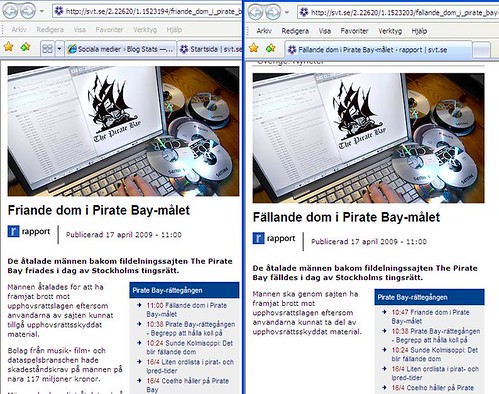
The four men behind the bittorrent tracker the Pirate Bay today was sentenced to one year in jail and 30 million kronor in damages. But a few minutes before the verdic was announced, SVT – the Swedish public service television – published two articles online, one in which the team behind the Pirate Bay was acquitted and one in which it was found guilty. See screen dump here.

piratebay

Tags: , , , , . Ping.

Twitter etiquette for businesses

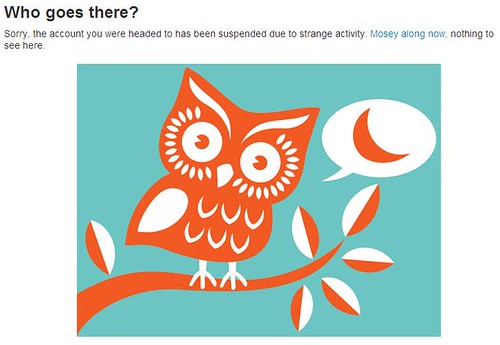
Swedish businesses are starting to explore Twitter with varying degree of success. SMS loan company Folkia recently launched its Twitter account and quickly added several hundred users to follow, something that was discussed on Jaiku. It also published only promotional information about their own services and a few days later the account got suspended.

folkia

The same strategy was used by Myspace Nordic which added some 2,000 people in a few days. This procedure is called “aggressive following” (a large number of people are followed in a short amount of time) and is one reason (update: new link) a Twitter account may get suspended.

With these incidents in mind, here’s 10 advice for businesses that are about to engage on Twitter (parts of this is also published in Dagens Industri today).

  • Be clear about who the sender is. Is this the official Twitter channel then make that clear. If you can specify who is doing the tweeting it will be easier to get a more personal relationship with the company and it will also set the right expectations.
  • Twitter is a great tool for listening to customers and for dialogue in general. Answer direct questions and comments that are directed to the company on Twitter.
  • Give your followers something of value for following you. Share your knowledge, both from your own company but also from other sources. Excessive linking to your own site might be considered spam.
  • Retweet good tips from others. It shows your are willing to give cred to others and that you are up to date on things within your line of work.
  • Use common sense. All information (apart from Direct Messages) are public so normal confidentiality rules still apply.
  • Respect the privacy of others. Just because you have heard that transparency is the new black, that doesn’t mean it is ok to tweet about colleagues without their approval.
  • Add other sources of information to your Twitter feed if you think they are of value to your followers. It might be press releases, Flick photos, YouTube videos or promotional offers. But be careful, a feed with just press releases is extremely boring.
  • Don’t ask for retweets, unless you are posting a question you want many to see. That’s something you deserv by posting interesting information.
  • Don’t start following hundreds of people at once. It is called aggressive following and is one reason your account may be suspended by Twitter. But adding a small number of interesting people may be a good way to start building your network.
  • Avoid ghost twittering if you can. You can support the person in many ways but in the end the words should be his/her own.

Here are some examples of Swedish businesses on Twitter (many taken from a list on Webbsverige).

3
Acne
Björn Borg
Boxer
Dustin
Electrolux
Lantmännen
Pyramid
Rebtel
Scania Group
Skanska Group
Spotify
Tele2
Telia Sonera Services
Ving
Vulkan
Ängavallen

Traditional media plan to invite readers even more

It might seem strange now, but it wasn’t very long ago that traditional media did not do much in order to reach out to the audience through journalist blogs and other means. RSS feeds is also a feature that most media outlets have not used for more than a few years. Back in 2005, this blog had more incoming links that the website of Göteborgs-Posten (159 vs 134 for www.gp.se), the largest daily in Sweden’s second town. TV4.se had the same amount of incoming links as my blog had, according to Technorati. In 2005, Sweden’s largest daily Dagens Industri didn’t even keep links to online articles for more than a few weeks or months. This is what I wrote in January 2005.

“Links to articles on its web site di.se, disappear soon after they have been published. A search on Google for a random word like “Tallinn” on di.se gives us only 11 hits, and the first article in the list (hit #5 in Google) is from April 2004, and it’s a dead link. This message is a common greating on di.se (“the page has changed address”).”

Today, the situation is entirely different. Any media worth its salt has a number of blogs and invite the audience to participate in the news process. Media link to comments on Twitter and some journalists even ask for news tips on Twitter. The list can be made much longer. Much of the commentary on blogs today revolve around news stories in traditional media, although there is also a significant portion of the online discussion that is entirely separate from the old media model. If we look at the number of incoming blog links today, this blog has 522 but TV4.se has 2,855 and www.gp.se has 5,381.

And more will come. There was an interesting article yesterday on E24.no about the future of traditional media. Gunn Enli is a media researcher at the University of Oslo. She has some good quotes about how media will invite the audience in the news process.

“There has been a media revolution that we can no longer ignore. We have become so accustomed to be invited to participate and to express ourselves that it is not possible to lock those channels again,” Enli says.

Espen Egil Hansen, the responsible editor at VG Nett agrees. He says:

“The control culture in locked rooms is gone. The times when you could be a journalist alone in your office and be brilliant is over. Either you communicate with the world around you or you die.”

Both NRK and VG will introduce more participatory features in the near future.

“We will take functionality from for example Facebook or Nettby and build it into the editorial products,” Hansen said about the plans for VG Nett the coming six months.

Tags: , , , , , , . Ping.