Widget for Swedes on Twitter

Billy McCormac recently suggested that Swedes on Twitter would use the hashtag #svpt for their tweets so that it would be easier to tap into discussions by fellow Swedes. This morning he posted a question on Twitter about how we can get people to use the tag.

I think there has to be a clear incentive in order to get people to start using a general hashtag. One such incentive could be that other people can find your micro blog posts and thereby users can grow their networks. So if you can publicize the stream of tweets on your blog, you will also reach non-Twitterers, and all users that use the #svpt tag will benefit.

I quickly set up this widget this morning. Maybe this can help promote the Swedes on Twitter channel. Feel free to post it to your blog, link to it, or just leave a comment if you think this is an interesting or lousy idea. You can of course also subscribe to the #svpt RSS feed by copying this URL to your blog reader: http://search.twitter.com/search.atom?q=%23svpt

You can also visit Widgetbox to get the embed code to post the widget to your MySpace page or Blogger/Wordpress blog.

If you want to follow me on Twitter you can find me at http://www.twitter.com/kullin

Footnote: Other examples of hashtags on Twitter: Mumbai and Motrinmoms.

Tags: , , . Ping.

Old data in new study on Swedes and blogs

SOM-institutet, the SOM Institute at Göteborg University, has released the results of a study about blogging – “Bloggers – who are they?”. In my view, the researcher Annika Bergström has had a somewhat skeptic attitude towards the role of blogs in previous comments. In an interview in Dagens Nyheter in 2006 she said about our media consumption that “there are changes, but they are slow, there will be no revolution”. She also commented to IDG.se that the differences in blog adoption between Sweden and the USA is due to strong Swedish tradition to read newspapers.

– Swedes turn to traditional dailies online for information. And we don’t get more time just because new media appear.

A year ago she said that “not many people read blogs, and the ones that do are often the ones that blog themselves”.

This skepticism is visible also in the “new” study. I write “new”, because the data was collected during the fall of 2007. In the report, Bergström writes:

“The survey was conducted during the fall of 2007 and it is likely that the use of blogs have increased slightly since then, but if we look at what we know from the development of other areas of online behavior we should expect only small changes.”

The study says that only 2 percent of Swedes wrote a blog each week and that 15 percent read a blog weekly. Good for us then that the World Internet Institute the other day released it’s fresh report about how Swedes use the internet, so we have figures for 2008 to compare with.

WII says that 5 percent of the population blog and 26 percent read blogs, which according to me is more than just a “small change”.

When respondents in the SOM survey were asked if they had read a blog during the last 12 months, 39 percent said yes. Still the final comment in the report reads:

“The previously mentioned debate about the importance of blogs, is to a high degree about what a small portion of the population engage in. With that said, there is nothing that says that single blogs can have a larger influence in society.”

This old data seems to appeal to TU, the Swedish Newspaper Publishers’ Association. On its site TU comments on the “latest figures” on blogging like this:

“Nowadays it seems like everyone is blogging. But it is not entirely true. Two percent of Swedes blog each week. And 15 percent reads what they write. The so called blogosphere is, in other words, smaller than the impression we get from the media attention.”

Stats from WII suggests that 1.9 million Swedes read blogs so I think it is safe to say that blogs are starting to reach a significant portion of the population. In my view, this study is based on data that is too old to really have any real value, and it doesn’t do newspapers any good to take these figures as a sign that blogs and other online channels are no big threat to them.

Tags: , , , . Ping.

Launch video unavailable when YouTube opens up in Sweden

As expected, YouTube today opened up a Swedish version of the site. A launch video is posted on the site in which a number of celebrities welcome YouTube to Sweden, including Google’s Chief Internet Evangelist Vint Cerf; Mona Sahlin, leader of the Social Democrats and Ulf Ekberg of pop combo Ace of Base. The video is also promoted on the front page of the Social Democratic Party webpage (!).

For some reason YouTube has made it very hard to embed this launch video and it took me a while to find the embed code.

What the video does not reveal is how a Swedish version is any different than using the global site. Everything on the site is still in English, a language most Swedes handle very well.

On top of this, the launch video is suddenly unavailable. Probably temporarily, because as I type this the video comes back up, becomes unavailable again, then up again.

www.youtube.se

Tags: , , , , . Ping.

Almost 2 million Swedes read blogs

Following up on my previous post, I have now read through parts of the World Internet Institute’s new report about how Swedes use the internet.

Some of the more interesting findings are:

– 350,000 Swedes have a blog (estimate), or 6% of the online population.
– 1,900,000 Swedes read blogs (estimate), or 33% of the online population. That means that there are more than five times as many blog readers as there are bloggers. Possibly a good argument against the common view that “nobody reads blogs”.
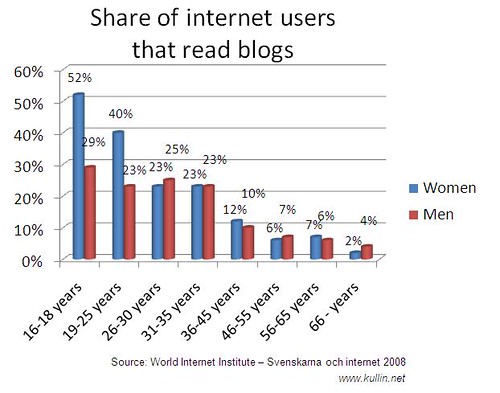
– Young women between 16 and 25 years are frequent blog readers, see graph below. As many as 52% of all girls 16-18 years that are online, read blogs.

swedenblogreaders

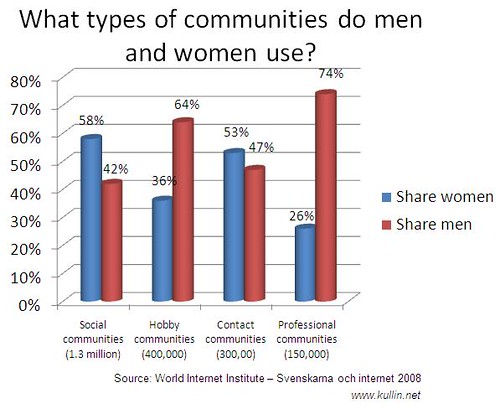
– There is a big difference in which types of communities that attract women and men. Women are more frequent users of social communities while men are more frequent users of hobby and professional communities, see graph below. In my BlogSweden 3 survey the responses indicated that women are more motivated by social interaction than men, which was also a result from a study by Kaye Trammell: “Female bloggers, however, were somewhat more motivated by social interaction (67.1%) than were their male counterparts (51.3%).”

swedencommunities

Tags: , , , . Ping. Följ min blogg med bloggkoll

Swedish footballer banned from blogging

Kalmar FF’s midfielder Viktor Elm has been chosen to play for the Swedish national team. Viktor and his two brothers Rasmus and David are part of the reason why Kalmar currently is the best football team in Sweden. But the trio are not only succesful on the pitch, they also have a very popular blog on the local newspaper Barometern’s site.

However, as the Swedish team meets to prepare for the first FIFA World Cup qualifier against Albania on Saturday, the Swedish team manager Lars Richt tells fotbollskanalen.se that Elm will not be able to blog while he is with the Swedish team.

– That is something that we don’t do when we meet and I will talk to him about it, says Lars Richt, and continues.

– I will talk to him and after that he will surely not blog.

The Elm brothers’ blog caused some commotion after the brothers blogged some negative comments about Henrik Larsson and how media portray him. Still, even if Viktor Elm is quite outspoken on his blog, it does seem that the Swedish national team should lighten up a bit about this command and control attitude towards media and everyone else, for that matter. Football is the sport that interests most Swedes and it wouldn’t be hard to use this commitment to get fans talking and discussing even more about football. A search for football on Twingly.com shows more than 4,000 Swedish blog posts during the last month. I think the Swedish Football Association is crazy not to participate in this discussion. Encourage your fans, let all players have a blog, invite bloggers to press conferences, build a social media press room on your site. There are many things you could do, and if you don’t know how, I can show you.

Tags: , , , , . Ping.

Poke is “peta” when Facebook goes Swedish

Facebook will soon release a version in Norwegian (via NRK beta). The social networking site has been translated by members to Norwegian and is currently in a voting stage where users are choosing the best options for different translations. Facebook is also soon to be released in Swedish, according to the Translation application on the site.

“Poke” is currently “peta” in Swedish and “prik” in Danish. In Norwegian it is still called “poke” although “pirk” and “dytt” are possible alternatives. Other suggestions for poke in Swedish are “puffa” and “knuffa” and users will decide which translation that will win.

1,207 members are currently registered as translators for Norwegian and 480 for Swedish.

Tags: , , , . Ping.