Using Twitter for real-time search

I’m not a search expert, but working in communications requires at least basic knowledge about online search. Search is such a vital part of the way we find information about brands these days. A recent Swedish study (pdf) showed that among those who used the internet to search for information about products and services, 91 percent used a search engine.

We can also use data from search ingines to track the latest buzz online. A good tool to see trends in search behaviour is to use Google Insight For Search which shows how often different search terms have been used over time. It also tells you what terms have increased the most during the last few days.

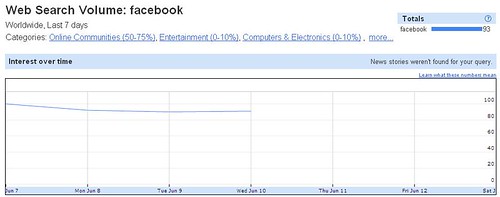
If we use Google Insight For Search to see how often people search for the term Facebook, we can’t find anything unusual related to Facebook that happens right now.
facebook-google-trends

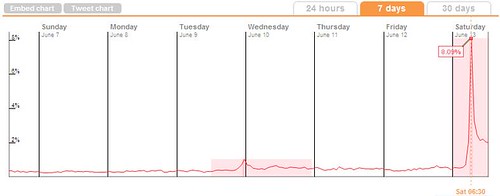
But as most of you know, Facebook launched vanity URLs today on a first-come, first-served basis. So members who wanted to grab a specific name had to be alert this morning to secure the desired URL. Obviously the has been a lot of buzz about this on Twitter this morning, so a quick search for “Facebook” on Twist, a tool for trend search on Twitter, we discover that there was a big peak in mentions of Facebook on Twitter this morning.
vanityurl-facebook

It might not be the perfect tool, but I think the difference illustrates how Twitter and Twitter-related applications are becoming very useful in finding out what happens in close to real-time on the web. Other tools that analyze Twitter to bring you the latest buzz are MicroBlogBuzz (no 1 topic: Facebook Username) and Retweetradar (Facebook is one of the most retweeted phrases right now).

Google knows this, of course. This article states that Google is working on solutions for real-time search but I haven’t managed to find out how that works.

Tags: , , , , , . Ping.

Facebook vanity URLs doesn’t work via mobile

This morning many people are logging on to Facebook to claim their vanity URL, a personalized web address that makes it easier to share the link to your profile page. My profile page can now be accessed at http://www.facebook.com/kullin instead of facebook.com followed by a series of numbers and signs. But the new vanity URLs are not accessible via mobile phone. If you type http://m.facebook.com/kullin you get an error message that the page is not valid.

Facebook has more than 20 million monthly users that access the social networking site via mobile platforms so the problem with the profile pages must be solved quickly.

Hat tip: Albert Cuesta.

Tags: , , , , . Ping.

Swedish daily gets 8 percent of traffic from social media

One of the challenges with trying to convince businesses and organizations to engage in social media is that there isn’t an abundance of public cases with measurable results. In order to invest, many want to see proof that social media can deliver. Therefore it is with great pleasure I read that the local Swedish daily Sydsvenskan gets 8 percent of its web traffic from social media sites. Mattias Pehrsson writes today on Sydsvenskan’s blog:

“For more and more readers, the door to us is not the address http://sydsvenskan.se or a search engine, it’s a link in a blog, in a [social] network or in a forum.”

Last week, 8 percent of the traffic to Sydsvenskan.se came from social media sites, out of which Facebook is the leading referring site with 1.5 percent of the generated traffic. After Facebook comes Svenska Fans (sports community), Buzz (forum), Wikipedia and Twitter. Each of these sites deliver a few tenths of a percent of the total visits to the site. Pehrsson explains:

“But above all the traffic from social media is about the long tail. Many small sources in the end make up 8 percent of the visits”.

There you have it. Now go fish where the fishes are.

Tags: , , , , , , . Ping.

Traditional media plan to invite readers even more

It might seem strange now, but it wasn’t very long ago that traditional media did not do much in order to reach out to the audience through journalist blogs and other means. RSS feeds is also a feature that most media outlets have not used for more than a few years. Back in 2005, this blog had more incoming links that the website of Göteborgs-Posten (159 vs 134 for www.gp.se), the largest daily in Sweden’s second town. TV4.se had the same amount of incoming links as my blog had, according to Technorati. In 2005, Sweden’s largest daily Dagens Industri didn’t even keep links to online articles for more than a few weeks or months. This is what I wrote in January 2005.

“Links to articles on its web site di.se, disappear soon after they have been published. A search on Google for a random word like “Tallinn” on di.se gives us only 11 hits, and the first article in the list (hit #5 in Google) is from April 2004, and it’s a dead link. This message is a common greating on di.se (“the page has changed address”).”

Today, the situation is entirely different. Any media worth its salt has a number of blogs and invite the audience to participate in the news process. Media link to comments on Twitter and some journalists even ask for news tips on Twitter. The list can be made much longer. Much of the commentary on blogs today revolve around news stories in traditional media, although there is also a significant portion of the online discussion that is entirely separate from the old media model. If we look at the number of incoming blog links today, this blog has 522 but TV4.se has 2,855 and www.gp.se has 5,381.

And more will come. There was an interesting article yesterday on E24.no about the future of traditional media. Gunn Enli is a media researcher at the University of Oslo. She has some good quotes about how media will invite the audience in the news process.

“There has been a media revolution that we can no longer ignore. We have become so accustomed to be invited to participate and to express ourselves that it is not possible to lock those channels again,” Enli says.

Espen Egil Hansen, the responsible editor at VG Nett agrees. He says:

“The control culture in locked rooms is gone. The times when you could be a journalist alone in your office and be brilliant is over. Either you communicate with the world around you or you die.”

Both NRK and VG will introduce more participatory features in the near future.

“We will take functionality from for example Facebook or Nettby and build it into the editorial products,” Hansen said about the plans for VG Nett the coming six months.

Tags: , , , , , , . Ping.

Blogging still more popular than Twitter

The most prestigious Swedish advertising awards Guldägget (the Golden Egg) were handed out last evening and several prizes were given to campaigns that involved social media.

“If I should mention one trend then it has to be that the winning campaigns used a lot more of social media and PR than before”, said Digge Zetterberg, responsible for Guldägget at the Advertising Association of Sweden.

Among the different social media tools, there is little doubt that Twitter has been the one that has gotten the most attention lately. Politicians, opinion leaders and now even businesses in Sweden have joined Twitter in hope of influencing key people in their target audience.

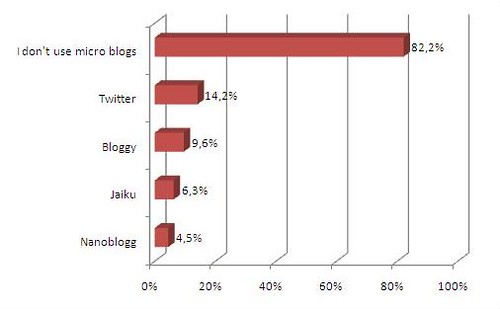
But micro blogging is still lagging conventional blogging, at least according to the results from my fourth annual Swedish blog survey BlogSweden 4/BloggSverige 4. I surveyed 1,500 blog readers in Feburary this year and more than 8 out of 10 do not use micro blogs. Twitter is the most popular of the ones mentioned in the survey and the local Swedish micro blog Bloggy has in a short period of time become more popular than Jaiku.

21 blog readers

Several also mentioned the status bar in Facebook as a micro blog tool they use. More results from the survey will be published here in the next few days.

Tags: , , , , , , . Ping.

Ace of Base relaunch with fans as fourth member

mia rose and ulf ekberg of ace of base

British-Portuguese artist Mia Rose became an instant hit on YouTube after uploading videos of herself singing. The twenty-year old singer quickly grew a large dedicated fan base that loved her songs on YouTube, which has now been viewed many million times. Her channel on YouTube has more than 150,000 subscribers. Her popularity got her a record deal with a major record label, which she now has left for an independent label in order to be more in control over her career.

mia rose at sime

Mia performed one of her songs today at SIME in Stockholm and attended a panel together with Stefan Glaenzer, founder of Last.fm and Ulf Ekberg of Ace of Base. Last.fm according to Glaenzer “is the last destination you need in your life”.

Swedish pop combo Ace of Base might be the next succesful example of the future of the music business. Ulf Ekberg showed how the band is preparing for a comeback after more than a decade in retirement. This morning the band launched a widget on its website that lets users remix and change the band’s songs. People can share the widget with their friends on Facebook, MySpace, Piczo, Bebo, Blogger, hi5 and other social network. There is a sequencer where users can create their own remixes of both old and new Ace of Base songs, buy new loops and materials to add to the remixes. The band will also use the best remixes and put them up on the site. By engaging fans to make their own versions, Ace of Base creates a number of new revenue streams.

The former four man band now has three members, but as Ulf Ekberg stated:
– The fourth member of Ace of Base is now the consumer.

Tags: , , , , . Ping.