Sydsvenskan today writes about the media year 2005 and the balkanization of media. Apparently as many as 145 publications were launched in Sweden in 2005, among them five (!) sudoku publications. Since 2002, almost 400 new publications have been introduced in the Swedish market.
von Holstein is blogging
“Sanningen enligt mig” (The truth according to me) is a new blog by IT guru Johan Staël von Holstein who has been the entrepreneur behind for example Icon Medialab and Letsbuyit.com. Glad to see that I’m almost two years ahead of him this time 😉
680% increase in blog coverage during 2005
It’s safe to say that Swedish mainstream media “got blogs” in 2005. I predicted in November 2004 that blogs had broken through on a wider scale in Sweden as the number of articles about blogs in media increased significantly during that month. And the increase has continued during 2005. Swedish media wrote 500 articles mentioning blogs during 2004. This year we are up to 3,404 articles, that’s a 680% increase.
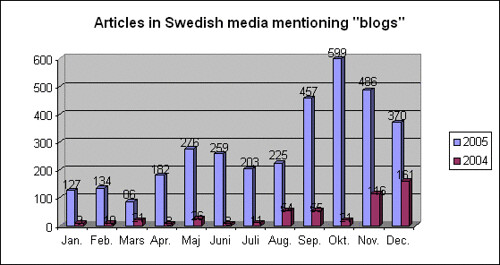
October was the month with the highest number of articles: 599, more than the entire year before. Some of the blog related news that got covered during October included:
– The pseudonymous blogger Mats Hård is revealed.
– Journalist blogger Linda Skugge is nominated for Sweden’s grand journalist award (which she didn’t win).
The mainstream media that wrote most about blogs were (number of online articles during 2005):
1. Aftonbladet (257)
2. Svenska Dagbladet (211)
3. Computer Sweden (191)
4. IDG (186)
5. Norrbottens-Kuriren (107)
6. Expressen (107)
7. Dagens Nyheter (80)
8. Helsingborgs Dagblad (73)
9. Trelleborgs Allehanda (61)
10. Ystads Allehanda (60)
An interesting fact about these statistics is that Aftonbladet only published two (2) articles that included the word “blog” (in Swedish) during 2004. The very first Aftonbladet article available online this year is from 25 March 2005.
Source: Retriever.
Technorati tags: blog, media, statistics.
UCLA media bias study under counterfire
UCLA has published a study that finally “proves” that US media has a liberal bias. The usual Swedish suspects are quick to jump on the bandwagon (and make parallels with Sweden). Now, it’s hard for me to comment on the study when I haven’t read it, but after reading the summary I thought the methodology was a bit odd. Then I found this response from Dow Jones, and thery’re not pulling their punches:
“…the research technique used in this study hardly inspires confidence. In fact, it is logically suspect and simply baffling in some of its details.”
They continue:
“First, its measure of media bias consists entirely of counting the number of mentions of, or quotes from, various think tanks that the researchers determine to be “liberal” or “conservative.” By this logic, a mention of Al Qaeda in a story suggests the newspaper endorses its views, which is obviously not the case. And if a think tank is explicitly labeled “liberal” or “conservative” within a story to provide context to readers, that example doesn’t count at all. The researchers simply threw out such mentions.”
They move on with more arguments, and then the final blow:
“Suffice it to say that “research” of this variety would be unlikely to warrant a mention at all in any Wall Street Journal story.”
Pascalidou-gate isn’t going away
In October, Metro columnist Alexandra Pascalidou was accused of plagiarising an article from L.A. Times by Daniel Hernandez. The two articles contained a number of similar quotes and parts, but Pascalidou denied any wrongdoing.
In an interview in Resumé, Metro’s chief editor Sakari Pitkänen was asked:
Will you talk to Pascalidou about this?
– I talk to my columnists every day.
Then nothing. A month later, her column started to appear in Metro again as if nothing had happened. This Tuesday, a second column was published. But when reading the comments to the articles we see that the plagiarism story still haunts Pascalidou.
It’s not going away. Metro needs to deal with it.
How Cocaine Kate became Comeback Kate
Maxine Frith and PR practitioner Mark Borkowski writes intelligently about the fall and rise of supermodel Kate Moss in today’s The Independent.