Readers go online, journalists prefer paper

twodonkeys

Lars Bringert and Bertil Torekull wrote in Dagens Nyheter earlier this week about the paper vs online dilemma for journalism (read good vs bad). And while readers flock online, journalists still prefer “dead tree” journalism. Kristine Lowe writes about the situation in Norway:

“Despite how Norway’s most successful newspaper, both in terms of profits and readers, is the online version of VG, aspiring journalists would rather work for VG’s print version. The former is currently hiring, the latter firing. Still, while 1510 applied for summer jobs in VG this year, the printed tabloid, VG online only received 162 applications. Öyvind Naess, VG’s Human Resources director, said he thought this indicated that journalism education was still stuck in ‘old patterns of thinking’ (via Kampanje).”

Tags: , , , , . Ping.

How bloggers helped launch a make up brand

Affärsvärlden today writes (subscription req.) about how the new cosmetics company EasyLooks approached blogs like Legally Blonde and Sofiaovärlden to market their make up concept. Fashion bloggers were invited to the first press breakfast and goodie bags have been sent to bloggers. The company also link to fashion bloggers from their site (no negative quotes though).

The founder, Caroline Barthon, says (my translation):
– Blogs are very important, really. They are influential.

She also says that they try to limit the number of freebies because there are bloggers who do not want to be “bought”. (Which is interesting considering the current debate in Sweden regarding the independence of bloggers.)

– We have realized that many [bloggers] don’t like when you give them stuff for promotion, they want to keep that independent feeling, Barthon says.

A number of bloggers also show up before the company site in a Google search for “Easy Looks”.

Tags: , , , , . Ping.

Mainstream media gets link love from bloggers

Flirting with blogs and social networking sites may lead to a significant boost in traffic. Ask British fashion retailer TopShop.co.uk. Five percent of the traffic to its online store came from its MySpace profile, which meant it was the second biggest source of traffic and “more than twice as much traffic than was received from MSN and Yahoo Search combined”.

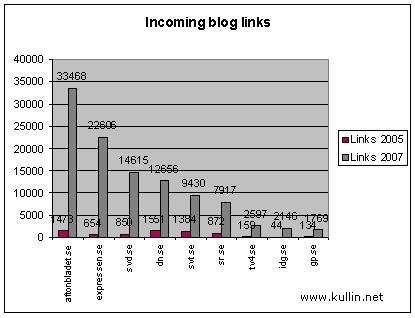
Mainstream media can also benefit from the links that for example bloggers provide. In May 2005 I checked the number of incoming links to a number of Swedish media sites and found that Dagens Nyheter had the highest number of incoming links (via Technorati) of those media sites and blogs. Today we can see a huge increase in incoming links to media sites, and the increase for Expressen, for example, has been more than 3,000 percent.

medialinks07

Dagens Nyheter has not been able to maintain its top position. But recently both DN, Aftonbladet and Svenska Dagbladet have started to publish blog links next to their articles and a follow up in six months time will show if that has had any effect on “link love” from Swedish bloggers.

Tags: , , , , , . Ping.

4 percent of Swedish companies have corporate blogs

The Scandinavian based telecom operator TeliaSonera has done some trend watching which is presented in a report here (pdf). Among the findings are:

– One in four Swedes regularly follow one or more blogs
– Most popular blog topics to read about are everyday life (36%), diary/personal (33%), politics/society (28 %), computers/IT (27%), sport (21%).
– 4 percent of the companies in the survey have a corporate blog, an additional 6 percent are planning to launch one in 2007
– Of respondents under the age of 26, 73 percent would consider taking pictures if they found themselves in the middle of a news situation

Most popular blog topics to read in the other Nordic countris are:
– Denmark: everyday life (40%)
– Norway: diary/personal (35%)
– Finland: everyday life (42%)

Note: 1,404 of Telia’s corporate customers and 8,887 private customers answered the survey.

Tags: , , , . Ping.