Sweden’s Foreign Minister in legal trouble for blog comments

[Republished post, the original must have been accidentally deleted. Sorry for the inconvenience]

The blog of Sweden’s Foreign Minster Carl Bildt has become a question for Konstitutionsutskottet (KU), the Parliamentary Committee on the Constitution, writes Riksdag & Departement. Bildt’s blog is subject to an investigation by the prosecutor because Bildt did not remove hateful comments to some of his blog posts earlier this year. And before the prosecutor continues with the preliminary investigation, he wants KU to determine whether Bildt is blogging as a minister or as a private individual. If he is blogging as a minister, then KU will determine if he is to be prosecuted or not.

According to Swedish law it is the responsibility of the site owner to remove hateful comments “within reasonable time”. Bildt has declared that he knew about the comments and that he found them “very inappropriate”. But he did not remove them with the explanation that they were archived anyway. The comments were finally removed later in the spring.

Initially the blog was launched as a private blog, but when Bildt became a minister in the new right wing goverment he added a link to the Ministry for Foreign Affairs’ website which also registers all the posts on the blog as public documents.

During the 200 years that KU has existed it has only decided to prosecute a minister once, and that was in the 1850’s.

Tags: , , , , . Ping.

Paint it white

Did you know that two of the most important tools in crisis management are a brush and a bucket of white paint? At least if we’re talking about the airline industry. Swedes may remember the 1991 Scandinavian Airlines crash in Gottröra when SAS quickly painted over the logo on the wreckage in an effort to minimize the damage to its brand.

The same thing happened last week when a jet from China Airlines exploded in flames in Okinawa. See story and before-and-after shots here.

“China Airlines has painted over its name and logo on the wreckage of a passenger jet that exploded in flames at Naha Airport in Okinawa moments after passengers slid down emergency chutes to escape.”

Via B.L. Ochman.

Tags: , , , , . Ping.

Swedish bloggers won’t make millions

You know that the blog hype is reaching some sort of boiling point when media predict million dollar incomes for the top bloggers in Sweden. An estimate by the media agency Wisely today at ekonominyheterna.se, says that the top 20 Swedish bloggers have a potential combined annual advertising income of 100 million kronor (14.5 milllion USD). Unfortunately that’s just not possible. Let’s make a comparison.

TechCrunch, one of the world’s top blogs, a year ago had more than 100,000 subscribers and today its FeedBurner icon says the site has in excess of 600,000 subscribers. In May, TechCrunch averaged about 2.5 million visits a month, a figure that is probably much higher today. Still, TechCrunch “only” generates about $200,000 a month from advertising, job listings, and sponsorships (about 16.5 million kronor a year).

The 20 Swedish top blogs in this article have a total of 880,000 weekly visitors (according to Bloggportalen.se). Wisely suggests that Alex Schulman’s blog could generate as much as 28.7 million kronor and his brother’s blog Schulmania, which was only active for 30 days (!) would attract revenues of 16.5 million kronor (his last post was made more than a week ago).

Blogs like my own have so far only gotten bread crumbs from advertising and even though a few fashion blogs have become quite successful, these figures are extremely unlikely. And furthermore, as an example, Alex Schulman’s blog is a personal blog and quite controversial (in Bloglines he only has 75 subscribers, even I have more). TechCrunch is a network of niche blogs with a high degree of involvement by its readers. To suggest that Schulman would attract more advertising income than TechCrunch just doesn’t make sense.

Of course blogs increasingly attract advertisers but we should try to make a reality check now and then.

Footnote: In this week’s Dagens Media (not online), an article says that the number of visitors to Swedish blogs is “brutally exaggerated”.

Tags: , , , , . Ping.

Media agencies increase investments online

advertising sweden

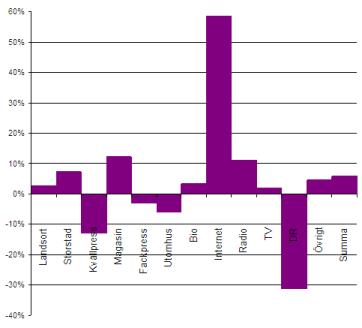
Swedish media agencies’ investments in online advertising are up with 60% for the first six months of 2007, according to their own statistics. Radio and magazines are up more than 10%, while evening press and direct marketing lose big time. Media agencies however make up only a small portion of the investments in direct marketing, so the overall trend is unclear.

Tags: , , , , . Ping.

Cision monitors blogs with Twingly

I’ve been almost completely offline for about a month, an awkward feeling for a person who usually reads three or four papers in the morning and constantly has one eye on the web. I have spent the last few weeks at my summer house without tv, newspapers or the internet. But now I’m back home again and will hopefully blog a bit more often.

From the news flood I’ve picked this story to start off the new semester. This week, media intelligence company Cision (formerly Observer, or Bacon’s in the US), announced that it will start monitoring blogs in the Nordic countries with Primelabs’ service Twingly. Alexander Mason, business developer at Cision says that there is a demand from companies for convenient monitoring services that summarize information from the blogosphere, in spite of many free alternatives.

Cision gets access to more than 100,000 Nordic blogs via Twingly, according to a press release from Primelabs. Half of those are Swedish.

Footnote: Swedish media such as Dagens Nyheter, Svenska Dagbladet, IDG and Dagen use Twingly to track blog comments to their online editions.

Tags: , , , . Ping.