Gudmundson story far from over

The story about journalist Per Gudmundson’s blog is far from over. Tobias Billström of (m) the Moderate Party just now asked (interpellation) Leif Pagrotsky, Minister for Education and Culture:

> if he thought that freedom of speech does not include employees of a public service company?

> if he thinks that individual journalists employed in public service companies can not express views in public, even if they are not in direct connection to the work that they do as employees at SVT?

Second blogger to bite the dust

Dagens Nyheter today writes that liberal debater Johnny Munkhammar will lose his job for blogging about topics that are not in line with the vision of his employer the Confederation of Swedish Enterprise (Svenskt Näringsliv).

– He hasn’t always had the same opinion as Svenskt Näringsliv, and it can be hard to separate when he speaks as a private person and when he speaks for us. Our mission is to represent the views of our member companies, says Inger Holmström, head of communications at Svenskt Näringsliv.

Just about a week ago we had the incident with journalist Per Gudmundson who was told to quit blogging and now this. What does that tell us about blogging in Sweden? I’m not sure yet. But clearly some bloggers should be nervous. Is your blog officially approved by your organization or is it clearly a private matter? If you don’t have a clear answer to this question you should arrange for a meeting with your boss today.

The article is not online yet. Munkhammar says he will keep his blog.

Footnote: Bloggers saw this coming last week.

November 2004: A break through for blogs

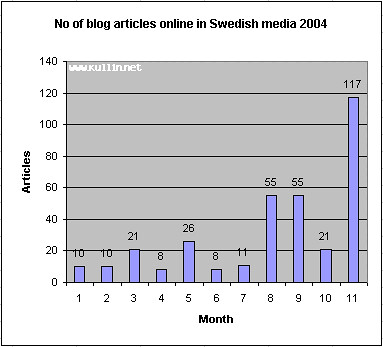
I think we can officially declare November 2004 as the month that blogs broke through on a wider scale in Sweden. There has been a significant increase in the number of online articles in traditional media that have mentioned blogs and some of the incidents that have helped bring blogs into the spotlight are:

> The first Swedish blog forum, Bloggforum 2004, in Stockholm. Thanks again Stefan & Erik for the initiative.

> Dagens Nyheter deleted a sentence about one of its journalists in Oivvio Polite’s article about Bloggforum. This stirred up a big debate.

> Media monitoring company Observer decides to monitor 10+ blogs. Several traditional media report about this.

> Journalist Per Gudmundson had to quit blogging if he wanted to keep his job at SVT. Also made it into several mainstream media, like SVT, Sydsvenskan, Journalisten (1 & 2) etc.

Apart from the increase in number of articles online, there were at least three occasions when blogs were discussed on Swedish Television in November and early December, first the Gudmundson incident was discussed on Kulturnyheterna on SVT, then Malte and Chadie were interviewed in K2 on SVT24, followed by a discussion about blogs in SVT1 with PJ Anders Linder and Nicklas Mattsson. I also had a small part in evangelizing blogs during November as I was interviewed by TT Spektra. The articles appeared in at least 15 local Swedish dailies, including Skånska Dagbladet and VLT (only one of them online though).

Does this mean that most people now know what a blog is? Definitely not. Most Swedes still haven’t heard about blogs or at least are not aware of what it is. But mainstream media are continuing to write about blogs in December, for example about how blogs were named word of the year by Merriam-Webster. Slowly, blogs are becoming mainstream.

UPDATE: My interview with TT Spektra has now been in 15 Swedish dailies:

Hallandsposten

Hudiksvalls Tidning

Hälsinge-Kuriren

Karlskoga-Kuriren (twice)

Kinda-Posten

Linköpings Tidning

Ljusdals-Posten

Mariestads-Tidningen

Nyheterna (Kalmar)

Skaraborgs Läns Tidning

Skånska Dagbladet

Vestmanlands Läns Tidning

Vimmerby Tidning

Örebro Kuriren

Legal risks in corporate blogging

This article about legal risks in corporate blogging is from early November but well worth highlighting. Some key points:

> Negative or defamatory posts about a corporation or an individual might result in libel suits.

> Do your homework. If the blogger is going to make negative statements about a company he has to do his research and be able to prove his statements.

> Disclosure of trade secrets or confidential information. Employees who blog may intentionally or unintentionally share company secrets.

> Careless statements about the business that can be used during litigation.

Paying bloggers to blog – a sell out?

Software company Marqui.com are paying about 15 leading bloggers 800 USD to blog about their company. Bloggers need to put up a logo and link to the company website and mention Marqui once a week. I’m not so sure about this. OK, they claim that the bloggers can write positive or negative information, and they will not interfere. And because is it a first, it is a good PR opportunity for Marqui to create a buzz about the company and they even got mentioned in Business Week. But this approach is clearly different from just having ads on your blog. I have never been a friend of mixing advertising with editorial content. It dilutes the credibility of both the advertiser and the medium and bloggers who get paid to blog by one specific company are very close to selling out. The reason so many have turned to blogging is that they feel the corporate powers have too much influence – direct or indirect – over traditional media. If you then let sponsors have influence over your editorial content, I think you’ve lost a lot of cred, no matter what you actually write in those Marqui posts.

Sure I wouldn’t mind 2,400 USD for three months of blogging, but this is not the model I would choose.

What the paid bloggers say themselves about the sponsorships: here and here.

Only rock bands sell out. Journalists are supposed to make their money from ads. The second point is that this all comes down to trust. If you can trust me to be objective, it doesn’t matter that I’m being paid, so long as you know I’m being honest.

A wake-up call for bloggers

Super-popular blogger Jason Kottke, is in trouble with Sony for posting first an audio file of a Jeopardy show with serial winner Ken Jennings, then a transcript from the same show that revealed the outcome of his record long winning streak.

Kottke says:

“I can’t say too much about it (soon perhaps), but it sure has had a chilling effect on my enthusiasm for continuing to maintain kottke.org.”

One wonders if Washington Post recieved the same treatment. But regardless if you think Sony is right or overreacting, it seems incredibly naive to think that your blog somehow makes you immune to rules and regulations that are present elsewhere in the world – moral, ethical or otherwise. Of course that is not the case. I have no opinion on if Sony or Kottke are the moral winners in this story, but the incident should serve as a wake-up call for bloggers who are aiming for scoops or are just posting controversial information in general.