Image doping

I had an enjoyable lunch today with fellow blogger Henrik Torstensson. He brought up a subject that we both had experienced, the fact that both our blogs had gotten a significant amount of traffic from Google Images. We concluded that the amount of traffic signalled that there is an opportunity in search engine optimization of the images of your webpage, call it “image doping” of your website if you will. That is, if the type of traffic it generates is desirable to you, and not just eat up your bandwidth.

Looking around the net I couldn’t find a whole lot of info about image optimization, but some tips for getting a higher rank on Google Images are:

> Use the alt attribute
> Name the image with the desired keywords: “nissan-maxima.gif” if you are promoting a Nissan Maxima car.
> “putting each image in a specifically optimized html page” [not sure what that means, to be honest]
> using a picture gallery and a thumbnails systems
> consider the size of your image, bigger seems to get higher rankings
> when naming image files, don’t use underscore, use “-” instead of “_”

To me, this seems to be unexplored territory and savvy webmasters and bloggers could use this opportunity to increase traffic. Further reading here, here, here and here.
Nerikes Allehanda a role model for newspapers’ use of RSS

More Swedish newspapers are adding RSS feeds to their online editions. Linköpings Tidning announced a new feed yesterday at http://www.linkopingstidning.se/rssfeed. An even more innovative approach comes from another local daily, namely Nerikes Allehanda. They have introduced an application that lets you choose what news you want and then create your own news feed. For example, if I am only interested in soccer and news from the city of Karlskoga I can just click those boxes and the application creates a feed which combines the two sub feeds (http://na.se/rss/rss.asp?a=7&s;=2). Or I could subscribe to several feeds in my news reader.

Very nice work and intelligent in many ways, not just because it lets readers decide on what news are important to them. It is also a change of attitude, a willingness to acknowledge that the gatekeeper role where media pick and choose what news you should consume, take it or leave it, that role is not relevant anymore. Media consumers today have a wide range of choices when it comes to searching, selecting and consuming information. The news business is becoming more of a conversation than a lecture, to use the words of journalism professor Jay Rosen. The shift in the balance of power from media producers to media consumers means that content providers who stay in the “lecture model” may get abandoned by readers who want to “roll their own” media. If media consumers require a smorgasbord of news, you can’t serve just one dish.

Also see my extensive list of some 220 Nordic media RSS feeds here.

Tracking blog buzz

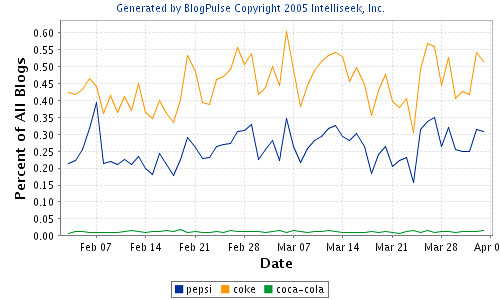
BlogPulse’s Trend Search is a nice feature I haven’t seen before, where you can track different search terms in the blogosphere. Take a look at this graph covering the blog posts mentioning Coke and Pepsi the last two months. It shows that Coke is discussed more frequently than its rival. The two graphs are following each other very closely, which makes me suspect that the difference between the two is due to the fact that Coke is not only carbonated water but also a drug.

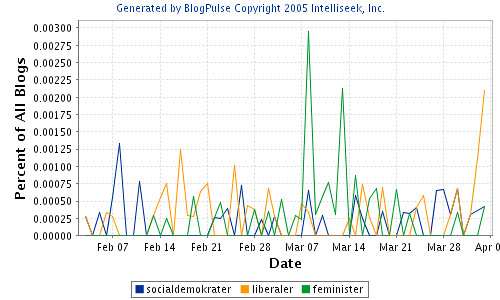
Here’s another example. The Swedish blogosphere seems to be discussing feminists (“feminister”) more often than social democrats (“socialdemokrater”) and liberals (“liberaler”), at least during International Women’s Day.

Also see BlogPulse’s new Conversation Tracker.

Podcasting a popular pastime

Almost a third, or 29%, of all owners of mp3-players in the US have listened to a podcast at least once reports Pew Internet & American Life Project in a new survey. That is a surprisingly high number, especially since podcasting hasn’t been around for that many months.

Hans #27

Jackie Huba at the Church of the Customer blog writes about a phenomenon called Google Juice, which is supposed to be “the ethereal substance which flows between web pages via their hyperlinks (in both directions!” and “the mysterious quality that causes pages to come up high in a Google search”. And since Google like blogs, bloggers get high rankings. For example, the number one Robert on Google is Microsoft überblogger Robert Scoble (except he’s really #4 when I try the search). Turns out I am Hans #27 on Google, and like Scoble, I don’t even have my name as the name of my blog. Other examples are Swedish blogger Henrik Torstensson, the #1 Henrik on Google, a few notches before writer Henrik Ibsen.

Radio Sweden podcast via Feedburner

Swedish Radio are testing podcasting for their English language program Radio Sweden. What is interesting to see is that they use free tools like Blogdrive and Feedburner. The articles are distributed via an RSS feed at Blogdrive (http://radiosweden.blogdrive.com/index.xml) and the podcasts via Feedburner (http://feeds.feedburner.com/RadioSweden). And I don’t think it’s wrong to rely on external solutions because it shows that they are eager to try new things and get started, rather than wait for internal procedures which almost always slow these kind of initiatives down. One negative effect though might be if they decide to change tools in the future and have a new URL, they might lose subscribers.

For some reason the mp3 files are posted to a free blog on Blogspot.com while the actual files are located on radiosweden.org.