Euro 2008 – The Sun goes Polish

What’s a UK newspaper to do during the Euro 2008 when neither England, Scotland, Wales or Northern Ireland have qualified for the football tournament of the year? Had the home teams participated it would have meant a significant increase in circulation for the UK papers. Well, the Sun have come up with a creative solution – tap into the UK’s 600,000-strong Polish community with the launch of The Polski Sun, a Polish language version of the Sun. The paper is predicted to attract 200,000 readers according to Sky News and will be produced by Polish journalists and columnists, and also include a Polish page 3 girl (no progress there, folks).

Six editions will be produced with an estimated circulation of 70,000 copies.

Hat tip to Nick Burcher who also has some photos.

Tags: , , , , , . Ping.

A recipe for reinventing newspapers

Newspapers today face many challenges. At WAN Göteborg 2008 I listened to a presentation about the new 2008 Global Report on Innovations in Newspapers. One of the more interesting comments came from Juan Antonio Giner, founder and Director of the Innovation International Media Consulting Group, who talked about some challenges and opportunities for newspapers.

How to kill a newspaper in 20 easy ways:

1. Be dull and boring
2. Change slowly
3. Publish yesterday’s news
4. Take not risks
5. Expect different results by doing things in the same way
6. Insult your readers
7. Lie to advertisers
8. Please politicians
9. Cover buildings
10. Don’t interact with your audience
11. Print badly
12. Print poor color
13. Write long
14. Don’t care about design
15. Don’t hire talent
16. Don’t fire bad editors and managers
17. Pay badly
18. Don’t innovate
19. Milk the cash cow
20. Expect miracles

How to reinvent newspapers:

– Try wild ideas
– Be different
– Shake up things
– “Raise hell and sell newspapers”
– Make readers smile
– Great stories
– Be hyper-local
– Integrate or die
– Show, don’t dell
– Graphics, graphics, graphics
– Talent, talent, talent
– Journalism, journalism, journalism

Footnote: More great reports about WAN 2008 at the Editors Weblog.

Tags: , , , , . Ping.

RSS advertising back from state of hibernation

Some good news for bloggers that have few visitors but many subscribers. RSS advertising is showing signs of slowly becoming a source of revenue. Gawker Media says it grew its revenue from RSS-driven traffic by 300 percent in Q1 2008. And RSS use is apparently growing worldwide. According to a global (29 countries) social media survey from Universal McCann in March, 34 percent said they had “ever” subscribed to an RSS feed, which is up from just 15 percent the previous year.

In the article on ClickZ, it was interesting to see how different RSS adoption is in different countries. Top users (had ever subscribed to an RSS feed) are blog readers in Russia (57 percent adoption), Brazil (55 percent) and China (54 percent), while Hungary is in the bottom among the surveyed countries with just 15 percent. [Via Uppkopplat]

Also, FeedBurner will start to include Adsense ads in RSS feeds starting next week. Bloggers already in their advertising programme will see a combination of the previously offered premium ads with AdSense ads filling up the remaining space.

“Starting next week, we’ll be rolling out AdSense for feeds to a small group of publishers, in anticipation of a full launch to all FeedBurner and AdSense publishers “coming soon”. If you start seeing “Ads by Google” on an ad in a feed somewhere, that’d be us.”

[Via Text 100]

Tags: , , , , , . Ping.

Growth of Flickr may be slowing down

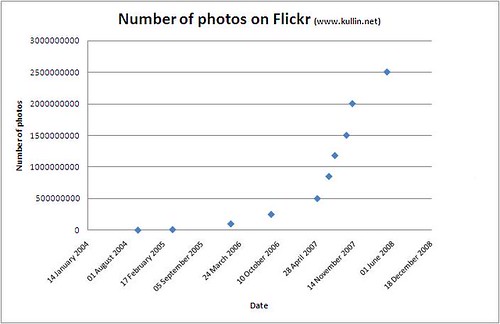
On May 17, 2008, the 2,500,000,000th photo was uploaded to Flickr (photo here). If we look at previous milestones, it appears that the growth of Flickr could be slowing down. In November last year I wrote that the first billion photos took three and a half years while the second billion took three months. Now we can assume that it took six months to get the next half a billion photos.

I have compiled the graph below out of data directly from Flickr by checking a series of photos to find the date they were uploaded and hopefully they are correct. Regarding the growth, we know that much of the explosive increase during mid 2007 (from June and three months forward) was due to the migration of photos from Yahoo Photos. But despite the fact that Yahoo Photos supposedly had 2 billion photos, the figures suggest that far less than 1 billion were migrated into Flickr.

So, while I don’t have any official figures from Flickr, it does not seem that the organic growth is keeping the same pace as it did in the fall last year. It will be interesting to keep an eye on the development the coming six months for Flickr.

flickr photos

Footnote: The series of data I used was the following:

22-okt-04 1000000
20-apr-05 10000000
15-feb-06 100000000
22-sep-06 250000000
15-maj-07 500000000
19-jul-07 850000000
20-aug-07 1180000000
06-okt-07 1500000000
13-nov-07 2000000000
17-may-08 2500000000

Tags: , , , , . Ping.

Sweden celebrates National Day in Second Life

second house of sweden

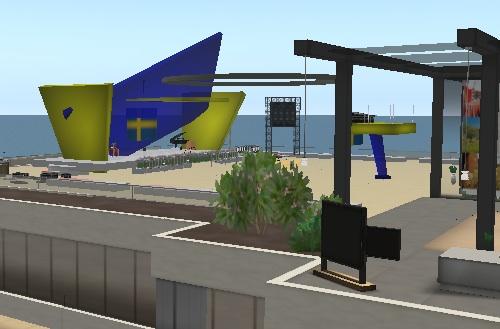
The Swedish Institute will host a party in Second Life on June 6 to celebrate Sweden’s National Day. The celebrations will take place on the roof of Second House of Sweden, Sweden’s virtual embassy in Second Life. Swedish Institute’s General Director Olle Wästberg (Olle Ivory) will kick off the party and will be followed by performance artists, clowns and DJs. The event has been organized by Second Life enthusiast Tina Dahl who has more information on her blog.

Tags: , , , , . Ping.

A new model for news consumption

Right after lunch at the World Editors Forum, Timothy Balding, Chief Executive Officer of WAN gave us an update of the trends in the newspaper industry. His message was clear, the printed newspaper is far from dead. Global paid circulation for newspapers is up by 2.57% in one year and up 9.39% in five years. The total number of paid printed daily newspapers is up by 2.98% and there is now a total of 11,684 paid titles. About the common statement that the printed newspaper is dead, Balding concluded that “the figures don’t match it.”

But like Roy Greenslade of the Guardian noted, the following session painted a somewhat different picture. “We are living on borrowed time”, said Christof Pleitgen, Reuters. The session included an international consumer study by the Associated Press (pdf here). The AP studied how 18-34 year olds around the globe consume news and found that news publishers need a new model. Some conclusions:

News is connected to email. “I get my news when I check my e-mail,” was the most often heard response in reference to when people get their news.
Constant checking is linked to boredom. After e-mail, participants in the study said they checked updates and headlines as a way to pass time and break boredom.
Contemporary lifestyles impact news consumption. People are sharing information within the home and outside. People sitting with their laptop at home may look antisocial, but they are sharing.
Consumers want depth but aren’t getting it.– News is multitasked. As part of other activities. News is secondary, not prioritized.
Consumers are experiencing news fatigue.
Television impacts consumers expectations. You cant get away from tv. Tv represents a certain delivery of news that people are used to.
Story resolution is key. Sports and entertainment deliver on that (these stories have a beginning and an end). News do not do that.
News takes work today. But it creates social currency. Young media consumers have to work to get their news. They are the ones that need to create the value.

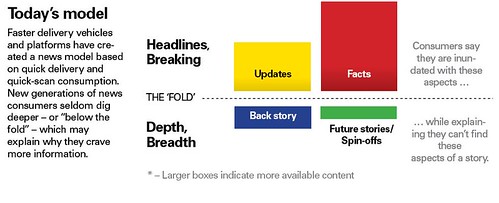
Jim Kennedy, Associated Press and Robbie Blinkoff, Context-Based Research Group talked about how the old media model – the inverted pyramid – has been undone. Now people are consuming news across platforms and brands. So media need to deliver appealing content, designed to satisfy all four news needs in the consumption model (Facts, Updates, Back Story, Future Story) and then deliver it across all the channels.

Anthropologist’s (Blinkoff) recommendations to media:
– Deliver depth.
– Address news fatigue and balance. Need to reduce the repetition. Don’t serve us headlines, we have already read that.
– Create social currency. Which piece of what I am about the produce is easy to share? News you can use by sharing.

The new model:
AP

Tags: , , , , . Ping.