Nordic communicators are lagging behind journalists in use of social media

PR practitioners and professional communicators at organizations and businesses are often experts in building good relations with journalists and other influencers that can help get their messages across to the target audience. Reading and monitoring traditional media has always been an essential part of the daily routines of PR professionals, we need to know who says what and where. With the strong growth in comsumption of social media, one would assume that most communicators had started to use social media by know, but according to a survey by Cision, there is still room for improvement.

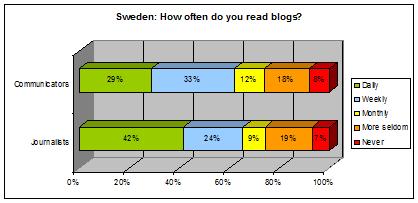
Cision conducted a survey of journalists and professional communicators in Denmark, Finland, Norway and Sweden about their attitudes to and use of social media. The survey revealed that journalists are becoming heavy users of social media such as blogs and micro blogs (like Twitter), especially in Sweden. As many as 42% of Swedish journalists and 26% of Danish journalists read blogs daily. In Norway and Finland the figure is slightly lower, 19% and 16%, respectively.

53% of Swedish journalists read blogs for research and 28% say that they blog as part of their work.
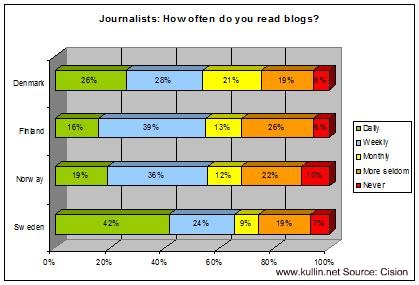
journalists-blogs-chart

Twitter is a lot more popular among journalists in Norway and Sweden, where one in four read it daily (27% and 25%). In Finland, only 4% read micro blogs daily.

17% of Swedish journalist write on micro blogs daily. When asked “how do you work with micro blogs?”, 36% said that they monitor what is written, 36% follow interesting people, 25% publish news, 21% build relationships and 21% read for research.
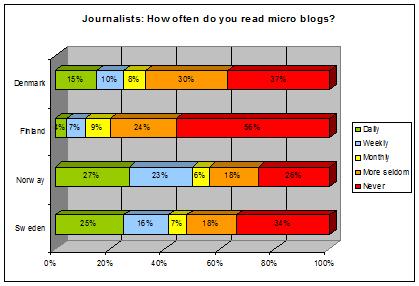
journalists-microblogs-chart

Among communicators, it is more common to read blogs in Sweden and Denmark, at least on a daily basis.
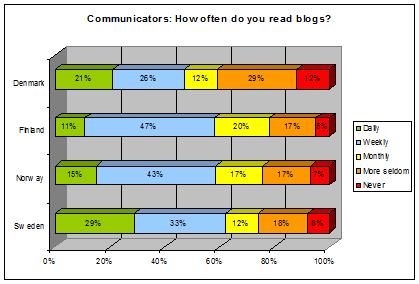
communicators-blogs-chart

Communicators in Sweden and Norway are the most frequent users of Twitter.
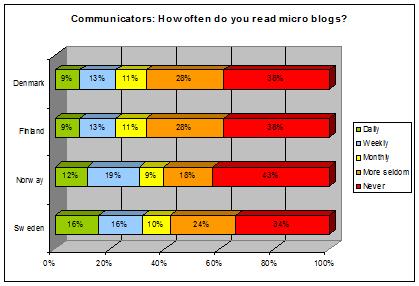
communicators-microblogs-chart

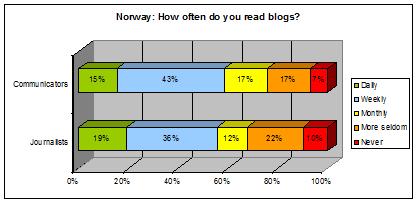
If we compare the use of blogs and Twitter between journalists and communcators in each country, we find that a larger percentage of journalists read blogs on a daily basis. This is quite interesting because it could signal that journalists are better connected to the blogosphere than professional communicators. And if as many as 53% of Swedish journalists read blogs for research (35% of Danish and 33% of Norwegian journalists) then communicators probably should put even more focus on building relations with bloggers.
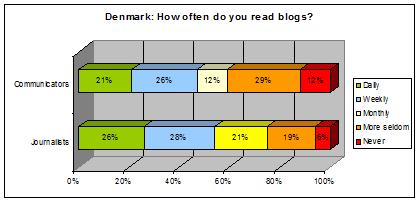
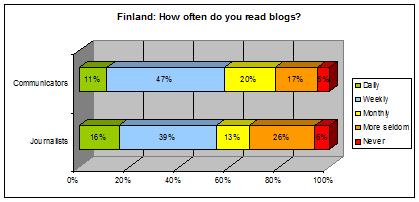
denmark-chart

finland-chart

norway-chart

sweden-chart

Journalists are also more frequent readers of Twitter than communicators, with the exception of Finland. If for example 50% of Norwegian journalists read micro blogs at least weekly, why are only 32% of communicators doing the same? Shouldn’t they be out there to monitor and connect with influencers on Twitter? Well, I think so. Fortunately for communicators, there are people that they can turn to for advice, namely PR consultants (yes, people like me…). It turns out, not very suprising, that the individuals that uses social media most often are PR consultants. 52% of Swedish PR consultants read blogs daily, 50% in Norway and 35% in Finland (not enough responses in Denmark). As many as 61% of Norwegian PR consultants read Twitter daily, 34% in Sweden and 17% in Finland.
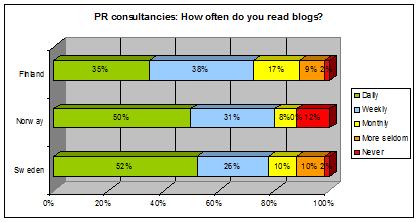
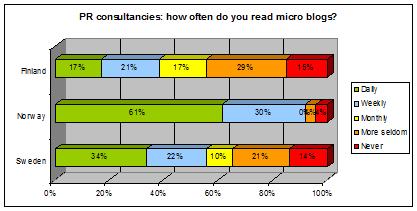
pr-blogs-chart

pr-microblogs-chart

Footnote: The report Cision Social Media Survey 2010 can be downloaded here.

Tags: , , , . Ping.

Vodafone gained Twitter followers after bad tweet

Companies that manage an issue or crisis well may often come out stronger on the other side. As a follow up to my post yesterday about Vodafone and the obscene tweet, I thought I would check in on the number of followers to Vodafone’s Twitter account. In my view, the company handled the indicident well and I almost expected that they would gain a number of followers from the attention. As you can see from the graph below, that is exactly what happened. We can see a sharp increase in number of followers for VodafoneUK since the unfortunate tweet was published, almost twice the amount than on a normal day (+377 compared to +215 on average).

vodafone uk

Graph from twittercounter.com.

Tags: , , , . Ping.

One tweet causes crisis for Vodafone

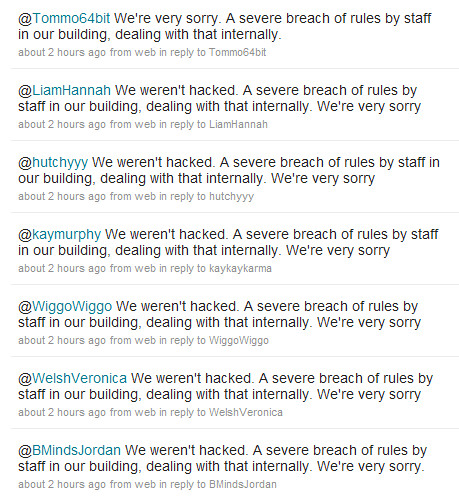
When social media enters the business world, a larger number of employees get to speak on behalf of the company than what was standard practice before. Often this is a good thing, but of course there can always be one or two bad apples that will take advantage of this new found power and try to harm the organization. That was probably what happened to Vodafone today when someone internally tweeted an obscene tweet from Vodafone’s corporate account. And since Twitter is Twitter, also bad news spread extremely fast. That’s why VodafoneUK currently is involved in some serious online crisis management, see their Twitter stream below.

vodafoneuk

The story is currently among the top tweeted stories on Tweetmeme.com, but Vodafone is acting switfly to limit the damages before there are any major impact on its brand. They seem to be directly addressing a large number of people that are commenting on the issue or retweeting the obscene tweet. And I think Vodafone will manage to go quite unharmed through this incident. Fresh Networks sums it up nicely:

1.They responded quickly and said what was happening. In social media, people can spread messages quickly. Vodafone also responded quickly and said exactly what happened and was happening. It wasn’t a hack but an internal employee and that person was being dealt with.

2.They responded in the same place that people are talking about them. Vodafone responded to its Twitter followers on Twitter, using the VodafoneUK account. The key to crisis management in social media is to respond where people complain. Otherwise you risk alienating them and losing your role in the story.

Update: According to a statement from Vodafone, the employee has now been suspended. From the Telegraph: “The employee has been suspended immediately and we have started an internal investigation. This was not a hack and we apologise for any offence the tweet may have caused.”

Tags: , , , , . Ping.

Top 20 countries on Twitter

Twitter doesn’t disclose how many members it has, so it has been hard to determine how many people that use Twitter in Sweden. I tried to calculate a number in June 2009 using a survey by Sysomos that showed that 0.54% of the accounts were from Sweden. My estimate landed at 75,000 Swedes on Twitter.

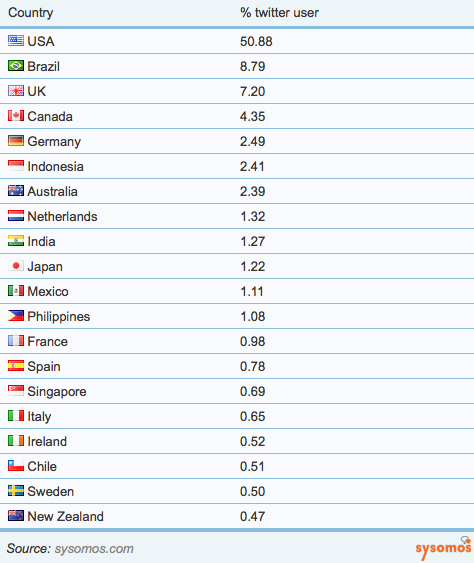
Now, Sysomos have now published a new report, in which they have studied 13 million unique Twitter accounts that demonstrated tweeting activity within the period from Oct. 16, 2009 to Dec. 16, 2009. The US is still by far the largest country, but it’s dominance has decreased as the service has expanded more rapidly outside the US, with a very fast growth in for example Brazil (the US dropped from 62.1% share in June to 50.9% now.

Sweden is still in the top 20 chart but has slipped one spot from 18 to 19 and the share has decreased from 0.54% to 0.50%.

twitter-users-sweden-chart

Sysomos also looked at the number of tweets by country, and in that chart, Sweden is not among the top 20 countries.

So how many Swedish Twitter accounts are there then? Hard to tell, but according to Twitter COO Dick Costolo, the micro blogging service had more than 58 million global users in November 2009. Here is a quote from a chat with Michael Arrington of TechCrunch.

MA: What about user accounts?

DC: Yeah I won’t say that, but 58 million undercounts it.

So, taking these to figures into account, there should be somewhere in the range of 290,000 Swedish accounts, which sound like a lot. If the statistics from Sysomos are correct, they have at least found 65,000 Swedish accounts (0.50% of 13 million active). What springs to my mind is that considering the extreme growth for Twitter, it might not be long before more Swedes are tweeting than blogging. By the end of 2010, that might actually be a reality.

Footnote: I’m @kullin on Twitter.

Tags: , , , . Ping.

How to brand your tweets with TweetBrand

Every tweet you post on Twitter comes with a line that states what time it was published and what application you used to tweet (TweetDeck, Tweetie etc, or the Twitter site). Now there is a free application that lets you hack this line and brand it with your own information. With TweetBrand you can brand your tweets with the name of your company, your blog or whatever you want it to say. And not only that, you can link it directly to any landing page you choose.

I tried TweetBrand and it seems to work perfectly (so far). The tweet below is branded with the name of my blog (Media Culpa) and has a link to the blog.

brandedtweet

You can name your “application” anything, as long as no-one else has taken that name. Once your app is installed and you have downloaded the software, you get this little screen to tweet from. You may use it to run several Twitter accounts, which I guess is pretty neat.

tweetbrandtestit

Although this is a cool app, I don’t see myself using it very frequently, but I will continue to experiment with it and see if it drives any traffic to my blog.

According to Tammy from TweetBrand, this is just the free “lite” version and a main service will be launched soon with more functionality.

Tags: , , , . Ping.

Tweets from people you don’t follow appear in your Twitter stream

It seems that tweets from people you don’t follow are appearing in some users’ Twitter streams. I noticed this morning that there were two tweets from people that I don’t follow and they were not retweeted by any of my friends. They just appeared in my stream like any regular tweet from my friends.

tweet1

tweet3

I did some quick searches on Google and found this note on Posterous posted yesterday and updated today. The user “aulia” in Indonesia writes about “Twittruders: Stray Tweets from people you don’t follow”:

“It seems that there is a breach of some sorts in Twitter today where stray tweets show up unexpectedly on people’s timelines. These tweets are not retweets, they’re not quoted tweets, and they’re not from people being followed. These stray tweets may not necessarily be spam. It’s entirely possible at this point that there is or was a breakdown in Twitter’s network which leaked messages into other people’s timelines.

Speaking with Peter Baxter from AVG a few weeks ago, he mentioned that the Twitter network as well as the website are very insecure and Twitter, the company, isn’t doing very well when dealing with these attacks. It’s difficult to dispute the man when the facts speak for themselves.”

Twitter has been over capacity this morning so the site does not run smoothly and I hope that there aren’t any real security issues behind these tweets that appear. I will try to monitor this story further during the day. If these stray tweets pop up in your stream too, do let me know.

Update: The Mirror in the UK also writes about the story: Twitter spills the beans: leaks private tweets

Update 2: Comment from Twitter.

Note: I’m @kullin on Twitter.

Tags: , , , . Ping.