Zlatan Ibrahimovic is not on Twitter

As the Swedish football striker Zlatan Ibrahimovic this weekend declared that he is leaving FC Barcelona for AC Milan, my blog posts about the fake “Ibra” on Twitter” has gotten tons of traffic. I guess it’s a natural reaction nowadays – a player is discussed frequently in the media and fans want to know if he is on Twitter so that they can follow his updates directly.

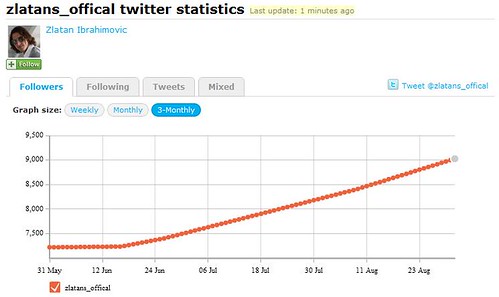
However, the first result in a Google search is a Twitter account: “@zlatans_official”, but is not the real “Ibra”. Now that doesn’t stop 9,000 people from following the fake account on Twitter. The prankster got almost 600 new followers yesterday and has gained more than 1,500 new followers in the last two months. And the account is not even active. I think that demonstrates the strong demand among consumers for direct communication from celebrities. That, and the fact that we’re all very easy to fool. (Ping AP!)

zlatan-twitter-account

Stats from Twittercounter.com. I’m @kullin on Twitter by the way. I might not be spectacular, but I’m real.

Top five social media risks for businesses

Earlier today I blogged about the trend that brands get hijacked on Twitter. A report released today by ISACA confirms that this is a major risk for businesses. The white paper outlines five major social media risks for business and “brand hijacking” is one of them. Top five risks are:

  • Viruses/malware
  • Brand hijacking
  • Lack of control over content
  • Unrealistic customer expectations of “Internet-speed” service
  • Non-compliance with record management regulations

The full white paper Social Media:  Business Benefits and Security, Governance and Assurance Perspectives” can be downloaded here. [pdf]

Oscar de la Renta to live-stream runway show

oscardelarenta Fashion house Oscar de la Renta will live-stream the designer’s runway show online today, Monday at 1 p.m. EST. The designer himself explains why he is taking the show public on the company live-streaming channel.

“Without a doubt, the role of a runway show has changed. In the past, the show was principally for buyers. While they are still a key constituency, we also show for the media. Online media is increasingly influential in fashion. This allows that group and others that can’t attend in person to see things in real time. It’s evolution.”

“A show is the greatest source of brand content that you have, and to be able to share it on such a large scale — it’s really amazing. I think that this is where the real power of the Internet lies, allowing anyone anywhere to interact with your brand, shifting what has traditionally been kept private to the public space. I suppose it’s a bit like adding more seats to the venue.

The company is active in social media and the corporate Twitter account @OscarPRGirl has more than 7,000 followers. When asked about how social media affects the company and the fashion industry, de la Renta replies:

“The great thing about fashion is that it always looks forward. I would be lying if I said that we understand the complete picture and the long-term effects that social media will have on our company. Right now, we feel strongly that we have to be a part of it. You have to experiment, and our hope is that eventually we will get it right.”

I really like that attitude.

The live-streamed runway show can be viewed here.

Brand-jacking on Twitter new challenge for PR

As if BP didn’t have enough problems in the aftermath of the oil spill in the Gulf of Mexico, the sarcastic tweets from the not-so-official Twitter account @BPGlobalPR has taken the twitterverse by storm. And not only has the person behind the account attracted 130,000 followers, he has also spawned a number of copy cats and started something of a trend. After the Israeli attack on the Flotilla convoy a few days ago, two similar Twitter accounts soon appeared – @IsraelGlobalPR  and @HamasGlobalPR – both using fake Twitter handles to try to influence the opinion.

Of course, it doesn’t end there. Meet @PunchTavernPR, the unofficial Twitter channel for the UK pub group Punch Taverns. It was launched after an incident on Saturday afternoon, when a group from the LGBT Labour Annual General Meeting was turned away from the Greencoat Boy pub in central London, a pub owned by Punch Taverns. The group of around 100 people were allegedly refused service by the manager because they were gay. It didn’t take long before people started to voice their opinions on social media channels, primarily on Twitter. According to the Guardian, the flood of tweets started after @LGBTLabour tweeted about it.

The hashtag #Greencoatboy soon became a trending topic in the UK and other tags that were used were for example #bigotbar and #boycottpunch. Articles about the incident were among the most read on BBC’s website yesterday.

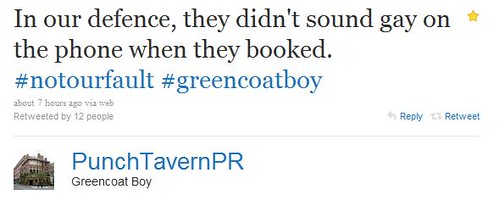
On top of that, someone started the fake Twitter account PunchTavernPR, spewing out tweets like this one:

punchtavern

The negative publicity in both traditional media and social media forced Punch Taverns to apologize in a statement on Sunday.

Brands have been hijacked on Twitter for a long time, remember the fake corporate Twitter account from Exxon Mobil in 2008? But now the blow more often seems to be directed specifically towards corporate public relations in what I can only describe as the digital equivalent to preemtive strike. What better way to get the opposing side in a conflict look bad than to mock the PR departement with silly jokes and ironic remarks? It can be very tricky to defend yourself against humor.

But all in all, this is not a good sign for PR. I get the feeling that this trend has emerged because people are sick of bad public relations efforts during crisis situations. It’s still all too common that when a corporation or an organization is facing a real crisis, it is slow to respond and when it does act, it uses half-truths and stonewalling tactics.

Perhaps it is a wake up-call for corporate PR. My advice would be to study this trend carefully and think through, what would our company do if we got brandjacked on Twitter in a crisis? It’s not an easy task to deal with.

Related about “Twitterjacking”: Zlatan Ibrahimovic on Twitter.

Japanese clothing brand trending on Twitter

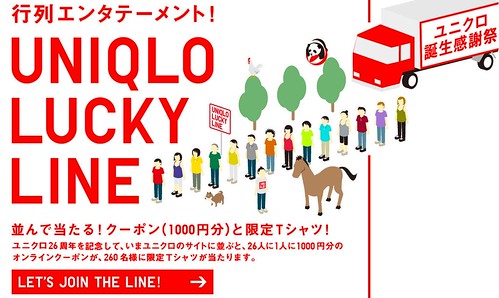
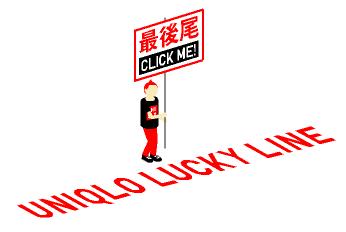
The Japanese retail clothing chain Uniqlo is currently the most tweeted topic on Twitter, thanks to a creative promotion campaign for their 26th anniversary. On Uniqlo’s site users can add their Twitter user name in order to win special gifts. Each participant gets a unique number in a virtual line and has the chance to win based on their Lucky Line Quene Number.

As soon as a person joins the competition, he or she also tweets the line “UNIQLO LUCKY LINEに行列なう。” and their queue number. Currently there are hundreds of tweets per minute and the total amount is currently close to 39,000, and growing very rapidly.

uniqlo lucky line

Not all commenters are positive to the flood of tweets. Some compare it to spam.

More details on Whatthetrend.com.

uniqlo2

Update: The volume of tweets is quite extraordinary. The time from tweet #6 to #50,000 is about one day. (haven’t been able to locate tweet #1).

BP Oil Spill and Social Media

BP are now caught in the middle of the worst possible scenario – one of the company’s oil drilling rigs in the Gulf of Mexico exploded on April 22 and sunk, resulting in a major environmental disaster as more than 5,000 barrels of oil leak into the ocean per day. The long term reputation of the company is at stake because of the accident, that in many instances has been labelled “the BP oil spill”. On the EPA site, for example, it is called “the British Petroleum Oil Spill” and even the link to the site is http://www.epa.gov/bpspill/. As the Star Phoenix notes, “in PR circles, if a disaster gets named after your company, this is a bad thing”.

This is obviously a horrible situation, on so many levels, and I don’t envy the people at BP that have to handle communication during this tough time. And nowadays, crisis management has extended into social media and it is a parameter a company need to integrate into its communication strategy.
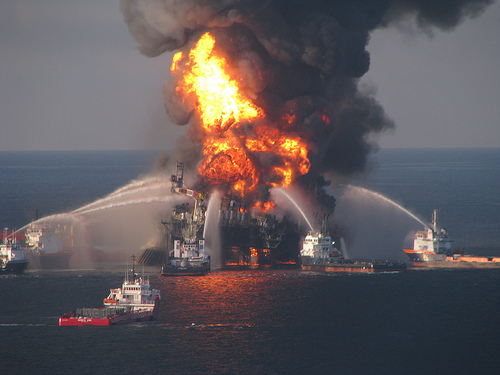
Oil Spill

As one would expect, BP is taking a severe beating in social media right now, when consumers vent their frustration with the effects of the disaster. On Twitter, thousands of tweets are currently being published mentioning BP in connection with the oil spill. Many of them are also directly addressing BP’s US corporate Twitter account with angry comments, suggestions and questions.
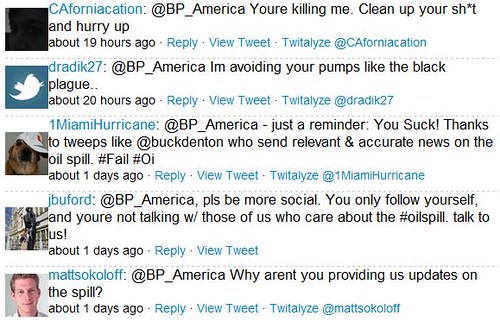
bp-oil-spill-twitter

However, BP are not responding to any of those comments. In fact, the company does not communicate much at all via @BP_America. The account does not respond, retweet or follow anyone else on Twitter (see Klout score below), making it a pure one way communication channel. On top of that, the few tweets that are being published are press releases syndicated to Twitter via Twitterfeed. Nothing wrong with that, but if you publish press releases on your site in capital letters, it doesn’t land well on Twitter, where it equals SHOUTING!
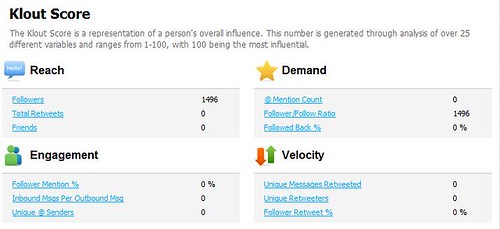
bp-oil-spill

I don’t want to point fingers at BP for not using Twitter to its fullest potential in this difficult position. Instead, why not point to other stakeholders in this catastrophe that are doing things well?
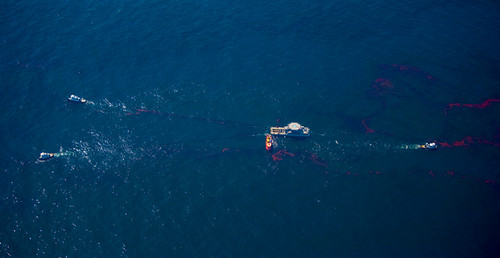
BP oil spill

For example, the US Coast Guard has a Flickr account where it publishes photos and images under Creative Commons license. Images are displayed on http://www.deepwaterhorizonresponse.com/ as a slide show. In the menu of the site, there is even a section for “Social Media” which points to the U.S. Coast Guard’s presence on Facebook, Twitter and Flickr. Update: I forgot to mention that this site is being maintained by British Petroleum, Transocean, the U.S. Coast Guard, the National Atmospheric and Oceanic Administration, the U.S. Department of Homeland Security and the U.S. Department of Department.

The US Environmental Protection Agency, EPA, also uses social media. Administrator Lisa Jackson responds on Facebook and Twitter. I’m sure there are many more examples. The problem for a company in a crisis, especially when you are already in the “bad guy” position, is that when you leave an entire arena to your opponents, the damage to your brand in the long run may be worse than it would have to be. Facebook has more than 400 million members and that’s a big channel to leave unattended. If you do a search for “BP oil”, the first hit you get is the group Boycott BP Oil. As a contrast, the BP America Facebook page has not been updated since Feb 18, 2010. In other words, there is room for improvement.

Photo credit: http://www.flickr.com/photos/uscgd8/