Universal McCann present Wave 5 – the Socialisation of Brands

Universal McCann have just released the fifth installment of their global social media survey: Wave 5 – The Socialisation Of Brands. It is further evidence that social media continues to have a huge impact on brands. This time UM surveyed 37,600 active internet users (that go online every day or every other day) in 54 countries.

Decline for company/brand web pages
Among all the graphs I found the one below to be one of the most interesting. It shows how many of the respondents that visited an official brand or company website during the last 6 months and the percentage is declining quite rapidly. From 85% to 75% in the last two years. It is clear that it is becoming increasingly difficult to get consumers to visit your company website and that brands (also) need to reach out to consumers on social media platforms.

wave 5 fig 20

The percentage of internet users who follow or become fans of brands on social networks has increased from about 10% last year to about 30% in 2010.
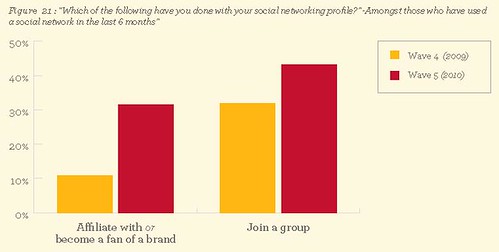
wave 5 fig 21

Another interesting conclusion from the Wave 5 survey is that face to face meetings is becoming the least used means of staying in contact with friends. Text messages is still used more seldom but is growing in importance.
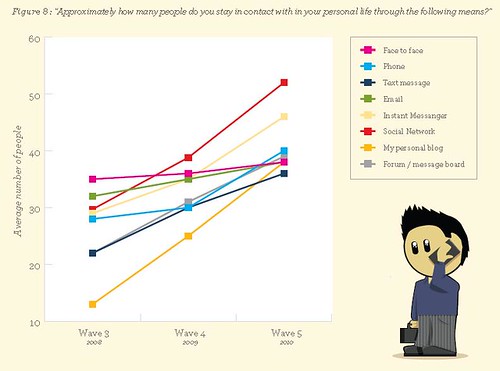
wave 5 fig 8

The entire report can be found below.

Social Media Wave 5 – OCT2010 (Universal McCann)

Top reasons for unfriending on Facebook

Do you post all your Gowalla and Foursquare check-ins to your Facebook profile, as well as your tweets, Delicious bookmarks and TripIt travels? Chances are, you are starting to become as dull as dishwater to your Facebook friends. Sharing is caring, but oversharing might not be the ultimate way to add value to your network. A new study by Christopher Sibona, a PhD student at the University of Colorado at Denver, investigated why people unfriend someone on Facebook. The study, which surveyed some 1,500 Facebook users, found that 57 percent of those surveyed unfriended for online reasons, while 26.9 percent did so for offline behavior.

The number one reason for unfriending someone on Facebook was “frequent, unimportant posts”.

“The 100th post about your favorite band is no longer interesting,” he said.

The second reason was posting about polarizing topics like religion and politics. Third reason for being unfriended was posting inappropriate posts, such as crude or racist comments.

Footnote: Hat tip to @jeanlucr

TV brands are the most followed brands on Foursquare

Traditional media make up the majority of most followed brands on the location-based service Foursquare. Metro, the global daily newspaper of Swedish origin, is one of the 30 most followed brands, for example. More specifically, it is the Canadian arm of Metro that holds that position, with in excess of 9,000 friends on Foursquare. By following Metro News, users can find tips and places that Metro recommends and they can also unlock a Metro Foursquare Badge.

foursquare

According to Fanpagelist.com, the most followed brand on Foursquare is Bravo TV, with 70,000 friends, which is not a whole lot out of a total user base of 3 million.

A blog post on Aboutfoursquare.com suggests that there are two main reasons why not more people follow brand on Foursquare. First, the site doesn’t do a good enough job promoting sponsored badges, leaving brands with the only option to market them through their own channels. The second reason has to do with privacy concerns. Most people aren’t very fond of the idea of letting brands know where they check in.

As you can see, the top 10 list of brands on Foursquare are dominated by traditional media and especially tv shows/stations:

  1. Bravo (tv)
  2. MTV (tv)
  3. Zagat Survey
  4. History (tv)
  5. Bastard Jeans
  6. VH1 (tv)
  7. Bon Appétit Magazine
  8. TLC (tv)
  9. Wall Street Journal
  10. The New York Times

The value of a “like” on Facebook

Facebook has released some statistics about people that click on the Like button on for example media sites. Apparently people who click the Facebook Like button are more engaged, active and connected than the average Facebook user. The average “liker” has 2.4x the amount of friends than that of a typical Facebook user. They are also more interested in exploring content they discover on Facebook — they click on 5.3x more links to external sites than the typical Facebook user.

Working Together to Build Social News

Findings from the Social Media and Online PR Report 2010

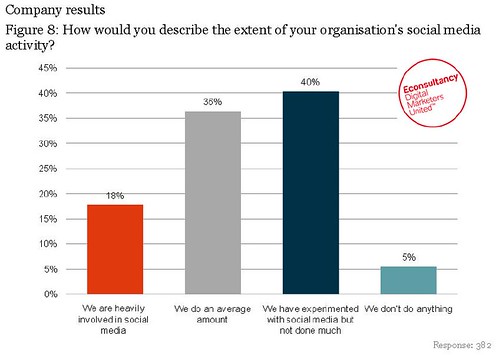
According to the Social Media and Online PR Report 2010 by Econsultancy and Bigmouthmedia, 95% of surveyed companies (mainly in the UK) have been involved in social media. But only 18% say they are heavily involved. 40% have experimented with social media but not done much.

econsultancy-Social Media and Online PR Report 2010

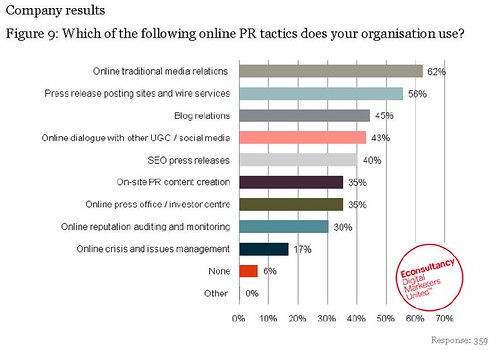
The most common PR activities in social media are online traditional media relations (62%), press release posting sites and wire services (56%) adn blog relations (45%).

Social Media and Online PR Report 2010

Other findings include:

  • Twitter, Facebook and YouTube are the most widely used external websites/services.
  • When asked how organisations are using Facebook, more than two thirds of companies (67%) are using Facebook as a marketing channel.
  • Around a quarter of company respondents (26%) said their most senior managers were “very interested indeed” in social media, compared to 19% who said there was “very little interest”.
  • Social network profile creation and management is still the most widely used social media tactic, although the proportion of companies who do this has decreased from 65% last year to 56% this year.
  • Direct traffic (72%) is still regarded as the most important metric for assessing social media activity. Almost three-quarters of respondents say this is one of the three most important metrics they use.
  • 45% of responding companies don’t have any policies or guidelines for the use of social media.

A sample report can be found here.

Flickr reaches 5 billion photos

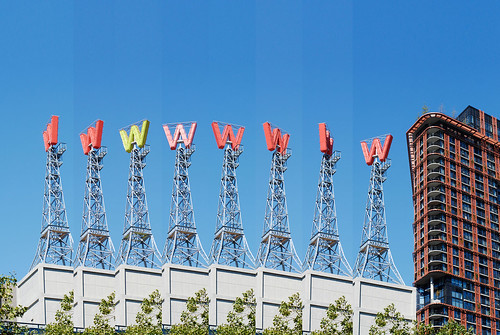
The photo sharing site Flickr just reached 5 billion photos this morning. Here is a link to photo number 5 billion, a photo of Woodward’s building in Vancouver, taken by Aaron Yeo:

http://www.flickr.com/photos/yeoaaron/5000000000/

Update: Since it became known it was the 5 billionth photo, Aaron Yeo has decided to share the Woodwards Collage picture with a CC license. So here it is:

Woodwards Collage

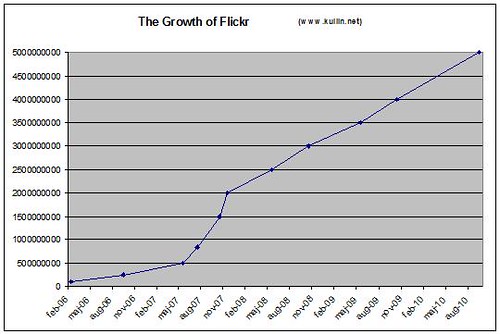
Despite the fact that social networks like Facebook have become popular places to share photos, it seems that the growth of Flickr continues at the same pace as during the last 3 years, adding about one billion photos per year. (Facebook claims that users uploaded 2.5 billion photos per month, in February 2010.)

I have been tracking the dates when Flickr has passed different milestones and calculated the graph below. Although Flickr seems to be handing out id numbers to each photo somewhat randomely, for example, the graph below has an id number just below 5 billion although it was uploaded after the photo mentioned above, it still seems to be pretty accurate.

flickr-5-billion

Previous milestones for Flickr:

22 Oct 04: 1,000,000
20 Apr 05: 10,000,000
15 Feb 06: 100,000,000
22 Sep 06: 250,000,000
15 May 07: 500,000,000
19 Jul 07: 850,000,000
06 Oct 07: 1,500,000,000
13 Nov 07: 2,000,000,000
17 May 08: 2,500,000,000
03 Nov 08: 3,000,000,000
04 May 09: 3,500,000,000
11 Oct 09: 4,000,000,000
18 Sept 10: 5,000,000,000

Update: Flickr has confirmed on its blog that the site has now reached 5 billion photos.