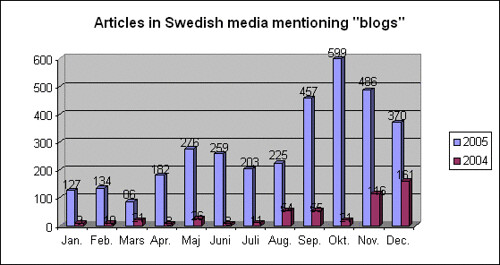
680% increase in blog coverage during 2005

It's safe to say that Swedish mainstream media "got blogs" in 2005. I predicted in November 2004 that blogs had broken through on a wider scale in Sweden as the number of articles about blogs in media increased significantly during that month. And the increase has continued during 2005. Swedish media wrote 500 articles mentioning blogs during 2004. This year we are up to 3,404 articles, that's a 680% increase.

blog stats 04 05

October was the month with the highest number of articles: 599, more than the entire year before. Some of the blog related news that got covered during October included:

- The pseudonymous blogger Mats Hård is revealed.
- Journalist blogger Linda Skugge is nominated for Sweden's grand journalist award (which she didn't win).

The mainstream media that wrote most about blogs were (number of online articles during 2005):

1. Aftonbladet (257)
2. Svenska Dagbladet (211)
3. Computer Sweden (191)
4. IDG (186)
5. Norrbottens-Kuriren (107)
6. Expressen (107)
7. Dagens Nyheter (80)
8. Helsingborgs Dagblad (73)
9. Trelleborgs Allehanda (61)
10. Ystads Allehanda (60)

An interesting fact about these statistics is that Aftonbladet only published two (2) articles that included the word "blog" (in Swedish) during 2004. The very first Aftonbladet article available online this year is from 25 March 2005.

Source: Retriever.

Technorati tags: , , .

UCLA media bias study under counterfire

UCLA has published a study that finally "proves" that US media has a liberal bias. The usual Swedish suspects are quick to jump on the bandwagon (and make parallels with Sweden). Now, it's hard for me to comment on the study when I haven't read it, but after reading the summary I thought the methodology was a bit odd. Then I found this response from Dow Jones, and thery're not pulling their punches:

"...the research technique used in this study hardly inspires confidence. In fact, it is logically suspect and simply baffling in some of its details."

They continue:

"First, its measure of media bias consists entirely of counting the number of mentions of, or quotes from, various think tanks that the researchers determine to be "liberal" or "conservative." By this logic, a mention of Al Qaeda in a story suggests the newspaper endorses its views, which is obviously not the case. And if a think tank is explicitly labeled "liberal" or "conservative" within a story to provide context to readers, that example doesn't count at all. The researchers simply threw out such mentions."

They move on with more arguments, and then the final blow:

"Suffice it to say that "research" of this variety would be unlikely to warrant a mention at all in any Wall Street Journal story."

Pascalidou-gate isn't going away

In October, Metro columnist Alexandra Pascalidou was accused of plagiarising an article from L.A. Times by Daniel Hernandez. The two articles contained a number of similar quotes and parts, but Pascalidou denied any wrongdoing.

In an interview in Resumé, Metro's chief editor Sakari Pitkänen was asked:

Will you talk to Pascalidou about this?
- I talk to my columnists every day.

Then nothing. A month later, her column started to appear in Metro again as if nothing had happened. This Tuesday, a second column was published. But when reading the comments to the articles we see that the plagiarism story still haunts Pascalidou.

"Den största klappen du kan få Alexandra är förmodligen vår glömska. Med hjälp av Sakari har ni snart lyckats tiga ihjäl en skandal!"

"Alltså förlåt mig - Jag har alltid läst dina krönikor, men sedan plagiat-skandalen tror jag inte på ditt engagemang."


It's not going away. Metro needs to deal with it.

How Cocaine Kate became Comeback Kate

Maxine Frith and PR practitioner Mark Borkowski writes intelligently about the fall and rise of supermodel Kate Moss in today's The Independent.

Technorati tags: , .

Zlatan and Henke won't be blogging the World Cup

It looks like the Swedish football team will be subject to a no-blog policy during the World Cup 2006, just like the German team.

- I can't imagine that there will be other rules than during the last European Championships, Lars Richt of the Swedish Football Association told Aftonbladet.

The Swedish FA implemented a new policy for the last WC in Japan and Korea 2002 that said players could not write columns in newspapers during the tournament. Richt says that blogging will be included in the policy.

Reuters launches software generated podcasts

Reuters have launched a number of podcasts that are automatically generated by text-to-speech software. And it actually sounds pretty good. Reuters writes that "each podcast contains the ten most recent news stories in that news channel".

Via Cyber Journalist.

Blogs made in China

The Swedish blogosphere is really big. Thousands of blogs have been started during the last year. Oh, and China has 37 million. Ouch.

China Web2.0 Review says: "Baidu (Nasdaq:BIDU), most popular search engine in China, released some statistics of China’s blogosphere based on its indexed pages. According to Baidu, the number of Chinese bloggers has amounted to over 16 million, number of blogs is about 37 million, that is every blogger has 2.3 blogs in average."

Via Poynteronline.

Dagens Nyheter and Metro hires gatekeeper for press releases

Dagens Nyheter has signed an agreement with Newsdesk where the paper is paying Newsdesk to "manage all distribution of press information to Dagens Nyheter's all news desks, editors and reporters". Metro has signed a similar agreement, according to Resumé.

- We will sort the material in a relevant way for DN, says Kristofer Björkman at Newsdesk.

In a sales letter from DN and Newsdesk, press contacts are asked to send all press releases to a central email address at Newsdesk, but Newsdesk clarifies in an interview that it is still an acceptable procedure to send press releases directly to journalists.

I can understand that individual journalists might need help in filtering the flood of emails that are being sent to them, but I have some doubts as to whether this is the right method. But maybe I have completely misunderstood the purpose of this agreement?

Having worked almost a decade in PR I can tell that press releases rarely get picked up by journalists you have absolutely no relation to. What will happen is that PR practitioners will add the central address to their mailing lists and still continue to send press releases to their regular journalist contacts. PR people don't want another layer between themselves and their audience. It is "bad enough" with having journalists as gatekeepers. Now the gatekeeper hires a gatekeeper? I'm not so sure. I prefer to look in the opposite direction by experimenting with a direct dialogue with the target audience as a complement, via blogs and RSS for corporate information.

New Year's resolutions for newspapers

While some might think that fabricating news is the future of media, Steve Outing has some advice for the rest of us. Yes, it's that time of the year. Here's Steve's 9 New Year's resolutions for the newspaper industry:

1. "I will discuss more, talk less."
2. "I will dare to wiki."
3. "I will be more interactive."
4. "I will seek out 'citizen advertisers.'"
5. "I will learn to turn free classifieds into money."
6. "I will publish where the young people are."
7. "I will devise a better Web site registration scheme."
8. "I will become a podcast god."
9. "I will not become complacent; I will remain alert."

Blogs as agenda setters

Undercurrent points to a new article on First Monday about agenda-setting, opinion leading and blogs.

From the conclusion:
"Attempts at amateur journalism constitute only a small part of the overall blogosphere, but they have demonstrated their ability to affect the flow of information between traditional journalists and audiences. From the standpoint of agenda setting, the most important thing about web logs is the way that they bridge these components of our public sphere.

In an article published shortly after his death, Steve Chaffee (writing with Miriam Metzger in 2001) argued that new media transform the assumptions of traditional communications theory. Anticipating the developments we have seen with web logs, he predicted that “the key problem for agenda-setting theory will change from what issues the media tell people to think about to what issues people tell the media they want to think about” (375). This study suggests that he was correct."

No blog for German footballers

The German players can't blog during the World Cup in Germany next summer, according to Aftonbladet. The German Football Federation stops the players from writing blogs or contributing to media articles because their focus should be on the game.

Hill & Knowlton's PO box [no longer] used in suspicious campaign

Marcus writes that a webpage called Sheriffbilen (the Sheriff's car) promotes a sticker in the form of the license plate belonging to Peter Eriksson, spokesperson for the Swedish Green Party. The web page is a protest against Eriksson's role in the launch of a road toll and congestion charging scheme in Stockholm, due to start in January. As a member of the Swedish Parliament, Eriksson is excluded from paying the toll and the web page encourages people to order a free sticker and put it on their own license plate (it doesn't spell it out, but what other reason is there?), something that is of course illegal. There is a disclaimer on the site that the sticker cannot be used on a license plate (duh!).

The person behind the site seems to be a former PR consultant, the otherwise brilliant lobbyist Martin Borgs. To order a sticker you are supposed to send a stamped envelope to Martin Borgs, Box 15411, 104 65 Stockholm. This is the PO box of the PR agency Hill & Knowlton in Sweden, Borgs' previous employer. Hill & Knowlton is a member of the WPP Group, one of the world's largest communications services companies which is listed on Nasdaq and the London Stock Exchange. If we put the "Sheriff site" in that perspective, it is highly inappropriate for a listed company to let it's post box be used in acts that border on encouragement of criminal behavior. To be honest, I don't think Hill & Knowlton are aware of this site.

Hat tip to Urban Lindstedt.

Update: After reading my post, H&K asked Borgs to stop using the PO box for this campaign and the site has now been updated with a new address. Clearly, Hill & Knowlton had nothing to do with the site.

Metro to open in 17 new cities

Free daily Metro will start distribution in 17 new cities in Sweden, according to Svenska Dagbladet. Kalmar, Växjö, Halmstad, Umeå, Luleå and Sundsvall are some of the candidates. Metro have declined to comment the information.

Metro announced today that its global daily readership is up 22% to 18.5 million readers. Metro now has 59 editions in 19 countries.

Top concerns about corporate blogging

Peppercom has done a survey on corporate blogs that says ghostwriting and commercialization are the most common mistakes corporations make when blogging.

The key findings show that:

- 72% of PR and marketing professionals cite the creation of artificial, overly promotional corporate blogs as the principal mistake that companies make when attempting to blog.
- In addition, 50% cite "obvious ghostwriting" as another significant blunder that they have witnessed with corporate blogs.
- 50% also cite companies that just "blog for blog's sake" as a problem that they have seen.

On the positive side, the survey showed that:

- Most respondents (62%) agree that the blogosphere is an appropriate venue for corporations to communicate with stakeholders.
- 80% of respondents feel that a corporate blog can help improve the dialogue between a company and its stakeholders, customers, and employees.
- 79% feel that a corporate blog helps position the company / chief blogger as a thought leader.

Link via Communication Overtones.

Technorati tags: , , .

RSS ads outperform similar web ads

RSS marketing company Pheedo has published some interesting findings regarding the effectiveness of advertising in RSS feeds. It seems that standalone ad placement (ads as separate blog posts) get higher click-through rates than embedded ads (ads within a blog post). Pheedo says that a standalone RSS ad generates, on average, a 7.99% click-through rate compared to 0.85% for an embedded RSS ad.

Other findings are that:

- ads placed in every other feed post get the highest click-through
- Tuesday, Monday and Saturday have emerged as the days with the highest CTR while Thursday and Friday show the lowest percentage

Technorati tags: , .

Best blog in Norway

VamPus Verden is the very first winner of Norway's Gullbloggen (The golden blog), reports Undercurrent. Gullbloggen is the award for the best Norwegian blog.

Consumers are fighting back against marketing

Being Reasonable has an interview with author Douglas Rushkoff that is well worth reading. Rushkoff talks about today’s media environment and invasive marketing:
"Companies are no longer treating their consumers as anything other than consumers. When buyers and sellers were living in the same community, they were dependent on each other in a way they aren’t anymore. One of my students was just pointing this out in class: If I am your deli man and you are my pharmacist, I have an incentive make you a great sandwich – not just because I want your business again, but because I need you healthy so that you fill my prescription properly! Companies today see their consumers as consumers only. As targets to be manipulated; wallets to be emptied. And people pick up on that, eventually."

Corporate blogging on tv

If you, unlike me, have access to Dagens Industri's new tv channel DItv, you will be able to see me tomorrow morning, discussing corporate blogs with Mikael Zackrisson, chief editor of Internetworld.

Footnote: My company's corporate blog can be found here.

Podcast pioneer got Curried away with wiki

How is your company or brand described in Wikipedia? You don't know, do you? But it's just a question of time before communicators learn more about wikis and realize that they are important as a source of information about a brand, service or product. As they do, inevitably someone will misuse it.

Podcasting pioneer and former MTV veejay Adam Curry wanted to improve his role in the development of podcasting by anonymously edit the entry on the early history of podcasting, and giving himself a larger part.

What he didn't know was that revisions are tracked and the IP addresses are logged, so the Wikipedia editors soon found out that someone from an address controlled by Curry had made four major revisions and axed vital parts of the text.

Now it seems that this story has made it into the Wikipedia entry about - Adam Curry. That's poetic justice.

Rogers Cadenhead has the story and PR blogger Jeremy Pepper comments.

10 new rules of branding

Chief Marketer lists the 10 new rules of branding.

1) Brands that influence culture sell more; culture is the new catalyst for growth.
2) A brand with no point of view has no point; full-flavor branding is in, vanilla is out.
3) Today's consumer is leading from the front; this is the smartest generation to have ever walked the planet.
4) Customize wherever and whenever you can; customization is tomorrow's killer whale.
5) Forget the transaction, just give me an experience; the mandate is simple: Wow them every day, every way.
6) Deliver clarity at point of purchase; be obsessive about presentation.
7) You are only as good as your weakest link; do you know where you're vulnerable?
8) Social responsibility is no longer an option; what's your cause, what's your contribution?
9) Pulse, pace, and passion really make a difference; had your heartbeat checked recently?
10) Innovation is the new boardroom favorite.

Hat tip to PR Machine.

Edelman the only top agency to beat Media Culpa

Media Orchard has tested SiteScore, a tool that rates how well-designed, popular and accessible a website is on a scale of 1 to 10. Media Orhard tested the eight largest PR agencies and how they ranked:

1. Edelman ... 8.4
2. Porter Novelli ... 8.0
3. Hill and Knowlton ... 7.9
4. Ketchum ... 7.5
5. Ogilvy Public Relations Worldwide ... 7.4
6. Weber Shandwick Worldwide ... 7.2
7. Burson-Marsteller ... 6.9
8. Fleishman-Hillard ... 6.8

Naturally, I had to see how this blog rates in comparison and Media Culpa gets 8.0, so only Edelman is doing better.