Da-la-la-da

Some artists’ brands are so closely tied to one monster hit that you only need to hear a drumbeat or a few notes to recognize them. Or what about this description for the upcoming May concert in London with Sweden’s number one poodles – Europe:

“Da-la-la-da Da-la-la-da-da Da-la-la-daa-da It’s the final countdown… to Sweden’s finest son’s return to the London stage. Rock!”

PR speak translated

Here’s a lesson for PR professionals. As a result of Adobe’s acquisition of Macromedia the PR departement has produced a FAQ, completely soaked with words devoid of any real meaning. That becomes painfully obvious when Daring Fireball translates PR speak to plain English. Example:

Q:Do you anticipate a reduction in force as a result of this transaction?

A: When two successful growing companies join together, the result is a combined organization that creates new and exciting opportunities. The combination will lead to powerful new areas of innovation, new products and solutions, and an acceleration of our respective growth agendas. At the same time, there will be some duplication of employee functions between the two companies, and upon the close of the transaction, we anticipate some level of reduction in force. While we anticipate the integration team will identify opportunities for cost savings, the primary motivation for this acquisition is to continue to expand and grow our businesses into new markets.

Translation: Yes.

No-one under 15 reads Vecko-Revyn?

In its latest edition, Swedish publication Vecko-Revyn has a competition where three lucky winners will get an injection of Restylane, a gel that is used in lip sculpting. This highly controversial competition did not sit well with readers, in part due to the magazine’s leading standing with young girls. And after being critized in some of the largest dailies, Vecko-Revyn’s chief editor Charlotta Gustafsson today wrote an article in Expressen where she said the competition was a mistake, but that they will still go through with it. She claims that the majority of their readers are over 20 and mature enough to make their own choices about different beauty treatments.

“Detta eftersom vi riktar oss till kvinnor mellan 20 och 25 år.
Enligt Orvesto (en Sifoundersökning som mäter samtliga tidningar i Sverige), så är 67 % av VR:s läsare över 20 år. Snittåldern på våra läsare är 28,4 år.”

But a journalist at Östgöta Correspondenten had this argument with Gustafsson in December 2004 and bothered to investigate her claims. According to Linn Rittmalm-Glimne, the Orvesto survey only asks respondents aged between 15 and 79 (see yourself here). This means that no girls (or boys) under the age of 15 are asked if they read Vecko-Revyn. If 33% of all readers are between 15 and 19, and 67% between 20 and 79, there’s a pretty good chance that a significant number of very young readers are missing from the survey. How convenient. Especially since Sifo had told Rittmalm-Glimne that the response rate in the age group 15-19 is very low, or 52%, so the results may not be very reliable.

Here is a graph of Vecko-Revyn’s reach in different age groups (thousands of readers).
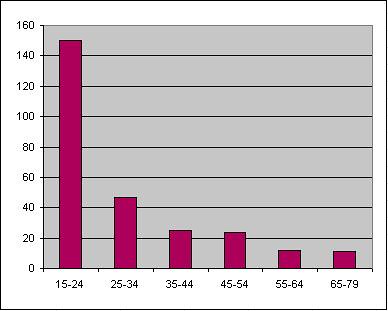
Vecko-Revyn

The TV news show Rapport had asked a number of retailers what age group buys Vecko-Revyn, and the response was “12 to 18”. This might not have any statistical relevance but adds to the suspicion that their readers are younger than they claim.

Dagens Nyheter wrote an article in 2000 (Eva Härnbäck, 2000-01-09, registration required) about this subject and citing a few different surveys (Mediebarometern, Nordicom-Sverige 1998 och 1999. Barnmediaindex 1997, Egmont) DN writes:

“35 procent av alla unga svenska kvinnor i åldrarna 15-24 läser Veckorevyn. Målgruppen, säger Veckorevyns redaktion, är 18-25-åriga tjejer. Men betydligt yngre flickor, 13-15 år, läser i ännu högre grad Vecko-Revyn: uppemot 40 procent.”

Translated this means that Vecko-Revyn at that time reached 40% of all girls between 13 and 15 years of age, an age group only partly surveyed by Sifo.

Worth noting is that this is the same magazine that only a few years ago stopped promoting the Swedish leg of the Miss World pageant – Fröken Sverige. Then chief editor Emma Hamberg said that competing in looks sucks: “Att tävla i hur man ser ut och vinna en resa om man är tillräckligt snygg anser Hamberg vara för ”jävligt”. Veckorevyn handlar också om skönhet men är inte en tävling i vem som är snyggast.” (see pdf page 27).

Living the brand

Via bisonblog I find an interesting article by Nicholas Ind about employee branding. The article is published on PR agency Springtime’s webpage and it touches upon a subject that is highly relevant in the professional services industry. It may be a cliché but nevertheless, our employees are our most important asset and probably the single most important vehicle for promoting our brand values.

I liked the simple example about how Nike used job applications to convey their brand values.

Nike responds to job applications with a thank you and this very brand driven message: ‘Use your imagination. If you are sure about what you want to do, you’re halfway there. There are no limits. Everyone at Nike has a dream.

Apparently most companies are either neglecting the issue or handling it poorly. Ind writes:

Research among Swedish companies by TEMO (2002) found that 31% of employees did not believe in their employers’ vision and values; a Gallup study of US workers (2003) found that 70% were either not engaged or were actively disengaged at work […]

Blogs are established now

There’s been a lot of different opinions about when the real breakthrough of blogs will occur in Sweden. I claimed it happened in November last year because of a significant increase in the number of blog articles in traditional media that took place that month. The last week however, blogs seem to be everywhere in Swedish media, culminating today with two events, one being that Internetworld named Sweden’s 50 most popular blogs (see previous post). This has been reported today in most Swedish media via news agency TT Spektra.

The second event is a quote from EU Commissioner Margot Wallström’s blog which the news agency TT has picked up. The blog post is about the EU constitution. Among other things Wallström says: “Now we all look at France with hopes and fear.” The fact that TT picks up blog posts from a leading politician without any further explanation to what a blog is, and it then finds its way to, currently 25 Swedish papers, is nothing short of a landmark. I don’t think we need to wait for a blogger to bring down a journalist or a politician. Blogs are already established.