IOC bans blogging

While most organizations are adapting to a world where transparency is the cathword, the IOC is moving in the opposite direction. With an attitude worthy a dictatorship, the IOC tries to control every communicative aspect of the Olympic games in Athens.

First we learned that spectators are banned from the arenas if they bring in products of the wrong brand. Then we all laughed at the moronic linking policy of Athens 2004.

Now USA Today reports that Olympic athletes are largely barred from posting online diaries such as blogs.

“The IOC’s rationale for the restrictions is that athletes and their coaches should not serve as journalists — and that the interests of broadcast rightsholders and accredited media come first.”

“The Olympic guidelines threaten to yank credentials from athletes who are in violation as well as to impose other sanctions or take legal action for any monetary damages.”

The US army tried a control/command approach in Iraq but failed miserably. Why would the IOC succeed in controlling the debate, and for what reason? Today, media consumers are also producers and anyone equipped with a digital camera or an internet connection can scoop big media. Trying to stop people from expressing what they see is a violation of freedom of speech.

In the end, it is we as consumers who pay for this spectacle by bying products from the sponsors, by watching the ads that finance media, by visiting the arenas and so on. We should demand a diversity of voices and not accept propaganda style reporting.

(Link via Micro Persuasion)

Oil price record levels is (still) a myth

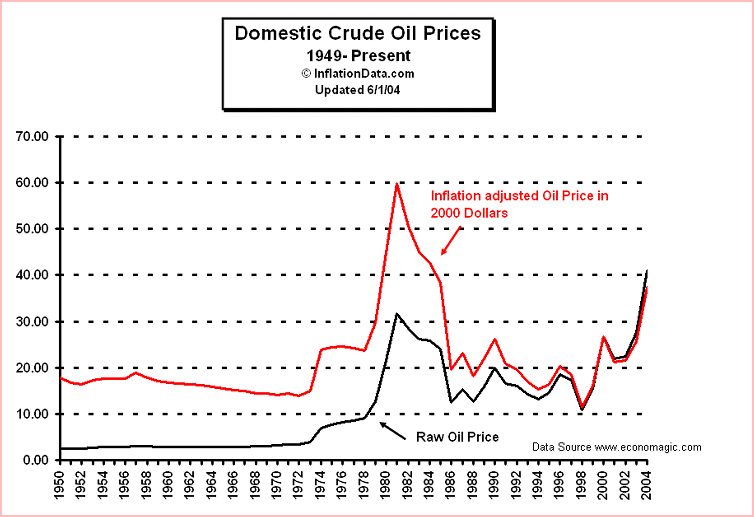
Since June media has been hammering the same message over and over again – oil has never been as expensive as now. True, and false. It is true that the different statistics that go back to 1983 or 1988 show that the oil price has not been higher during the period from the mid 80s up til now. False, because they only look on the actual dollar per barrel price, not adjusted for inflation, and the prices in 1980 were much higher, and the period before 1983 is excluded.

Stats that don’t take inflation into consideration are just fluff, it doesn’t mean anything. If your salary today was slightly higher in dollars than it was in 1980, you wouldn’t jump up and down with joy, because your money are worth less now.

In the US, Spinsanity has touched on the topic and how the oil price has been used on the political arena.

A more critical approach from media would be healthy, like when Dagens Industri (reg. required) for example last week noted that if adjusted for inflation, the price in 1980 was more than twice what it is today. But these examples are very rare.

Check my previous post, and below, for stats and graphs for inflation adjusted oil prices.

Chart from Inflationdata.com. Full size chart here.

Silly linking policy another PR flop for Athens 2004

The people who dreamed up the Athens 2004 linking policy have become the laughing stock of the entire internet, to the extent that the topic is no 3 at Daypop’s Top 40 list of the most popular (or in this case ridiculed) topics on the net.

As an example: In order to place a link embedded in copy interested parties should:

a) Use the term ATHENS 2004 only, and no other term as the text referent

b) Not associate the link with any image, esp. the ATHENS 2004 Emblem (see paragraph below)

c) Send a request letter to the Internet Department stating:

-Short description of site

-Reason for linking

-Unique URL containing the link (if no unique URL than just the main URL)

-Publishing period

Contact point (e-mail address)

The control/command attitude of the Olympic organization does not work in a blog-enabled world and the whole idea of controlling how people link to your site is just counterproductive and bad PR. Rick E. Bruner summarizes:

Apparently the folks behind Athens 2004, the offical site for the current Olympics, still use AOL or have only read about the Internet in airline magazines.

“Sweden in the news” – last week

Stories involving Sweden from last week:

> Sweden could be a talent magnet

> The sentence for pastor Åke Green’s hate speech against homosexuals is still a hot topic. It even sparked the Libertarian Alliance to demand that Sweden should be suspended from the EU (!). Interestingly, the Libertarian Alliance has some loose connections to the Swedish PR agency K-Street. The Libertarian Alliance is associated with Libertarian International, whose Swedish arm is Frihetsfronten, whose editor is Erik Lakomaa, founder of K-Street. Not that there’s anything wrong with it…

> Sweden threaten walk-out unless pair are banned: Kenteris and Thanou again.

> PlayStation banned from Swedish prisons: This one is fun. It was a story from Sydsvenska Dagbladet that I translated and did a short post on, which got picked up by the blog we-make-money-not-art, which in turn was picked up by Engadget and then the story spread across the net. What bummed me a bit was that most blogs linked to we-make-money-not-art instead of to me.

Gag order for Canadian athletes who want to blog from the Olympics

Cyberjournalist.net reports on two US athletes who blogs from the Olympics in Athens. Scott Goldblatt is on the U.S. swim team and is blogging for nj.com. What is more interesting is that U.S. officials told Goldblatt he can blog, “as long as I do not move into the territory of journalism” And Goldblatt says that Canada is not allowing its athletes to blog. Why a special blog gag order? Can they update their regular web pages? There’s nothing you can say in a blog that you can’t say on any other web page so to forbid blogging doesn’t serve any purpose.

While we are on the Olympic theme, today we got photos and video coverage from Kostas Kenteris in a hospital in Greece. This must be the worst crisis management case in years. Why is this guy still wearing his shoes in bed and why can’t we see the faces of the people working in the hospital? Even if Kenteris and Thanou are innocent, does anybody believe that the motorcycle accident and the hospital visit are not fake?

Consider for one moment that Kenteris and Thanou have not been using illegal substances and that they were not informed of the doping test that would take place in Athens. And that the motorcycle accident actually happened. Anyone who have spent two weeks in PR would recommend that they:

1. Show what you got: The entire world thinks you’re a cheat and everyone is trying to hunt you down, so you don’t hide in a hospital for two days sending out suspicious video footage wearing sneakers in bed. If you’re hurt, show it to the public. Take a photograph of the bike, it must be a wreck, right? Send out a press release with the exact time and location where the accident happened. And do your best to find the mystery man who drove you to the hospital.

2. Volunteer to take a doping test. You’re innocent, so you might as well step up to the plate and let them examine you.

3. Talk to the press: Unless you’re in a coma, you can talk to the press. Hiding isn’t making journalists go away, to the contrary they will dig deeper and assume that you are guilty.

Instead, Kenteris and Thanou are caught up in what looks like lies and half-truths. Either they are guilty or they have a very bad manager.

SvD comments on plagiarism in DN

Michael Moynihan of Stockholm Spectator Media Watch has been disappointed that his revelations of plagiarism in Dagens Nyheter hasn’t been causing any debate in Swedish media. Some blogs have noticed and commented on the story, but no traditional media have touched the topic, until today when competing daily Svenska Dagbladet ran a piece on plagiarism titled “It’s hard work to do your own thinking“, by editorial writer Moa Eriksson.