Facebook has released some statistics about people that click on the Like button on for example media sites. Apparently people who click the Facebook Like button are more engaged, active and connected than the average Facebook user. The average “liker” has 2.4x the amount of friends than that of a typical Facebook user. They are also more interested in exploring content they discover on Facebook — they click on 5.3x more links to external sites than the typical Facebook user.
Month: September 2010
Findings from the Social Media and Online PR Report 2010
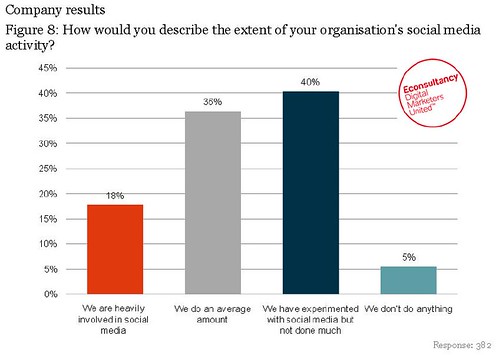
According to the Social Media and Online PR Report 2010 by Econsultancy and Bigmouthmedia, 95% of surveyed companies (mainly in the UK) have been involved in social media. But only 18% say they are heavily involved. 40% have experimented with social media but not done much.
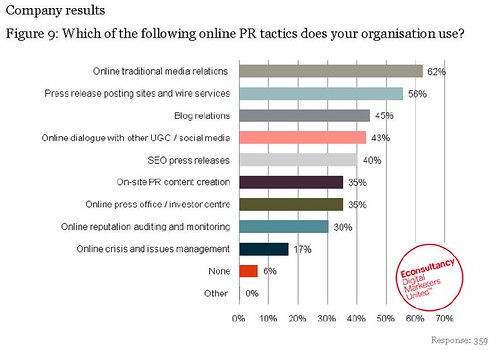
The most common PR activities in social media are online traditional media relations (62%), press release posting sites and wire services (56%) adn blog relations (45%).
Other findings include:
- Twitter, Facebook and YouTube are the most widely used external websites/services.
-
When asked how organisations are using Facebook, more than two thirds of companies (67%) are using Facebook as a marketing channel.
- Around a quarter of company respondents (26%) said their most senior managers were “very interested indeed” in social media, compared to 19% who said there was “very little interest”.
- Social network profile creation and management is still the most widely used social media tactic, although the proportion of companies who do this has decreased from 65% last year to 56% this year.
- Direct traffic (72%) is still regarded as the most important metric for assessing social media activity. Almost three-quarters of respondents say this is one of the three most important metrics they use.
- 45% of responding companies don’t have any policies or guidelines for the use of social media.
A sample report can be found here.
Sky Italia quotes fake Zlatan Ibrahimovic on Twitter
For some celebrities, social media has proven to be very useful communication channels that reach fans directly. They can communicate their point of view without running the risk that traditional media misinterpret or distort the message. When actor Jim Carrey announced that he and Jenny McCarthy would break up, he didn’t issue a press release. Instead, he simpy tweeted:
“Jenny and I have just ended our 5yr relationship. I’m grateful 4 the many blessings we’ve shared and I wish her the very best! S’okay! ?;^>”
With a simple tweet, he could reach millions of readers before traditional media had time to react. But not everything on Twitter is what it seems to be. Carrey has a verified account on Twitter, which certifies that it is actually The Jim Carrey that is tweeting (or someone he has hired to do so). So if a celebrity doesn’t have a verified Twitter account, you should probably think twice before you assume it is the real thing.
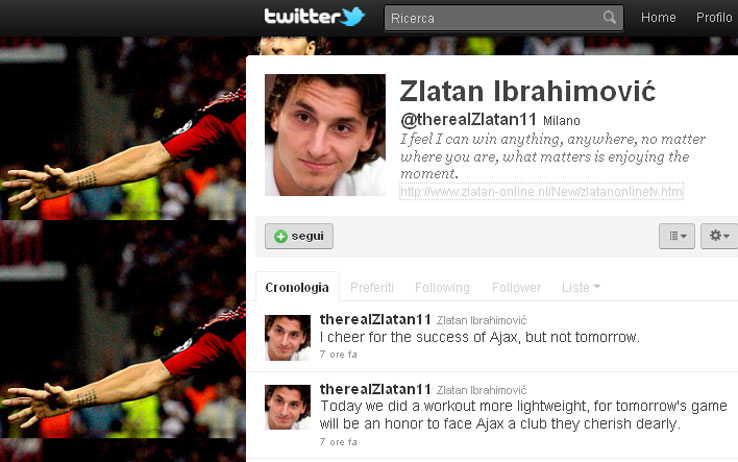
I have blogged before about how AP, Al Jazeera and a bunch of other media quoted a fake Zlatan Ibrahimovic account on Twitter. It didn’t take much work to prove it was fake. And yesterday it happened again as media started to cover the Champions League game tonight between AC Milan and Zlatan’s old club Ajax. Italian tv channel Sky Italia quoted @therealZlatan11 in an article that suggests that “Ibra” had tweeted “I cheer for the success of Ajax, but not tomorrow”.
Of course this is not the real Ibrahimovic. He has never been active online and certainly not on Twitter. You would only need to click on the link in the Twitter bio to see that the link is not to an official site, but to a rather poor fansite from the Netherlands.
If traditional media are going to use celebrities in social media as sources for news, they need to put a little more effort in to research to verify that the source is correct. Otherwise they will look pretty foolish.
Footnote: Thanks to http://twitter.com/ItalianMeetup for the scoop about Sky Italia.
Don’t mess with Sweden on Twitter
Now and then we read stories about businesses that use Twitter in ways that are creative, but not considered to be according to Twitter etiquette. Perhaps you remember when Habitat UK spammed several Twitter hashtags like #iPhone or #Mousavi, a tag associated with the Iran election, with tweets promoting their furniture? It created an uproar among Twitter users and gave the company lots of negative publicity.
Update: After a conversation with @dohop and checking the ID numbers of each tweet, I see that the tweet from @swedense came seconds before the first tweet from @dohop, giving this story a slightly different meaning. In other words, the tweet from @swedense was not directed to @dohop at all, but to several other comments on Twitter. Sorry that I hadn’t discovered that before.
Sweden on Twitter
Today I found another interesting example (hat tip to Johan Hedberg) from a website called Dohop.com, a “flight search engine”. It tried to generate business out of a very sensitive topic, namely the Swedish election. On Sunday last week, Sweden for the first time elected an anti-immigrant party into the Swedish parliament. The Sweden Democrats got 20 seats in the parliament, sending shock waves through the entire Swedish society, and the election results are not even final yet. So obviously this is not a topic that Swedes would take lightly, but it did not stop @dohop from publishing the following tweet.

However, Sweden.se, the official web presence of the Swedish Institute, would not take that kind of tweeting about our beloved country. So it sent out this rather upset tweet.
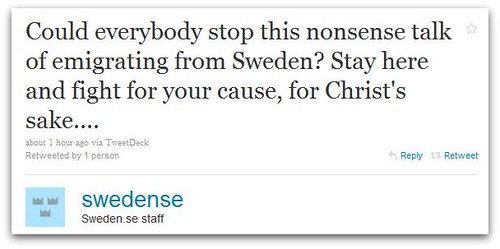
Which got picked up by @dohop, who apologized.
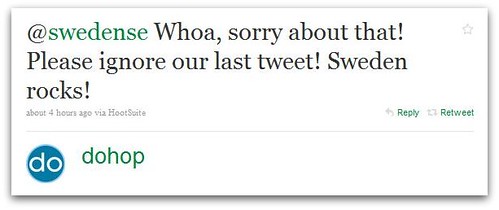
I don’t know if there is a moral to this story, but if you are trying to be funny on Twitter on someone else’s expense, be prepared that they might be listening and talk back. Way to go, Sweden.se!
Swedish customers can book Lufthansa tickets on Facebook
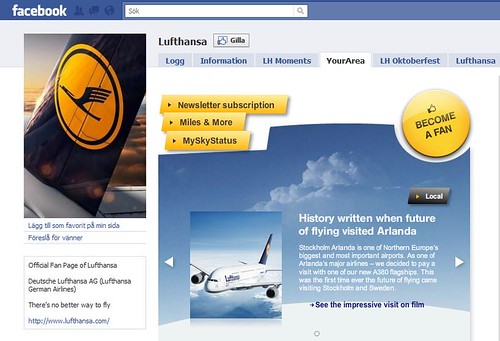
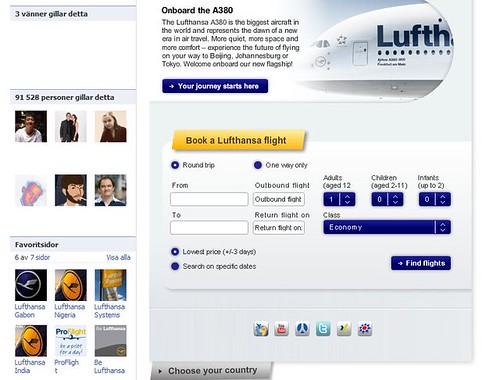
I blogged a week ago about how Delta Air Lines lets customers book airline tickets on the Delta Facebook page. EasyJet also has this application on its page on Facebook. Now Lufthansa has also introduced the same functionality to its page and it is available for customers in Sweden, USA, Germany, India, Spain, Great Britain, Greece, Turkey and the United Arab Emirates. Further markets will be added by the end of the year.
Lufthansa also cooperates with the location-based site Foursquare in Germany and users who check in at three different locations via Foursquare can get a 20 euro voucher for their next Lufthansa flight booking.

Users who select a certain country, get local news (see below from Sweden).
Flickr reaches 5 billion photos
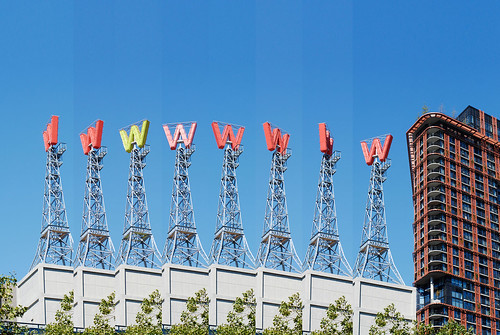
The photo sharing site Flickr just reached 5 billion photos this morning. Here is a link to photo number 5 billion, a photo of Woodward’s building in Vancouver, taken by Aaron Yeo:
http://www.flickr.com/photos/yeoaaron/5000000000/
Update: Since it became known it was the 5 billionth photo, Aaron Yeo has decided to share the Woodwards Collage picture with a CC license. So here it is:
Despite the fact that social networks like Facebook have become popular places to share photos, it seems that the growth of Flickr continues at the same pace as during the last 3 years, adding about one billion photos per year. (Facebook claims that users uploaded 2.5 billion photos per month, in February 2010.)
I have been tracking the dates when Flickr has passed different milestones and calculated the graph below. Although Flickr seems to be handing out id numbers to each photo somewhat randomely, for example, the graph below has an id number just below 5 billion although it was uploaded after the photo mentioned above, it still seems to be pretty accurate.
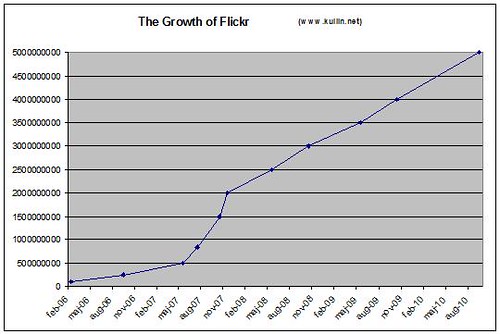
Previous milestones for Flickr:
22 Oct 04: 1,000,000
20 Apr 05: 10,000,000
15 Feb 06: 100,000,000
22 Sep 06: 250,000,000
15 May 07: 500,000,000
19 Jul 07: 850,000,000
06 Oct 07: 1,500,000,000
13 Nov 07: 2,000,000,000
17 May 08: 2,500,000,000
03 Nov 08: 3,000,000,000
04 May 09: 3,500,000,000
11 Oct 09: 4,000,000,000
18 Sept 10: 5,000,000,000
Update: Flickr has confirmed on its blog that the site has now reached 5 billion photos.