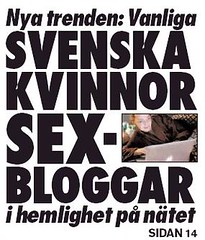
 From today’s Aftonbladet:
“The new trend. Ordinary Swedish women are secretly sex-blogging on the net”
(… as opposed to blogging off the net?)
Two Swedish Eyes on Media and Public Relations
From today’s Aftonbladet:
“The new trend. Ordinary Swedish women are secretly sex-blogging on the net”
(… as opposed to blogging off the net?)
Sweden’s largest daily Dagens Nyheter today announced it has quit its current agreement with TT, Sweden’s leading news agency. The goal is that DN will manage without external news agency material from the beginning of next year. Recently Metro, the free daily, announced a similar decision. Metro previously relied heavily on articles from news agencies and it is estimated that Metro spends close to 10 million SEK a year on TT news.
– We need to own our own material. It is becoming increasingly important to own the intellectual property rights to be able to forward them to other channels, Chief Editor Sakari Pitkänen then told Resumé.
– We have examined what we get from TT and found that the price tag is too high, said Charlotta Friborg, Dagens Nyheter’s Administrative Chief Editor.
Metro will increase its own staff while DN will use its current editorial staff, which already is under pressure from reductions.
– News are summarized in so many places today. Maybe time has run out on traditional local news agencies, Sakari Pitkänen told DN.
The Swedish Centre Party has sold its media holding company Centertidningar AB to a consortium consisting of MittMedia Förvaltnings AB, Morgonpress Invest AB, Tidningsaktiebolaget Stampen and VLT AB (publ). The value of the deal is an impressive 1.8 billion SEK (190 million euro) which makes the Centre Party one of the richest political parties in Europe.
The acquisition of Centertidningar includes the following Swedish dailies:
Fully owned: Hallands Nyheter, Lidingö Tidning, Länstidningen Södertälje, Norrtelje Tidning, Nynäshamns-Posten, Södermanlands Nyheter and Östersunds-Posten.
Partially owned via interests in Hälsingetidningar: Hudiksvalls Tidning, Hälsinge Kuriren and Ljusdals-Posten.
This is a few days old, but I can’t resist a top list that includes my blog. Scott at Media Orchard lists the top 25 PR blogs, based on blogs tagged “Public Relations” at Technorati (admittedly a blunt instrument for determining “authority” of bloggers, but hey, it’s always something).
1. Micro Persuasion
2. gapingvoid
3. Global PR Blog Week 2.0
4. Duct Tape Marketing Weblog
5. ALLIED by Jeneane Sessum
6. POP! PR Jots
7. hyku blog commentary by blog consultant Josh Hallett
8. Media Guerilla
9. B2B Lead Generation Blog
10. AuburnMedia
11. Media Culpa
12. PR Meets the WWW
13. Marcom Blog
14. Marketing Begins At Home
15. A PR Guru’s Musings
16. Beyond PR
17. One By One
18. On Message from Wagner Communications
19. Across the Sound
20. Morgan McLintic on PR
21. Phenix Rising
22. Media Orchard, by the Idea Grove
23. Shotgun Marketing BLOG
24. Kinetic Ideas: A Marketing Blog
25. ZnetLady: Modern Media Modo
A similar search on blogs tagged “Advertising” gives us this top 25 list (with Åsk at Adland in an impressive 4th spot, with me on #18). One duplicate site removed.
1. Micro Persuasion
2. gapingvoid
3. Adrants
4. AdLand
5. Adverblog
6. business2blog
7. Blog Advance Advancing the Blogosphere
8. Personal Democracy Forum
9. PSFK
10. Blog Karde?li?i “beta”
11. hyku blog commentary by blog consultant Josh Hallett
12. Brainstorm #9
13. Online Advertising and Web Industry Trends
14. AdPulp: Daily Juice from the Ad Biz
15. Digital Inspiration Software Reviews
16. Thinking by Peter Davidson
17. infOpinions? : Public Relations
18. Media Culpa
19. The Language Guy
20. everyhuman
21. The Surging Waves
22. Marcom Blog
23. Influx
24. Marketing Begins At Home
25. criteriondg.info/wordpress
Wired today has a story about how companies are starting to use security filters in order to block employees’ access to blogs, for example by blocking any site with the word “blog” in the URL (which affects all blogs hosted on blogspot.com or blogsome.com). Corporates worry about productivity and security issues. But of course, all blogs are not bad for business. One must not forget all the positive aspects of blogs in terms of gaining and sharing knowledge, building relations, marketing etc. But then again, Resumé points to an article on adage.com (reg. required) that says employees in the US will waste 551,000 years reading blogs in 2005.
“About 35 million workers — one in four people in the labor force — visit blogs and on average spend 3.5 hours, or 9%, of the work week engaged with them, according to Advertising Age’s analysis. Time spent in the office on non-work blogs this year will take up the equivalent of 2.3 million jobs.”
Procrastination has never been more ubiquitous.
The story about Alexandra Pascalidou’s “inspiration” of an L.A. Times article has now become an international embarrassment, as one of the major local blogs, L.A. Observed, today posted a comment.
It’s interesting that Pascalidou’s response hasn’t resulted in further questioning. She hasn’t admitted that she used or even read Hernandez’ article, when it is obvious to anyone who compares them that she must have. She is a regular columnist in Metro, the paper that recently launched a new concept with a daily correction column. Question is, will Metro do a follow-up, or was this initiative of transparency just lip service?
In contrast, when Resumé today revealed that Dagens Industri’s stock reporter Ingemar Carlsson was an active day trayder while he was giving stock advice in Dagens Industri, Carlsson published a sincere mea culpa and apologized. And he published it before Resumé managed to publish their scoop online.
My guess is that Carlsson will be back at DI after a short time-out, while Pascalidou’s “columnist brand” has been severely damaged. Especially since she has another crisis still waiting to explode once more, namely that she has been accused of using a ghost writer but denies it. Freelance journalist Isobel Hadley-Kamptz comments on her blog “since I know who the ghost writer is, I know she is lying“.