A collection of Swedish podcasts can be found at Podcasting.se.
Month: April 2005
Bloggers talk shopping on weekends
You can learn a great deal from just analyzing data. This new Trend Tool from BlogPulse that I wrote about earlier this week is really fun. For example, did you know that shopping is discussed much more frequently in the blogosphere on Saturdays and Sundays than the rest of the week?
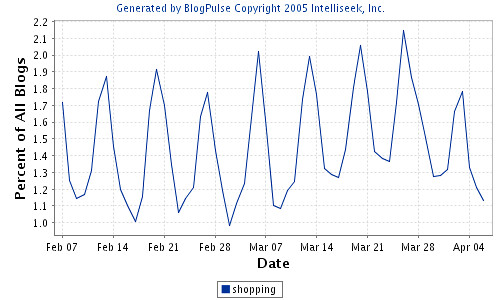
So what can you do with this information? Well, the fact that people shop more on weekends is probably not news. But say that you complement your current marketing strategy with an online campaign targeted to bloggers and run it on weekends when people are in a shopping mood. You can advertise via Google AdWords and pause your campaign from Monday to Thursday to reactivate it again on Friday. That way there is a higher chance that your ads deliver leads than during the rest of the week. Maybe, I don’t know if it works. Main point is that by running a simple search you can find different patterns in consumer behaviour.
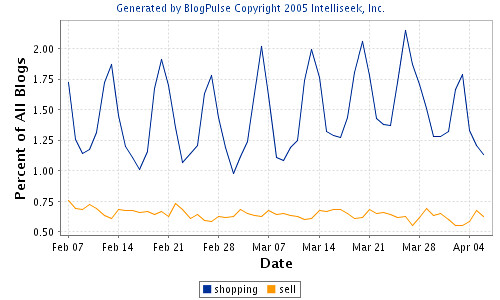
If we add another parameter, a search for the word “sell” the graph is close to inverted. Bloggers discuss selling less on weekends than the rest of the week. Why is that? Maybe we buy stuff on Saturday, get disappointed and want to sell it on Monday (kidding).
Don’t tell me what browser to use
If you are doing business and haven’t heard about customization by now, maybe you should look for another career or alternatively join the The World Congress on Mass Customization and Personalization in Hong Kong this fall. Today’s consumers demand the ability to tailor products and services after their individual needs and preferences. They customize and personalize everything, from software (with different plug-ins and skins), to cell phone covers and web browsers. Media consumers are getting more and more used to customize their news consumption, so if you are a media company and assume or demand that all readers use the same tools and desire the same information you aren’t paying attention.
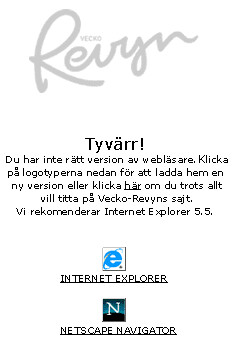
Here’s an example of a media web site that tells me what to use and lets me know that my choice of browser is wrong. This message greeted me at the website of female weekly Vecko-Revyn. The text reads as follows:
Too bad!
You don’t have the right version of browser. Click on the logos below to download a new version or click here if you still want to view Vecko-Revyn’s website. We recommend Internet Explorer 5.5.
I beg to differ. Only I decide if I have the right browser or not and you’d better have a pretty darn important website if I should choose to upgrade or switch browser just to visit you. If I was a webmaster I would try to make my website accessible for as many types of browsers as possible. Heard of Firefox maybe?
Footnote: I use Netscape from home.
Sharing listening habits
I’ve been using Audioscrobbler for a while, and it’s really a neat application. It tracks all songs you play on your computer via a plug in to Winamp or iTunes for example. It then takes that information and compile top lists for most played songs and artists the last week and in total. Had there been an application like this when I was younger I don’t think I would have ever left the room (don’t tell anyone but I compiled lists like this by hand way way back).
Sharing listening habits is not uncommon, celebrities do it on iTunes for example. Blogger Roxanne has started a meme where she and other bloggers share the first ten songs to appear in their mp3 player every Friday. Rox Populi’s Friday Random Ten can be found here. And by reading Mark Comerford’s blog I know that he likes David Sylvian which automatically makes him an intelligent person…
Anyway, here is my main page at Audioscrobbler and you can subsribe to information via my RSS feed. Let the ranting begin.
Image doping
I had an enjoyable lunch today with fellow blogger Henrik Torstensson. He brought up a subject that we both had experienced, the fact that both our blogs had gotten a significant amount of traffic from Google Images. We concluded that the amount of traffic signalled that there is an opportunity in search engine optimization of the images of your webpage, call it “image doping” of your website if you will. That is, if the type of traffic it generates is desirable to you, and not just eat up your bandwidth.
Looking around the net I couldn’t find a whole lot of info about image optimization, but some tips for getting a higher rank on Google Images are:
> Use the alt attribute
> Name the image with the desired keywords: “nissan-maxima.gif” if you are promoting a Nissan Maxima car.
> “putting each image in a specifically optimized html page” [not sure what that means, to be honest]
> using a picture gallery and a thumbnails systems
> consider the size of your image, bigger seems to get higher rankings
> when naming image files, don’t use underscore, use “-” instead of “_”
To me, this seems to be unexplored territory and savvy webmasters and bloggers could use this opportunity to increase traffic. Further reading here, here, here and here.
Nerikes Allehanda a role model for newspapers’ use of RSS
More Swedish newspapers are adding RSS feeds to their online editions. Linköpings Tidning announced a new feed yesterday at http://www.linkopingstidning.se/rssfeed. An even more innovative approach comes from another local daily, namely Nerikes Allehanda. They have introduced an application that lets you choose what news you want and then create your own news feed. For example, if I am only interested in soccer and news from the city of Karlskoga I can just click those boxes and the application creates a feed which combines the two sub feeds (http://na.se/rss/rss.asp?a=7&s;=2). Or I could subscribe to several feeds in my news reader.
Very nice work and intelligent in many ways, not just because it lets readers decide on what news are important to them. It is also a change of attitude, a willingness to acknowledge that the gatekeeper role where media pick and choose what news you should consume, take it or leave it, that role is not relevant anymore. Media consumers today have a wide range of choices when it comes to searching, selecting and consuming information. The news business is becoming more of a conversation than a lecture, to use the words of journalism professor Jay Rosen. The shift in the balance of power from media producers to media consumers means that content providers who stay in the “lecture model” may get abandoned by readers who want to “roll their own” media. If media consumers require a smorgasbord of news, you can’t serve just one dish.
Also see my extensive list of some 220 Nordic media RSS feeds here.