Blog hysteria in mainstream media

Swedish mainstream media are currently launching a bunch of blogs on their websites. I found a new one today at Aftonbladet where Tomas Ros blogs about the World Championships in hockey.

The other day Svenska Dagbladet launched a blog where a student, Helena Myrin, blogs about life after high school. (Hat tip to Chadie). On May 3 Expressen launched five blogs for a few of their well known columnists:

> PM Nilsson
> Cecilia Hagen
> Per Svensson
> Linda Skugge
> Ebba von Sydow

Journalist Fredrik Virtanen at Aftonbladet has attracted some impressive traffic to his quit-smoking-blog from its inception last month. And Sofia Olsson Olsén, chief editor at Norra Västerbotten has been blogging at Sofia OO just nu since December 2004. Political editor PJ Anders Linder was the first journalist with a blog hosted on a media website when he started his op-ed blog PJ just nu in August 2004.

During the last few months we have also seen the birth of some trade media blogs like science publication Forskning och Framsteg and IT publication IDG has one called IDG Subjektivt.

Norwegian daily Dagbladet has a different approach to its five blogs (football, politics, music, games and nightlife). It has invited some wellknown bloggers to participate on the blogs, like Bjørn Stærk.

Footnote: Aftonbladet promised to give 18-year old Evelina Björkegren a blog to be hosted at Aftonbladet.se. Her mother has chronic muscular pain and the family runs the risk of being evicted from their house. But from what I can see the blog is hosted at http://evelina.webblogg.se/

There are also a number of journalists with private blogs. More about that later.
Earning credibility through transparency

Amy Gahran writes an illuminating piece about transparency and credibility in media and blogs.

“Traditional news organizations often give lip service to the value of transparency. In practice they generally prefer to present themselves as omniscient, objective, and authoritative – a surprisingly opaque and highly artificial (incredible) stance.

For instance, most traditional news organizations publish only the finished results of their reporting and editorial processes. Even when publishing online, they often avoid or minimize direct links to sources. Questions or disagreements generally may be raised only via private communications with reporters and editors, and these discussions generally become public only at the news venue’s discretion (via “letters to the editor”).”

I find that media often explain the lack of external links with a fear of driving traffic away from the website (and the ads). I can understand the rationale behind that view, keeping the visitor as long as possible at the site will generate a much needed revenue, but there surely must be ways of making the sites “sticky” enough and still enable external links for increased transparency. The Norwegian blog Undercurrent has an interesting article about the original design of Norwegian newspapers’ websites. They have a huge amount of internal links which may help explain their relative success. Visitors are lured into clicking on links for additional news stories. The author Olav Anders Øvrebø calls it “the Drunken Sailor theory of web behaviour”.

US advertisers want to spend on blogs

According to Forrester research, US companies are planning to take ad budgets from traditional media to online channels like blogs and RSS feeds. One of the key findings says:

“Sixty-four percent of respondents are interested in advertising on blogs, 57 percent through RSS and 52 percent on mobile devices, including phones and PDAs.“

(v) wants to blog

An established “truth” in the blogosphere is that the left-wing in Sweden is not present in the blogosphere. Wiwi-Anne Johansson, Head of information at Vänsterpartiet (the Left Party) says in an interview in Dagens Nyheter today that the she will be working for the establishment of party blogs.

– Vi har inga bloggar i dag men jag kommer att arbeta för att vi får det, säger Wiwi-Anne Johansson, informationschef på vänsterpartiet.

Clueless quote of the day

Blogs are just old homepages according to free-lance journalist Marie-Louise Samuelsson. From Media 8 at TV8 tonight:

Q: Vilken sorts betydelse tror du nyhetsbloggar har för den svenska journalistkåren idag?

Samuelsson: Det är överskattat nu. Det är jättehype kring bloggar men det är som sagt gamla hemsidor.

Translation:
Q: What type of effect do you think that news blogs have today on Swedish journalists?

Samuelsson: It’s overrated now. There is a huge hype around blogs, but like I said, they are only old homepages.

Big Media vs Blogs – the Swedish version

For a long time I have wanted to do a Swedish version of the research performed by Dave Sifry, founder and CEO of Technorati. He has had some interesting posts about the state of the blogosphere and one of these posts covers Big Media vs. Blogs in terms of inbound sources. He writes:

“The number of people linking to you is a very powerful measurement of your influence or authority with those people – because if nothing else, those people are spending some attention on you. Documents are the exhaust of our attention streams – they are a tangible reflection on what we are spending our time and attention on. Negative attention “I hate such-and-such” runs counter to this theory, but empirical evidence shows that people overwhelmingly link to items and objects that they like or endorse, far more frequently than to things they disapprove of […]”

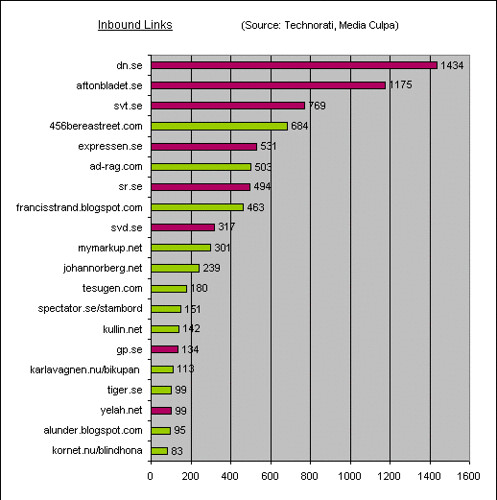
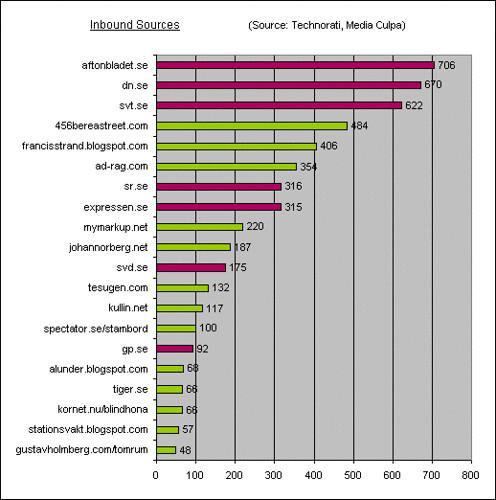
Sifry’s slides tells us that mainstream media are the websites that most bloggers link to (www.nytimes.com on top), but blogs are not that far behind. I have done a “lite-version” of Sifry’s research and looked at the websites of Swedish mainstream media versus the Swedish blogs with most inbound sources and links. The picture is quite similar, although on a much smaller scale.

The first graph is the number of inbound sources and the top three are the websites of Aftonbladet, Dagens Nyheter and SVT, but already in third, fourth and fifth place there are blogs, namely 456 Berea Street, How to learn Swedish in 1000 difficult lessons and Adland (way to go Roger, Francis and Åsk!). I’m at #13. In the graph below, green is for blogs, purple is for mainstream media.

inbound sources

The second graph counts the number of inbound links.

inbound links

I don’t claim that this is a 100% accurate ranking since there are probably some blogs out there that would fit on the list, but I’ve missed. But I think it still paints a fairly good picture of the influence blogs have recieved in a short period of time. Some of these blogs didn’t exist 12-18 months ago.

As a reference, here are the number of inbound links from a few other leading publications:

idg.se (44)
di.se (33)
nyteknik.se (32)
tv4.se (27)
computersweden.idg.se (26)
internetworld.idg.se (24)
tt.se (21)
sydsvenskan.se (20)

Footnote: Some results for inbound links may be a bit skewed depending on what URL you type in, like mymarkup.net and mymarkup.net/blog gives vastly different results (301/220 vs 164/141) probably due to the fact that the domain hosts several blogs, so the latter numbers might be the ones that should really be in the graphs above. Some blogs may also get more hits by linking to themselves, but I think it is a minor problem.