Google displays incorrect dates from news sites

I first became aware of the fact that Google displays dates in the search results after reading a blog post (in Swedish) by Simon Sundén. He also described how Google sometimes misinterprets the date an article or blog post is published. For example, this article was published on Newsmill in February 2009, but Google thinks it was published in December 1999 (see screen shot at Sundén’s blog) because it has the date 18 Dec, 1999 in the headline.

But there may be more to this story. Today I found that Google was displaying search results with the date 27 May, 2010 on articles that were in some cases several years old. Here are a few examples from Swedish dailies online.

– Dagens Nyheter, 29 Oct, 2003 – “Aftonbladet driver populismens journalistik”

– Aftonbladet, 8 Feb, 2007 – “Här är Bloggsverige!”

– Aftonbladet, 7 Oct, 2008 – “Välstajlad profilbild avslöjar dig”

– Aftonbladet, 3 Dec, 2008 – “Moderaterna ense efter krismöte”

– Ålandstidningen, 9 Dec, 2009 – “Zandra lämnar Xit – blir nöjesreporter på Aftonbladet”

– Expressen, 10 Dec, 2009 – “Moderaterna backar i ny mätning”

But Google thinks all these articles were published yesterday, 27 May, 2010. A few screen shots below:


ab-wendela-hans

dn-ab

alandstidningen

The immediate effect of this is that search results that aren’t very relevant to you may end up being ranked extremely high in the search results in Google. The article in Aftonbladet about my blog survey “Bloggsverige” is ranked #4 in Google on a search for Bloggsverige, when I know that previously it has not shown up in the top results.

It is also quite possible, as Simon Sundén also concludes, that it may be possible to game the system by fooling Google into thinking your blog post or article has been published more recently than it actually has.

I still haven’t quite sorted out exactly why Google misinterprets the dates of the articles listed above, but one thing is clear. All these articles have a more recent date in the code at one place or another, probably all of them have 28 May or 27 May 2010 somewhere. Once I or someone else figures this out, I will update this post. I would also like to know if this flaw is something that mostly benefits major news sites like the ones listed above.

Update:  James Royal-Lawson and I discussed this matter briefly on Twitter this evening and James posted his thoughts a few minutes ago. His conclusion is that Google takes the first date it finds, or at least the first date it finds reliable, and uses it to determine when the article has been pulblished. Since many online dailies have a number of different dates for different parts of each page, Google misinterprets the publication date. And if I look at for example the article in Dagens Nyheter above, from way back in 2003, that is exactly the case. The date 28 May, 2010 comes a few hundred lines of code before the actual publication date.

Update 2: Some more info here from Michael Gray.
Social media as big as traditional media online

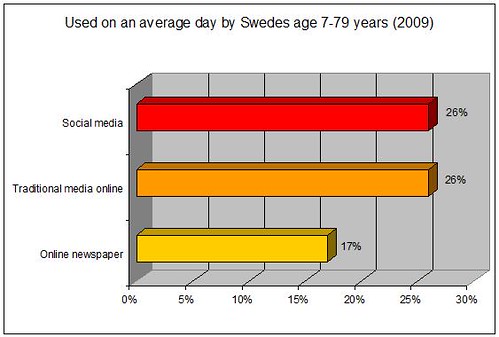
According to the survey “Mediebarometern 2009” (pdf in Swedish) by Nordicom, the share of Swedes that uses social media on an average day is as large as the share that uses traditional media online. Among Swedes (age 7-79 years), 26% use social media and 26% use traditional media online on an average day.

mediebarometern2009

The survey also reveals that nearly 65% of 15-24 year-olds participate in “social networking” on an average  day, while more than 50% of the young online users watch videos on YouTube.

*Social media is defined as social networks, communities, forums, chat or blogs. Traditional media is defined as newspaper, radio or tv.

Via Internetstatistik.se.

Japanese clothing brand trending on Twitter

The Japanese retail clothing chain Uniqlo is currently the most tweeted topic on Twitter, thanks to a creative promotion campaign for their 26th anniversary. On Uniqlo’s site users can add their Twitter user name in order to win special gifts. Each participant gets a unique number in a virtual line and has the chance to win based on their Lucky Line Quene Number.

As soon as a person joins the competition, he or she also tweets the line “UNIQLO LUCKY LINEに行列なう。” and their queue number. Currently there are hundreds of tweets per minute and the total amount is currently close to 39,000, and growing very rapidly.

uniqlo lucky line

Not all commenters are positive to the flood of tweets. Some compare it to spam.

More details on Whatthetrend.com.

uniqlo2

Update: The volume of tweets is quite extraordinary. The time from tweet #6 to #50,000 is about one day. (haven’t been able to locate tweet #1).

Create a Heat Map of Your Foursquare Checkins

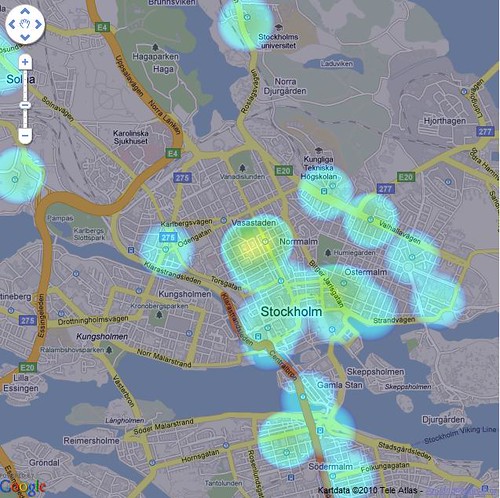
Are you using Foursquare to check in at different places? Then you can use WhereDoYouGo.net to illustrate where you check in most frequently. By letting the site fetch your Foursquare history it plots out a heatmap of your favorite places, like mine below from Stockholm city.

If you are going all in on transparency, you can also create a map that periodically updates itself.

heatmap-foursquare

How to lose 5,000 inlinks per month and alienate bloggers

If you have been blogging a few years, you may have noticed a change in the way other bloggers react to your content. Back then when I started, in 2004 and 2005, all you had to do is write a witty comment to some news story and five other bloggers would link to your post, possibly adding a few views of their own. Nowadays, you can spend weeks on research for a specific blog post and “all you get back” are a number of retweets, and maybe maybe one or two blog links. I’m not saying it’s a bad thing, especially for me who have an old blog with thousands of old links to it, I already have a high page rank. And it’s great that Twitter and Facebook have made it increadibly easy for your thoughts to travel across the web. But it was easier back then to get link love and, since a link is a “vote” on your content in Google, thereby building a good page rank for your blog.

So I will try to more often reward really good blog posts with a link back from my blog, not “only a retweet”.

“Good content deserves more than a retweet.”

Here is a good example that ties in well with the link love theme of this post. Simon Sundén, a great Swedish SEO expert, wrote a story the other day about how one Norwegian daily voluntarily turned down 5,000 natural inlinks per month. In short, Dagbladet.no used to use Twingly to show which blog posts link back to a given article. Since this concept is a win-win for both the paper and the blogger, many Scandinavian news sites have introduced Twingly. The news site gets lots of links and some traffic, while the blogger gets traffic back and some recognition.

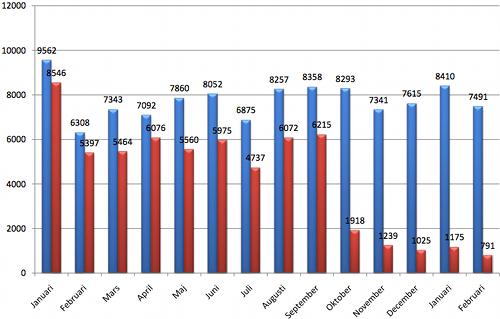
What Sundén noticed was that Dagbladet.no stopped using Twingly some time late in 2009 and as you can see from the red columns in the graph below, the effect was that the number of inlinks per month dropped drastically from 5,000-6,000 to a measly 1,000. Meanwhile, competing daily VG.no kept Twingly and has enjoyed a steady level of links from bloggers (see blue columns below).

In the long run, VG.no will probably become a stronger site from a search perspective, compared to Dagbladet.no because bloggers are more likely to link to a similar article on VG.no than on Dagbladet.no.

twingly-inlinks-vg-vs-dagbl

Image credit: Simon Sundén.

BP Oil Spill and Social Media

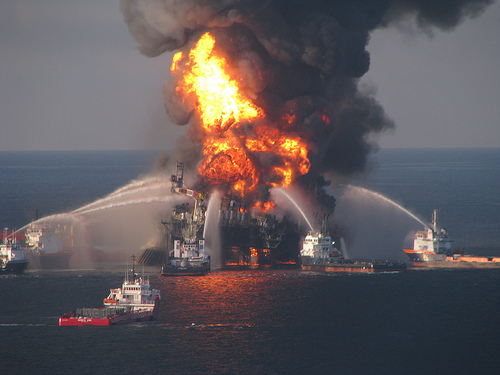
BP are now caught in the middle of the worst possible scenario – one of the company’s oil drilling rigs in the Gulf of Mexico exploded on April 22 and sunk, resulting in a major environmental disaster as more than 5,000 barrels of oil leak into the ocean per day. The long term reputation of the company is at stake because of the accident, that in many instances has been labelled “the BP oil spill”. On the EPA site, for example, it is called “the British Petroleum Oil Spill” and even the link to the site is http://www.epa.gov/bpspill/. As the Star Phoenix notes, “in PR circles, if a disaster gets named after your company, this is a bad thing”.

This is obviously a horrible situation, on so many levels, and I don’t envy the people at BP that have to handle communication during this tough time. And nowadays, crisis management has extended into social media and it is a parameter a company need to integrate into its communication strategy.

Oil Spill

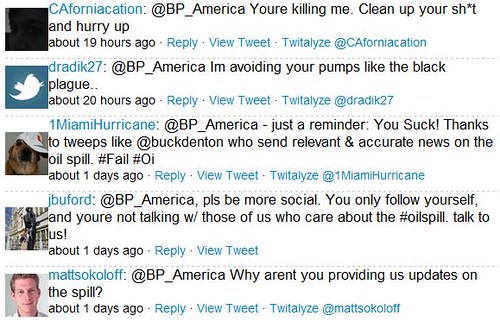
As one would expect, BP is taking a severe beating in social media right now, when consumers vent their frustration with the effects of the disaster. On Twitter, thousands of tweets are currently being published mentioning BP in connection with the oil spill. Many of them are also directly addressing BP’s US corporate Twitter account with angry comments, suggestions and questions.

bp-oil-spill-twitter

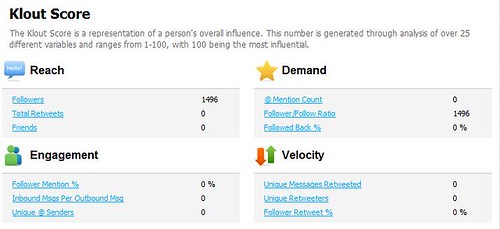
However, BP are not responding to any of those comments. In fact, the company does not communicate much at all via @BP_America. The account does not respond, retweet or follow anyone else on Twitter (see Klout score below), making it a pure one way communication channel. On top of that, the few tweets that are being published are press releases syndicated to Twitter via Twitterfeed. Nothing wrong with that, but if you publish press releases on your site in capital letters, it doesn’t land well on Twitter, where it equals SHOUTING!

bp-oil-spill

I don’t want to point fingers at BP for not using Twitter to its fullest potential in this difficult position. Instead, why not point to other stakeholders in this catastrophe that are doing things well?

BP oil spill

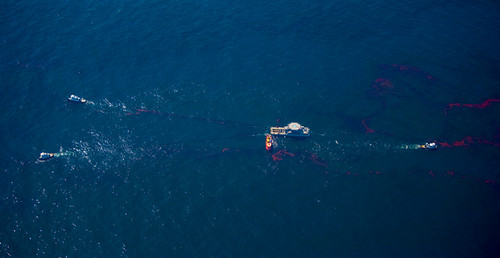
For example, the US Coast Guard has a Flickr account where it publishes photos and images under Creative Commons license. Images are displayed on http://www.deepwaterhorizonresponse.com/ as a slide show. In the menu of the site, there is even a section for “Social Media” which points to the U.S. Coast Guard’s presence on Facebook, Twitter and Flickr. Update: I forgot to mention that this site is being maintained by British Petroleum, Transocean, the U.S. Coast Guard, the National Atmospheric and Oceanic Administration, the U.S. Department of Homeland Security and the U.S. Department of Department.

The US Environmental Protection Agency, EPA, also uses social media. Administrator Lisa Jackson responds on Facebook and Twitter. I’m sure there are many more examples. The problem for a company in a crisis, especially when you are already in the “bad guy” position, is that when you leave an entire arena to your opponents, the damage to your brand in the long run may be worse than it would have to be. Facebook has more than 400 million members and that’s a big channel to leave unattended. If you do a search for “BP oil”, the first hit you get is the group Boycott BP Oil. As a contrast, the BP America Facebook page has not been updated since Feb 18, 2010. In other words, there is room for improvement.

Photo credit: http://www.flickr.com/photos/uscgd8/