Microsoft has started distributing press releases via RSS. I’m sooo way ahead of you 😉
Year: 2005
Bloggers and media rant over TV show
This is getting fun. Swedish public service television, an influential opinion journalist on a leading newspaper, an anonymous blogger and now the blogging president of Ung Vänster, the youth association of the left party – all punching at each other over a TV show about the definition of terrorism. And you didn’t think the Swedish blogosphere was able to stir up a heated debate?
Journalists vote for journalists – but media don’t tell you
Can journalists become too powerful? Yes of course. We often say that along with our peers, media is the most important source for citizens to shape an opinion of the state of our society. But media concentration, conglomeration, consolidation and corporatism puts the power of media into a declining number of hands. So when DSM for the 30th time announces Sweden’s 100 most influential opinion leaders, there is reason to reflect why the list looks like it does.
DSM (Debatt Sanningssökande Mediakritik) surveys every year what individuals are most influential in the debate in Sweden. The questionnaire is sent to 300 journalists, which ones is not disclosed. They are to select 12 individuals they think most shape opinion in Sweden. Not surprisingly, they vote for other journalists. On this year’s top 100 list, 17 of the top 30 are journalists (in bold below). Then the list is being sent to media where other journalists write about how influential they are (more than 40 articles today about the list). See a pattern?
Media then present this without disclosing that journalists are the only source. PJ Anders Linder of Svenska Dagbladet for example writes on his blog “[The list] is established by opinion leaders who vote for each other…” Not exactly true is it? The text would have a whole different ring to it if it stated that “journalists vote for each other”, right? On another place in Svenska Dagbladet the list is presented as being voted by “300 people who’s profession is to follow the debate in society”. TT falls in the same trap. How absurd. It is called journalists, and I think your readers deserve to know.
Why is this a problem? Well, if anything, it serves to uphold the view of media as the key influencer in society and that itself is a problem. Politicians can be voted out of office, but with few alternatives on a highly concentrated media market, it is harder to “get rid of” media influencers that we disagree with or for one or the other reason would like to see stripped off their power. This list should be considered a journalist lobbying campaign, nothing else. And second, who voted is not disclosed. Was it 150 journalists with a certain agenda? Was it more journalists from established media that responded, and then voted on themselves? We don’t know.
1. PERSON, Göran
2. REINFELDT, Fredrik
3. JOSEFSSON, Janne
4. BERGSTRAND, Mats
5. GUILLOU, Jan
6. MELLIN, Lena
7. OLOFSSON, Maud
8. WOLODARSKI, Peter
9. LUNDGREN, Nils
10. SCHYMAN, Gudrun
11. EKDAL, Niklas
12. GREIDER, Göran
13. ADAKTUSSON, Lars
14. CARL XVI GUSTAF
15. NUDER, Pär
16. BERGSTRÖM, KG
17. ISAKSSON, Anders
18. OHLSSON, Per T
19. BODSTRÖM, Thomas
20. WALLSTRÖM, Margot
21. LEIJONBORG, Lars
22. BLIX, Hans
23. KLEIN, Helle
24. LINDER, Anders PJ
25. GRÖNING, Lotta
26. HEDVALL, Barbro
27. NORBERG, Johan
28. WETTERSTRAND, Maria
29. ABRAHAMSSON, Maria
30. MARKLUND, Liza
Tidningen Ångermanland don’t buy the propaganda. Well done. SVT notes that journalists are the source. And journalist Dan Josefsson wrote about this in ETC already in 1998.
Footnote: 3 of the top 30 are also bloggers, see links.
Update: #29 is also a journalist, I missed that one. Thanks Johan.
Update 2: It was Dan Josefsson, not Janne, who wrote the article in ETC. Thanks Bengt.
Stupid copy protection
Today I went out of my way to get hold of a copy of Doves’ third album Some Cities, that was released in Sweden today. And I tell you, it was in the kind of weather you’d be close to insane to go out voluntarily in. Anyhow, after listening to the CD on my stereo I threw it into the PC to listen while I was doing some writing. About a third of the back of the sleeve is covered with warning texts about CD copy protection, so I was unsure if I would be able to play it on my PC. The first thing that happens is that this warning note is shown. Now, it’s not that I don’t trust record labels, but I’m just not up to installing a number of undefined files on my computer, not in these days of DRM paranoia. So I clicked “Cancel”.
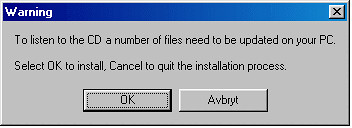
The fine part? The record played beautifully anyway. A review of the album will be posted tomorrow, hopefully.
Help wanted – Research on influence and public relations professionals
A former colleague of mine (aschoenb[at]cme.com) is conducting research for his master’s degree of in-house/corporate communication practitioners and their influence and relationships with senior management. He is hoping to understand what attributes, such as organizational structure, individual leadership and relationship management, contribute the most to our role as professionals. I’ve personally taken the survey and it should take only 15- 20 minutes to complete. The survey is completely confidential and he’s promised to send you the results if you’re interested. If you work on a corporate communications team here is a link to the survey: http://www.surveymonkey.com/s.asp?u=1797813187
Thank’s for your help.
Swedish Television angers Italians
SVT, the Swedish public service television, has caused irritation in Italy because of an ad campaign promoting SVT as “free television”, not folding under political pressure. The campaign portrays Italy as a warning example of the opposite, due to Silvio Berlusconi’s strong hold of some 90 per cent of Italian tv which in turn “gave him” the last election. The campaign did not amuse the Italians who unite in front of the insults from their northern EU neighbours. The Swedish ambassador in Rome Staffan Wrigstad was called up to the Ministry of Foreign Affairs and the embassy was the target of hundreds of email protests.
The reactions from Swedish politicians show that the left haven’t lost their tactic skills. Both (m), (c) and (kd) voice concern over the fact that Swedish state owned television makes political statements, while the left, (s) and (v) do not want to interfere. Quad erat demonstrandum, sort of.
Stockholm Spectator has a summary in English, while Expressen has some interesting views in Swedish, if you belong to those who believe that SVT might not be that free of political interference after all.