Socialbakers Facebook report for Sweden – Jan 2012

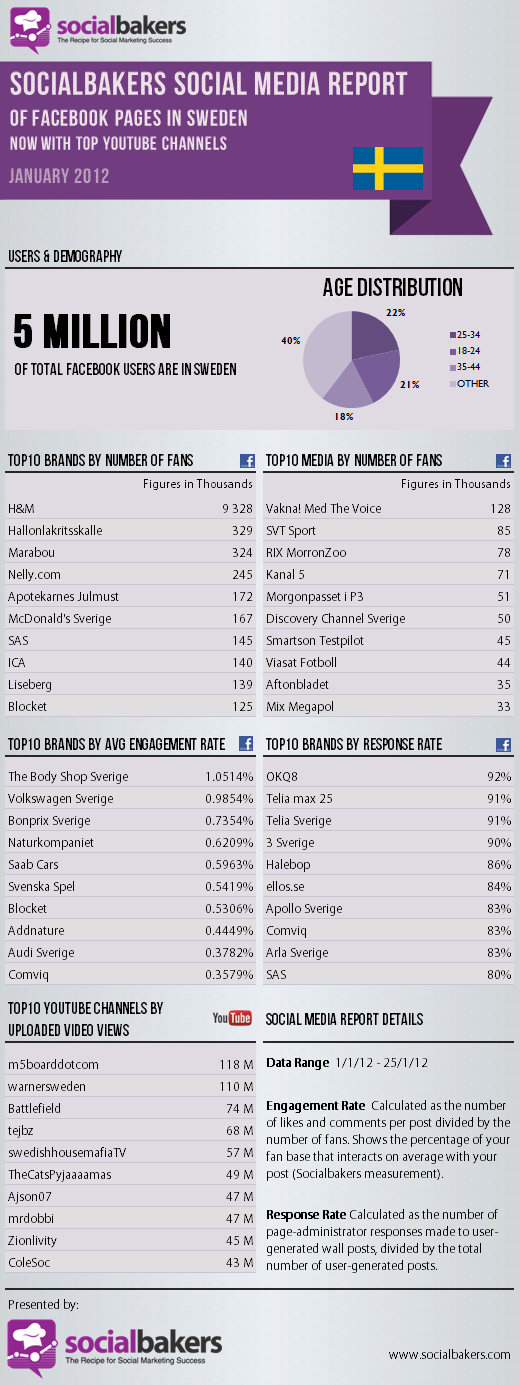
Just like in the last report (Nov 2011) from Socialbakers, the Body Shop is the brand page in Sweden with the highest level of engagement. OKQ8 is the page with the highes response rate, followed by two Telia pages. In fact, half of the top 10 pages in regards to response rate, are telecom operators.

Vakna! med the Voice is the media page with most fans.

socialbakers-facebook-stats-sweden-jan-2012

In case you are missing a page that would qualify in the top 10 lists above, please suggest it here.

Edelman Trust Barometer 2012 says trust in social media is up

The latest installement of the Edelman Trust Barometer has now been published and as usual, it is interesting reading. This year, there have been some dramatic changes in the views of the public in most of the countries surveyed. Trust in government, business and NGO’s is declining while trust in media is rising.

Trust in government shows an exceptionally sharp drop in the 2012 Barometer, after rising steadily for four years. In Sweden (“informed public”), trust in government is quite stable, dropping only from 64% to 62%, making Sweden the market with the fourth highest level of trust in government. Trust in business is also decreasing, although in Sweden it is acutally up from 52% to 54%, possibly thanks to the relatively stable Swedish economy compared to many other countries.

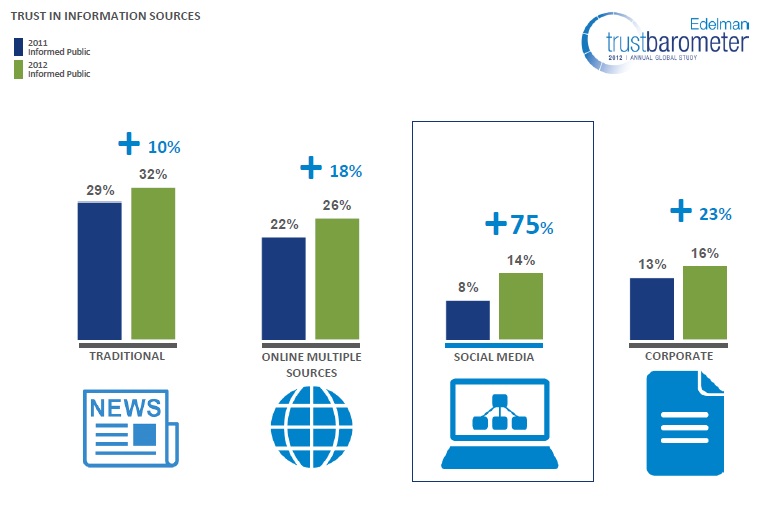
If we look at different media sources, it is interesting to see the dramatic increase in trust in social media, now almost at the same level as corporate information. Note: responses are for “informed public”, i.e. college educated, high income, high media consumption.

edelman-trust-barometer-2012

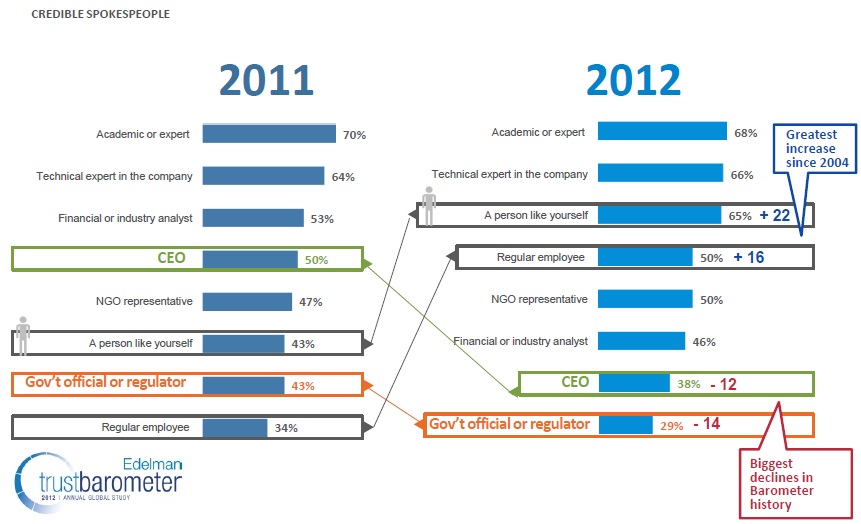
Overall, there is a huge drop in trust for CEO’s while trust in pers such as regular employees and “a person like yourself” is increasing dramatically.

edelman-trust-2012-peers

In other words, there is less trust in messages communicated by CEO’s through traditional corporate channels and increased trust in messages from our peers, communicated through for example social media channels. There’s a lot more to read and you’ll find the whole presentation here below.


Instagram now growing faster than Flickr

Three days ago I took a look at how many new photos users added on Instagram each day. By looking at the ID numbers of the photos I calculated that Instagram had now reached beyond 500 million photos and that about 4.5 million new photos were uploaded per day. Then I found a blog post from Instagram that summarized last year and in the post it says that at the end of 2011, 400 million photos had been shared in total on Instagram. This confirms that my calculations were pretty accurate (the 400 millionth photo was uploaded on Dec 7, 2011).

If we look at the volume of photos during January 2012, users added approximately 4.5 million photos each day to Instagram. This seems to be confirmed by the statistics from Instagram, that says that the average number of photos uploaded per second at the end of 2011 is 60, or about 5.2 million per day.

Steady growth for Flickr
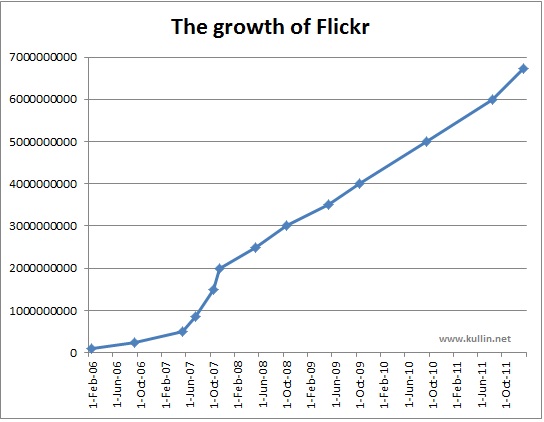
Now, if we look at the growth of Flickr, it seems that it continues to grow at about the same speed as it has been doing for the last couple of years. Official figures from Yahoo claim that users upload about 4.5 million photos per day to Flickr. But in reality, I believe it is slightly lower than 4.5 million. The 6 billionth photo was uploaded on August 1, 2011. Today, there are 6.7 billion photos on Flickr, which means that on average during the last 5 and a half months, users have uploaded 4.2 million photos per day to Flickr (724 million photos in 172 days).

In other words, Instagram is now growing faster than Flickr. Between 4.5 and 5.2 million per day for Instagram, compared to 4.2-4.5 on Flickr.

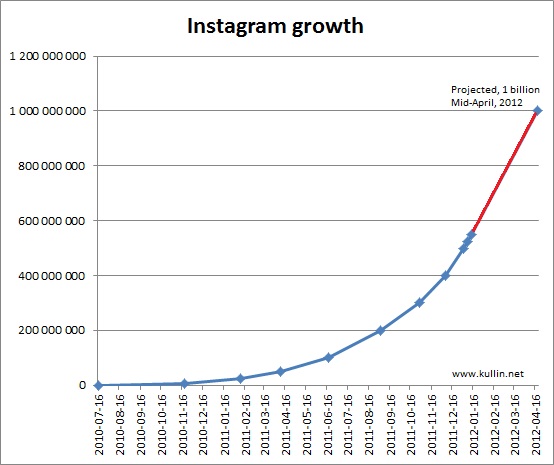
Here are two graphs describing the development and you can follow the links below for more stats and links to different milestones.

Pin It

instagram-1-billion-photos

Instagram may reach 1 billion photos in April

flickr-growth-2006-2012

Steady growth for Flickr as it reaches 6 billion photos

Instagram may reach 1 billion photos in April

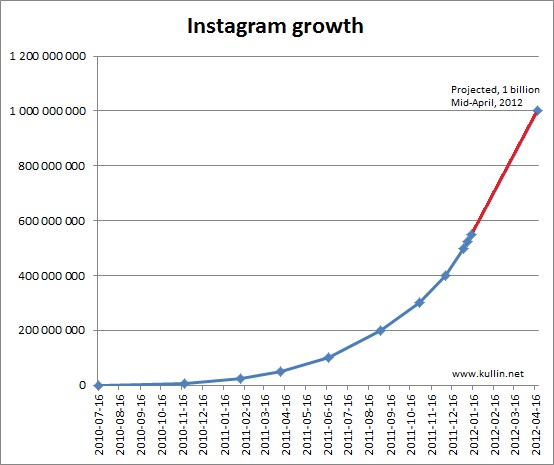
Instagram, one of my favourite apps, is growing like crazy. In September last year, I noted that users had uploaded 200 million photos, which meant that the growth rate in August was about 50 million photos per month. Now, it seems that users are adding the same number in just 11 days.

According to my calculations, Instagram passed 500 million photos on Jan 2, 2012 and 550 million on Jan 13. That means that 4.5 million photos are uploaded each day to Instagram and at that speed 1 billion photos will be reached about April 20, or possibly sooner if the service continues to add new users.

If you want to check the dates of the different milestone photos used in the graph above, follow the links below:

07-16-2010: 2

11-19.2010: 5000001

02-09-2011: 25000002

04-09-2011: 50000000

19-06-2011: 100000000

02-09-2011: 200000000

29-10-2011: 300000001

07-12-2011: 400000000

02-01-2012: 500000000

08-01-2012: 525000000

13-01-2012: 550000000

Some even numbers are not available, I suspect because they are private (or have been deleted). The ID’s of the milestones have been recovered by using Statigram and Ink360.com. There’s no guarantee that the ID numbers from theses sites are an accurate reflection of the total volume, but previously this way of counting has proven to be quite accurate.

Footnote: I’m @kullin on Instagram.

Your Facebook page is a litmus test of your brand’s health

Since I started blogging in early 2004, I’ve heard over and over again how brands have lost control of their reputation. Power has shifted away from brands and towards customers, employees and other individuals. With new publishing platforms, ordinary citizens have gotten the possibility to voice their opinions and influence businesses and organizations trough social media. Nowhere is this more evident today than on brand pages on Facebook.
litmus test

Due to the sheer volume of individuals that are present on Facebook, any people that have a bone to pick with a brand will almost automatically gravitate towards the Facebook page of that company simply because of the amount of exposure that comment can get. Sure, you can still influence by writing blog posts and using other channels, but writing on the wall on a Facebook page is more direct, you feel like you are talking directly to the brand and its customers, right on its turf.

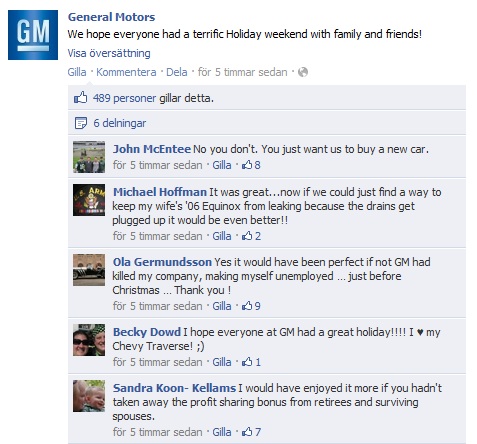
If you visit the Facebook page of a brand and it is nothing but a steady stream of negative comments, it will probably influence how you view this brand (see also my post about Chiquita on Facebook). Take a look at General Motors for example. I’ve written two blog posts about how Saab fans have turned the GM page into a big mess, while GM have done nothing. But GM have other problems on Facebook. People are complaining about everything from problems with cars to bad service. They are complaining about working conditions and the fact that GM killed off the Pontiac brand.

When GM wishes everyone a nice holiday, “fans” are responding with all sorts of negative comments, mostly about the decision by GM to cut Christmas bonuses for retirees. This post has 106 comments, at least half are probably negative.
General Motors comment bonus

It has now been more than two weeks since the first outburst of criticism from angry Saab fans and finally we are starting to see some activity from GM. There aren’t as many Saab photos posted as it was a week or two ago, but they keep coming. But maybe this incident pushed GM into taking a bit more care of their page than they previously did. Representatives from GM Customer Service have now responded to a few posts by fans and even the admin of the GM page has responded a few times.

A brand should not let critics run their Facebook page. If you are the subject of a smear campaign, like GM with the Saab story, you can’t comment on everything but you need to find a balance where you let critics comment but you don’t surrender the entire conversation to your opponents. As a brand, listen to the opinion and try actively to solve the issue.

Facebook has become an important driver of corporate reputation. If you don’t think that your Facebook page reflects reality, then you should do something about it. If you don’t, we are left to believe that this is how the world views your brand.
How to create a Twitter background image from your Instagram photos

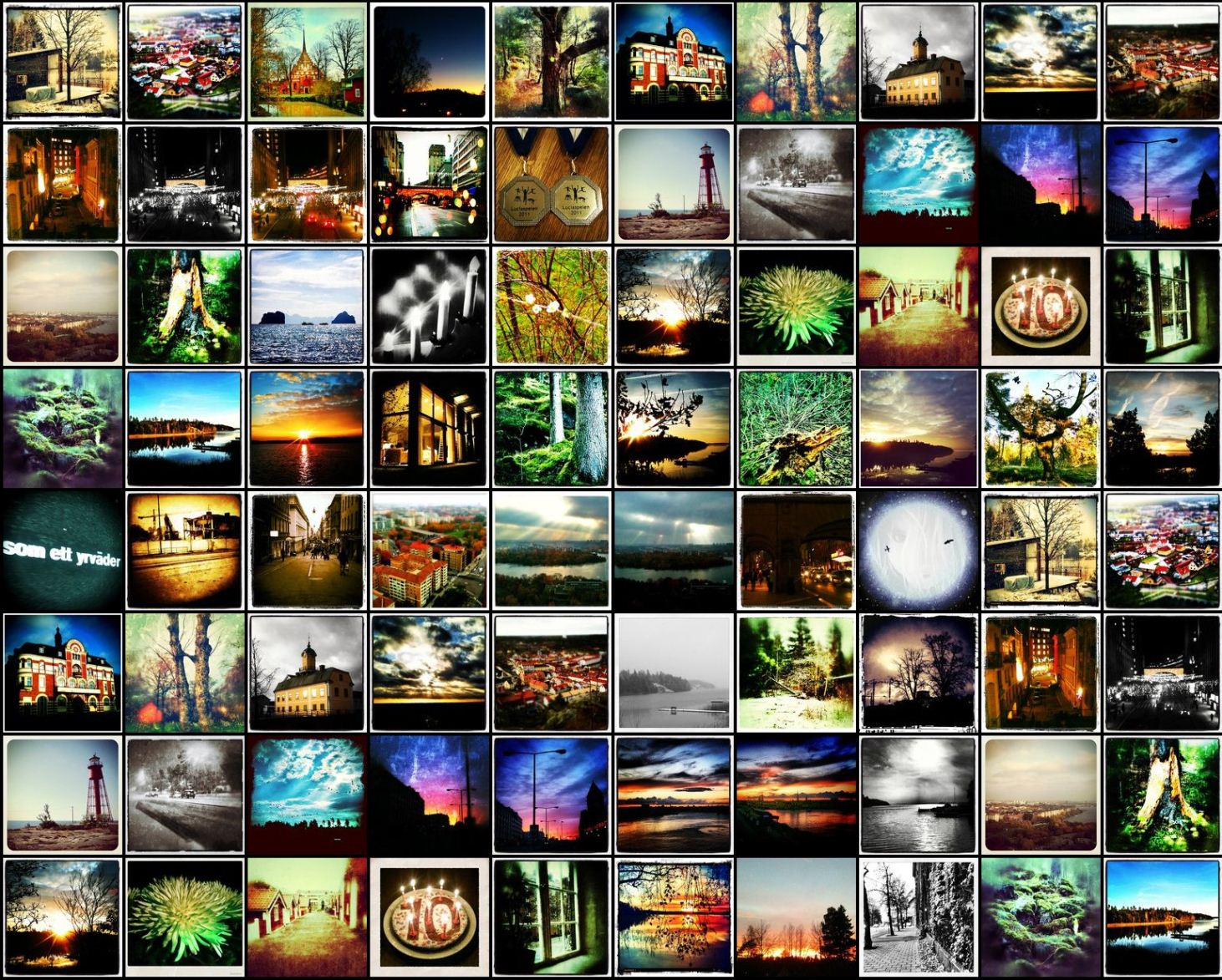
Yesterday I posted my 200th photo on the photo sharing app Instagram. I have become slightly addicted to Instagram and enjoy sharing photos that I adjust with different photo filters, as well as looking at the amazing images published by other users. Now, there’s an easy way to create a background image for your Twitter account, either from your own Instagram photos, or from other people’s photos. Just go to InstaBG.com and authorize the app. Then you can create an image from your own feed, from another user’s ID, a category or a tag.

You can choose size of the photos, order them by date, popularity or random order, and it is even possible to let the app auto-update the image daily with the latest Instagram photos of your choice. From what I can see, InstaBG takes the 48 latest photos from the stream you have chosen.

I added my photos to my Twitter account. The only problem I had was that it was not possible to upload a background image that was as large as 2.006 pixels wide so I saved it to my computer, then scaled it down to about 1.500 pixels wide and uploaded it manually, which was ok. If you also experience this problem I assume that the auto-update feature will not work properly.

Update: It seems that some are having trouble uploading the image via InstaBG (probably the image is too wide). But it is quite easy to save it to your computer, scale it down to about 1.500 pixels and then upload it yourself via Twitter.com.

twitter background instagram photos