Why do I still blog?

In July 2004, I was part of Global PR Blog Week 1.0, an online event featuring PR bloggers from around the world, who discussed blogging and communications. Back then, I was fairly new to blogging and found it incredibly fun and valuable to be able to get together with likeminded from other countries and share thoughts and ideas about how new media would influence public relations. I can’t believe it’s been six years since Constantin Basturea brought the group together to create this week of blogging.

Anyway, John Cass who was one of the participants, blogged last week about fact that most of the PR bloggers from 2004 were still blogging.

“I’d like to ask the PR Blog Week Alumni from 2004 why they still blog, and what keeps them motivated? These old timers in blogging have been around a long time. Is blogs a thing of the past, or are we seeing a return to the glory days?”

I think for most people, blogging serves as a channel for self-expression. It’s a great tool for sharing your thoughts about just about anything, and to be able to actually get some kind of response. For the last five years I have asked Swedish bloggers about why they blog, or more specifically, why they started blogging. The series of surveys is probably the longest running annual blog survey in the world and the latest version called BlogSweden 5 (soon translated to English) revealed that the main reason why people begin to blog remains the same. People blog because they like to write, to express opinions and share what’s on their minds. But also for the social aspects. They network, get feedback and keep in touch with friends and family.
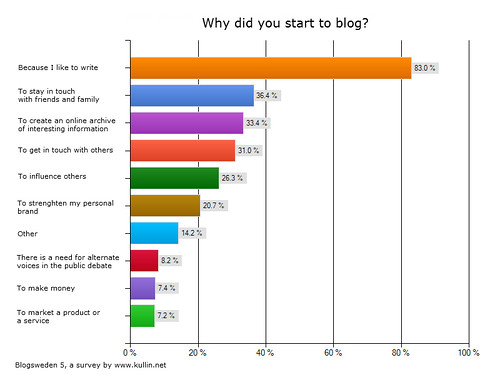
why do you blog

Table: from BlogSweden 5, a survey of 2,251 Swedish blog readers, out of which 94% had a blog.

In the report from my BlogSweden 3 survey in 2008, I tried to illustrate the answers from respondents (1,000 Swedish blog readers, of which 806 were bloggers) about what motivates them to use social media. This is not by any means a statistically proven model, but more my view of what drives people to blog, read blogs and participate in social networks. As you see in the image below, many factors motivate users, but some are more related to specific activities.

key-motivations-social-media

For me personally, blogging has always been a combination of things. First of all, it is a way to push myself to think deeper about a subject and to learn more. When you are forced to articulate your own opinion about a topic, you do more research and it seems to stick better in your memory. Then there is the social aspect. By writing a blog, I engage in a conversation with smart people and that is always a lot of fun. It is also a great way to build a good network. But perhaps most of all, my blogging has always been fuelled by the reactions from other people, who link to or comment about my content. The more (positive) reactions you get, the more fun it is to blog. And that’s where I have a real problem to motivate myself to blog these days. It seems that many people don’t have as much time to blog today as they used to, before Facebook and Twitter grew popular.

Below is a comparison between how much time Swedish bloggers spent reading blogs in 2009 vs 2010. Data is from my surveys BlogSweden 4 and BlogSweden 5. As you see below, it seems that the time spent reading blogs has decreased. Other data from the surveys suggest that bloggers still update their blogs as often as they used to, but updates are possibly not as time consuming as they used to be. For example, many bloggers now auto-update their blogs with shared links from Google Reader or Delicious, instead of writing their own original content.
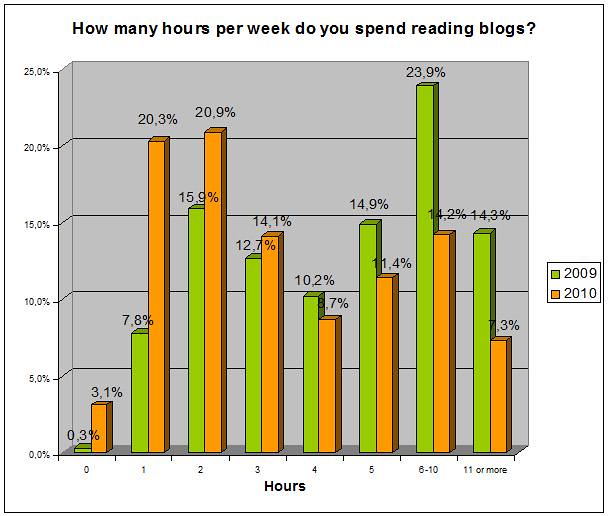
5 bswe5 bswe4

I have also noticed that previously you could get several bloggers that linked to your content, while today that happens more seldom. Instead, people are keen on retweeting your blog links on Twitter, so traffic to the blog from other sources is still good, but maybe Twitter has increased in importance. If your post doesn’t get traction on Twitter, you don’t get a lot of readers.

So I don’t think that we are seeing a return to the glory days of blogging. Instead, maybe we are seeing a divided blogosphere between the bloggers that find value in creating original content and the bloggers that don’t want to spend as much time blogging but instead just share links with a short comment.

If you have been blogging for several years, what’s your motivation for still maintaining your blog?
The travel industry turns to social media

The travel industry is turning to social media in order to build relations with customers and to promote its services. During the eruption of the Icelandic volcano in April, airlines, airports and travel agencies successfully used social media to communicate with travellers. Twitter was one of the channels that many used to update customers about delays and cancelled flights. Companies that tweeted actively quickly gained a large number of new followers, as seen in the presentation below, which would indicate that customers find it useful to follow companies on Twitter.

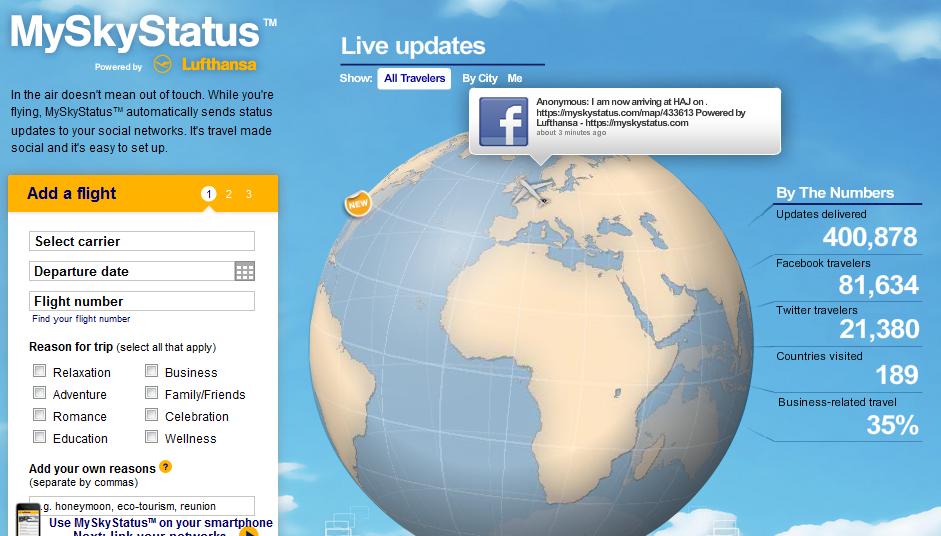
Another great social media case from the travel industry is the Twitter application by Lufthansa, called MySkyStatus. The site lets users automatically share flight information via Twitter, Facebook or LinkedIn, while in the air. The site is now open for travellers on all major airlines and everytime someone uses MySkyStatus they are greeted by the message “Powered by Lufthansa”. It’s a great way to add value to travellers and at the same time expose the brand to thousands of potential customers. To date, the site has distributed more than 400,000 status updates (81,000 on Facebook and 21,000 on Twitter).

myskystatus

Yet another example, soon to launch, is Topguest.com, a site that rewards travellers that frequently check in on hotels and other places using location based services such as Foursquare or Gowalla. According to USA Today and CNET, Topguest has launched a preview version that includes a co-operation with hotel chain Standard. Guests that check in using Topguest get a discount:

  • Social-media addicts who check into each of Standard’s four hotels in New York, Miami and Los Angeles in the span of one week will earn a free week at any one of the hotels.
  • You could also check in to Standard establishments – whether restaurants, bars, shops or the hotel spa – 10 times and receive 25% off your reservation.

The Swedish travel agencies Ving and Fritidsresor are actively answering questions from customers on their Facebook pages and they use Twitter to distribute promotions. There are many other good cases from the travel industry, which seems to be one of the industries that are most actively embracing social media. Other companies take note.

World Cup 2010: support your team with a Twibbon

On June 11, the FIFA World Cup 2010 in South Africa will kick off with the game between the host country and Mexico. This will be the first World Cup that will have a significant presence in social media as fans will discuss games and cheer on their teams through channels like Facebook and Twitter.

Here is a collection of “twibbons” that you can add to your Twitter avatar in order to show support for your team, one for each of the 32 participating teams.

Algeria:
Algeria

Argentina:
Argentina

Australia:
Australia

Brazil:
Brazil

Cameroon:
Cameroon

Chile:
Chile

Denmark:
Denmark

England:
England

France:
France

Germany:
Germany

Ghana:
Ghana

Greece:
Greece

Honduras:
Honduras

Italy:
Italy

Ivory Coast:
Ivory Coast

Japan:
Japan

Mexico:
Mexico

Netherlands:
Netherlands

New Zealand:
New Zealand

Nigeria:
Nigeria

North Korea:
North Korea

Paraguay:
Paraguay

Portugal:
Portugal

Serbia:
Serbia

Slovakia:
Slovakia

Slovenia:
Slovenia

Spain:
Spain

South Africa:
South Africa

South Korea:
South Korea

Switzerland:
Switzerland

Uruguay:
Uruguay

USA:
USA soccer

FIFA World Cup 2010:
World Cup 2010

Additional versions of Twibbons can be found at the site via AdHack and ITVfootball.

Top five social media risks for businesses

Earlier today I blogged about the trend that brands get hijacked on Twitter. A report released today by ISACA confirms that this is a major risk for businesses. The white paper outlines five major social media risks for business and “brand hijacking” is one of them. Top five risks are:

  • Viruses/malware
  • Brand hijacking
  • Lack of control over content
  • Unrealistic customer expectations of “Internet-speed” service
  • Non-compliance with record management regulations

The full white paper Social Media:  Business Benefits and Security, Governance and Assurance Perspectives” can be downloaded here. [pdf]

Oscar de la Renta to live-stream runway show

oscardelarenta Fashion house Oscar de la Renta will live-stream the designer’s runway show online today, Monday at 1 p.m. EST. The designer himself explains why he is taking the show public on the company live-streaming channel.

“Without a doubt, the role of a runway show has changed. In the past, the show was principally for buyers. While they are still a key constituency, we also show for the media. Online media is increasingly influential in fashion. This allows that group and others that can’t attend in person to see things in real time. It’s evolution.”

“A show is the greatest source of brand content that you have, and to be able to share it on such a large scale — it’s really amazing. I think that this is where the real power of the Internet lies, allowing anyone anywhere to interact with your brand, shifting what has traditionally been kept private to the public space. I suppose it’s a bit like adding more seats to the venue.

The company is active in social media and the corporate Twitter account @OscarPRGirl has more than 7,000 followers. When asked about how social media affects the company and the fashion industry, de la Renta replies:

“The great thing about fashion is that it always looks forward. I would be lying if I said that we understand the complete picture and the long-term effects that social media will have on our company. Right now, we feel strongly that we have to be a part of it. You have to experiment, and our hope is that eventually we will get it right.”

I really like that attitude.

The live-streamed runway show can be viewed here.

Brand-jacking on Twitter new challenge for PR

As if BP didn’t have enough problems in the aftermath of the oil spill in the Gulf of Mexico, the sarcastic tweets from the not-so-official Twitter account @BPGlobalPR has taken the twitterverse by storm. And not only has the person behind the account attracted 130,000 followers, he has also spawned a number of copy cats and started something of a trend. After the Israeli attack on the Flotilla convoy a few days ago, two similar Twitter accounts soon appeared – @IsraelGlobalPR  and @HamasGlobalPR – both using fake Twitter handles to try to influence the opinion.

Of course, it doesn’t end there. Meet @PunchTavernPR, the unofficial Twitter channel for the UK pub group Punch Taverns. It was launched after an incident on Saturday afternoon, when a group from the LGBT Labour Annual General Meeting was turned away from the Greencoat Boy pub in central London, a pub owned by Punch Taverns. The group of around 100 people were allegedly refused service by the manager because they were gay. It didn’t take long before people started to voice their opinions on social media channels, primarily on Twitter. According to the Guardian, the flood of tweets started after @LGBTLabour tweeted about it.

The hashtag #Greencoatboy soon became a trending topic in the UK and other tags that were used were for example #bigotbar and #boycottpunch. Articles about the incident were among the most read on BBC’s website yesterday.

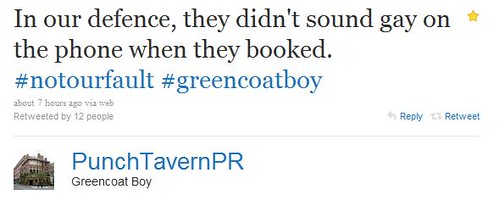
On top of that, someone started the fake Twitter account PunchTavernPR, spewing out tweets like this one:

punchtavern

The negative publicity in both traditional media and social media forced Punch Taverns to apologize in a statement on Sunday.

Brands have been hijacked on Twitter for a long time, remember the fake corporate Twitter account from Exxon Mobil in 2008? But now the blow more often seems to be directed specifically towards corporate public relations in what I can only describe as the digital equivalent to preemtive strike. What better way to get the opposing side in a conflict look bad than to mock the PR departement with silly jokes and ironic remarks? It can be very tricky to defend yourself against humor.

But all in all, this is not a good sign for PR. I get the feeling that this trend has emerged because people are sick of bad public relations efforts during crisis situations. It’s still all too common that when a corporation or an organization is facing a real crisis, it is slow to respond and when it does act, it uses half-truths and stonewalling tactics.

Perhaps it is a wake up-call for corporate PR. My advice would be to study this trend carefully and think through, what would our company do if we got brandjacked on Twitter in a crisis? It’s not an easy task to deal with.

Related about “Twitterjacking”: Zlatan Ibrahimovic on Twitter.