Banverket, the authority responsible for rail traffic in Sweden, has launched a ‘corporate’ blog today. Lars Berggrund is a senior advisor at Banverket and will be sharing his thoughts about railways and their role in society. One strange ‘feature’ is that you need to email Berggrund and write the title of the blog post in the email header (!) in order to comment. Can we hope for an easier solution soon?
Month: June 2007
Teens on social networks more often victims of cyberbullying
Pew Internet has a new study out about cyberbullying. Among other things it reveals that “32% of all teenagers who use the internet say they have been targets of a range of annoying and potentially menacing online activities – such as receiving threatening messages; having their private emails or text messages forwarded without consent; having an embarrassing picture posted without permission; or having rumors about them spread online.”
Girls are more often than boys being harassed online. And teens who are active on social networks have been bullied more often than those who are non-social network users (39% vs 23% have experience some form of cyberbullying).
However, worht noting is that Pew says that “most teens say that they are more likely to be bullied offline than online”. Full report here in pdf.
See also here – one in four Swedish bloggers have been harassed.
Tags: cyberbullying, pew, mobbing, näthat, ungdomar, sociala media. Ping.
Saturday is blog day in Sweden
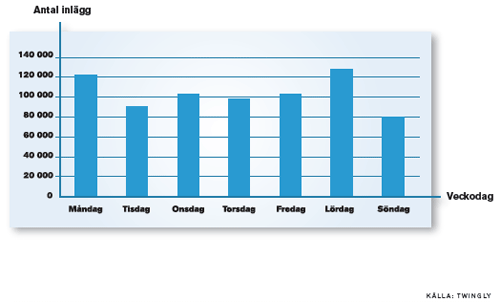
Primelabs, the company behind the service Twingly, released a report (pdf) a while back about the Swedish blogosphere. It contains a number of interesting statistics, like on what day of the week Swedes blog. As you can see (yes it’s in Swedish but I think you get it) from the graph below, bloggers are most active on Saturdays.
The two dailies (DN and SVD) that track blog links via Twingly are the ones with most incoming links from the blogosphere.
15,744 Dagens Nyheter
11,928 Svenska Dagbladet
10,956 Aftonbladet
4,843 Expressen
1,310 Sydsvenskan
1,121 Göteborgs-Posten
837 Metro
574 Dagens Industri
552 Dagens Media
502 Resumé
Metrobloggen a success in trouble
Metro’s new blogging service Metrobloggen, which was launched on June 18, has made quite a splash in the blogosphere. The idea to pay bloggers half a cent (3 öre) per page view has lured some 2,300 bloggers to sign up in just three days, according to Dagens Media. But I get just a tad bit suspicious when the service has already closed for new sign-ups in order to expand the capacity. Who builds a system that can only handle 2,000+ users in this day of blog hysteria? I may be totally out of line here, but a more reasonable explanation could be that Metrobloggen hasn’t been able to sell enough ads on the service to finance the flood of users. In a comment to blogger Makan Amini, Mattias Nyman at Metrobloggen says that “Yes, we sell ads but we haven’t really started yet […]”. I would like to get answers to these questions to believe that there isn’t something fishy going on here.
– How many blogs was the system initally built to handle?
– What are the bottlenecks?
– Exactly what capacity is it that needs to be expanded and how long will this take?
All in all, Metrobloggen has done a pretty bad job PR wise. Most bloggers have focused on negative aspects in the user agreement, like:
– You need to have at least 5,000 page views per month to get paid.
– Metrobloggen can introduce a maximum level that a popular blog gets paid.
– Payments are done through a MasterCard with several limitations to it.
– Bloggers aren’t allowed to publish any other (graphic) ads on their blogs.
– Bloggers give Metro permission to use anything you write and publish it without giving you compensation.
Then there was the kerfuffle with a blog that aimed to raise a million kronor for the Swedish Red Cross, but Metrobloggen closed the blog down within 13 hours. I can understand some of the rationale behind closing it down, but the blogosphere isn’t pulling its punches. Makan Amini made a video about the whole thing and posted it to YouTube where it has been viewed at least 2,000 times.
Beas tankar also noticed some striking similarities between Metrobloggen’s icons and Blogger’s icons.
Now one of the “professional bloggers” that were engaged have decided to quit and return to its old blog, Konsumbloggen.
What was really a very good initiative has been given a luke warm reception in part due to bad PR tactics and a desire to own and control content.
Tags: public relations, media, pr, metrobloggen. Ping.
IDG tracks blog comments with Twingly
The IT publishing house IDG has started to publish links to blogs that comment on their online articles. IDG is using the Twingly service that the two dailies Dagens Nyheter and Svenska Dagbladet have been using for a couple of months.
– It is important for us to become more active in the blogosphere, which is an important part of the new media landscape, says Lisa Bjerre who is responsible for the initiative at IDG.
Update: Webbsnack notices that there is a new feature where it shows the RSS feed of the blog if you drag the mouse over the link. Pretty neat. See more here.
Social networks a top news source for young people
WAN, the World Association of Newspapers, have published phase two of a research project about youth media behavior. The study, titled “Youth Media DNA” is a result of interviews with young people in 10 countries, among them Sweden.
Feedback from the respondents:
“…indicate that the importance of the social network as a disseminator of news and information is on the rise. Many participants in this phase listed “discussion with friends” as a top source for news and information, sometimes ranking higher than TV or newspapers. In particular, social networks appear to be key in spreading entertainment news for most young people.”
About user generated content, the study suggests:
“While most participants do not view video sharing sites like YouTube or blogs as credible first sources for news, many participants see them as channels for voicing opinion. In this sense, social networking and user-generated content sites can be seen as complements to their news and information experience.”
Tags: social media, sociala medier, bloggar, media. Ping.